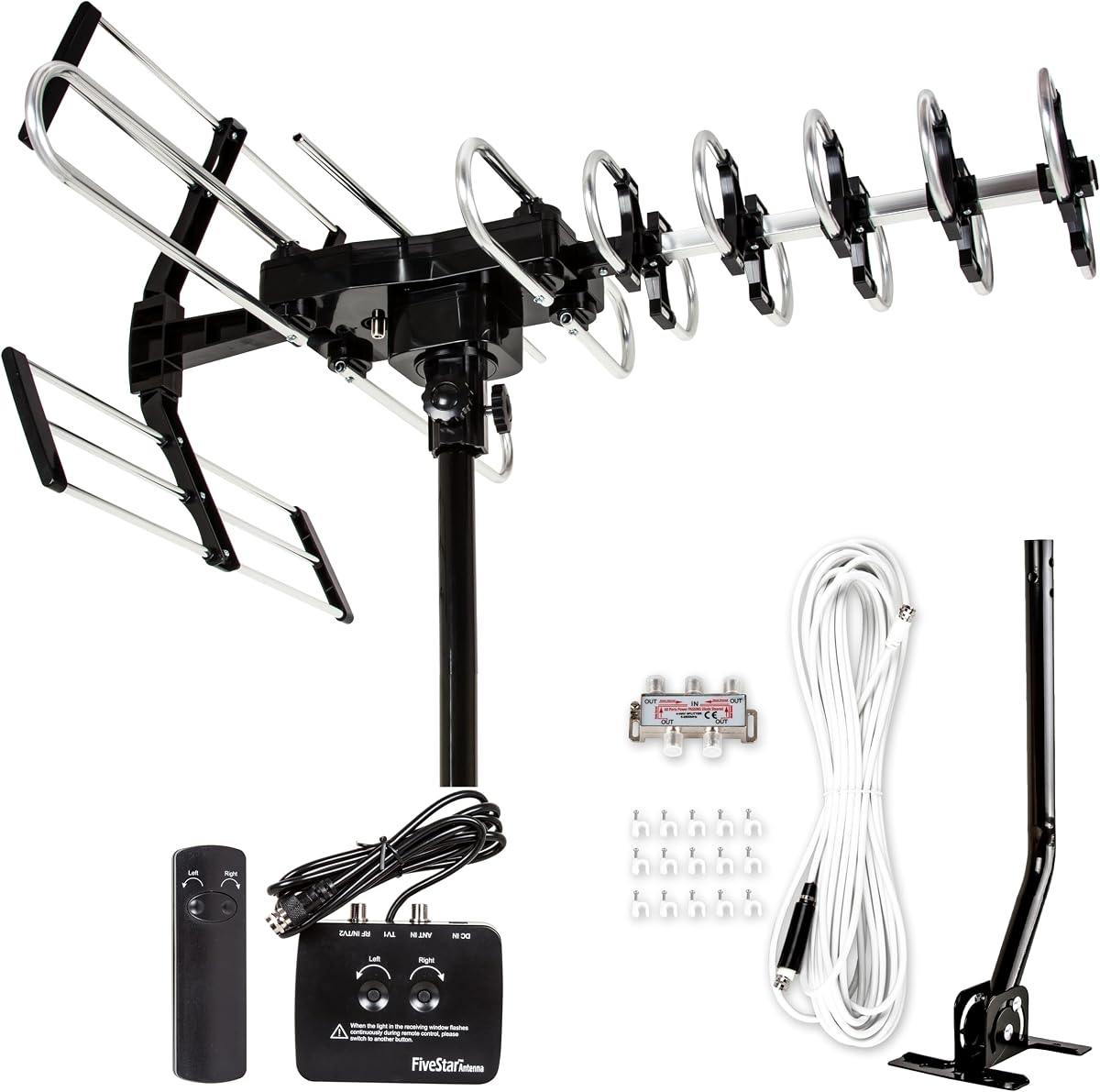
Five Star 2026 Upgraded Outdoor TV Antenna
4.1Editor score
Motorized 360-degree rotation
Remote-controlled fine adjustment
Tool-free snap-fold assembly
Supports five televisions
Our 200 Mile TV Antenna guide compares 10 outdoor and motorized antennas, helping you evaluate range, rotation, TV support, installation, and reception quality.
A 200 mile TV antenna can give households a practical way to receive local broadcast channels without relying on a cable or satellite provider. The best models combine VHF and UHF reception with stable amplification, useful mounting options, and features that help improve signal alignment in challenging locations.
We compared the ten antennas in this guide using the supplied product information, focusing on advertised range, broadcast-band coverage, motorized rotation, amplification, supported television formats, outdoor construction, included installation equipment, and the number of televisions each model can serve. The list includes both fixed multi-directional designs and remotely controlled antennas.
Each review explains the most useful characteristics, installation considerations, and honest trade-offs associated with its design. Our top three picks highlight the strongest balance of features, convenience, and value, but actual channel availability and reception depend on tower distance, terrain, trees, buildings, and other local conditions. Product prices and availability can change.
4.1Editor score

4.3Editor score

4.1Editor score
The table below compares all ten antennas by core reception features, rotation capability, television support, and installation convenience.


The Five Star Outdoor HDTV Antenna combines a multi-directional receiving design with advertised reception of up to 200 miles, making it our most versatile overall recommendation. Its 4.3 rating reflects a strong overall balance of reception features, modern format support, and installation flexibility. It is designed for both attic and outdoor roof mounting, giving households more than one way to position the antenna.
We may earn a commission when you buy through this link, at no additional cost to you.
The antenna receives both VHF and UHF signals, which is essential because television stations are transmitted across both frequency groups. It supports 4K and 1080p reception, is ATSC 3.0 ready, and can distribute reception to as many as four televisions when used with the included TV splitter. Its extended element length is intended to improve stability and signal strength, particularly in locations where a basic indoor antenna would struggle.
Its primary trade-off is that it does not offer the motorized remote positioning found on several competitors. It must be aimed manually, and a location with a clear sightline to multiple broadcast towers will be easier to optimize than a heavily obstructed urban site. The four-TV claim also depends on adequate signal at the antenna and compatible connections throughout the home. Nevertheless, the broad format support and included J-pole, mounting bracket, splitter, and instructions make this a well-rounded package.
This is the right choice for viewers who want one antenna to handle local news, sports, network programming, and several televisions without committing to a complex motorized system. Start by checking the available broadcast stations for your address, then test the antenna in the easiest accessible location before mounting it high. For most households seeking an advertised 200-mile capable outdoor antenna, its combination of multi-directional reception, four-TV capability, and installation hardware makes it our leading choice.
The multi-directional elements make this model less dependent on finding one exact facing direction than a strictly directional antenna. That flexibility is useful when broadcast towers are distributed around a property or when the installer is still determining which placement produces the strongest result.
ATSC 3.0 readiness and support for as many as four televisions give the antenna broader household utility. The included splitter helps distribute the signal, although every connected television still needs compatible over-the-air tuner inputs and adequate cable routing.
We may earn a commission when you buy through this link, at no additional cost to you.
The Five Star 2026 Upgraded Outdoor TV Antenna is the most feature-rich model in this roundup, offering motorized 360-degree rotation, remote-controlled micro-adjustments, an integrated bubble level, and a tool-free snap-and-fold assembly. Its 4.1 rating reflects a capable package for viewers who want precise control after the antenna has been installed. It is particularly attractive for properties where a fixed antenna may need repeated repositioning.
We may earn a commission when you buy through this link, at no additional cost to you.
The motor can be adjusted from left to right with small remote-controlled movements, making it easier to target stations arriving from different directions. A built-in spirit level helps balance the mount and supports smooth rotation. The antenna is advertised for reception up to 200 miles, with amplification, ATSC 3.0 compatibility, 4K and 1080p support, and capacity for five televisions. Its outdoor housing is designed to resist exposure to sun, rain, and dust.
The tradeoff is added mechanical and electrical complexity compared with a fixed multi-directional antenna. A motor, control system, and remote require more components that can potentially require troubleshooting, while the tool-free folding process still needs careful attention so the receiving arms are fully seated. Advertised range also remains conditional on unobstructed transmission, terrain, tower location, and installation height. Even so, none of the other picks combines motorized fine-tuning, a leveling aid, quick assembly, and five-TV support in the same supplied design.
Choose this antenna if reception is difficult, towers lie in different directions, or you want the ability to fine-tune the signal without climbing a roof or ladder. It is also a strong fit for a household that wants one outdoor system for up to five televisions and values weather resistance and organized setup. For straightforward coverage where a fixed broadside antenna is sufficient, it may offer more capability than needed.
Motorized micro-adjustments let an installer change the antenna's direction from a convenient location. This is particularly useful when different channels arrive from separate towers or when obstruction causes one orientation to perform better than another.
The integrated bubble level and folding receiving arms simplify setup. The level helps keep the rotating assembly balanced, while the click-together construction reduces the number of separate tools and pieces that must be handled during assembly.
We may earn a commission when you buy through this link, at no additional cost to you.
The CEKAY 200-Mile Outdoor TV Antenna delivers the core features many households need at an approachable cost: a built-in 360-degree motor rotor, wireless remote control, high-gain amplification, and support for VHF and UHF broadcasts. It carries a 4.1 rating and offers 720p, 1080i, 1080p, and 4K reception, making it a practical alternative to the more elaborate premium models.
We may earn a commission when you buy through this link, at no additional cost to you.
Its 40-foot RG6 coaxial cable provides useful installation reach, and the included power supply and remote make it possible to adjust direction after mounting. The operating frequencies cover VHF from 170 to 230MHz and UHF from 470 to 860MHz, two bands used for digital television broadcasting. A user manual is included, and the supplied information describes installation as tool-free.
Unlike several Five Star options in this list, the CEKAY package does not include a mounting pole. Buyers must source a suitable pole and appropriate mounting hardware or use an existing elevated structure. The advertised 200-mile reach is also a maximum range claim rather than a guarantee, and actual results will depend on line of sight, terrain, trees, nearby buildings, and broadcast tower placement. These limitations matter more in difficult locations, but the antenna still includes the essential rotor, remote, amplifier, power supply, and long cable.
This is a compelling choice for a value-conscious buyer who wants remote antenna positioning without moving to a full multi-TV premium system. It is particularly useful where the antenna must be installed beyond the reach of an indoor connection. Make sure the installation plan includes a stable pole and suitable weatherproof connections, and be prepared to experiment with direction and height to find the strongest channels.
A wireless remote and built-in rotor deliver the core convenience of motorized antennas. Once mounted, users can fine-tune the direction without repeatedly moving the entire assembly by hand.
The included 40-foot RG6 cable gives an installer more placement freedom than a short lead. It can help connect an elevated outdoor antenna to televisions inside the home while reducing the need for additional cable or fittings.
We may earn a commission when you buy through this link, at no additional cost to you.
The Five Star Multi-Directional 4V HDTV Antenna is a flexible option for households that want one antenna to work indoors, in an attic, or outdoors. Its 4.0 rating reflects a solid feature set, with advertised reception up to 200 miles, VHF and UHF coverage, support for as many as four televisions, and an included installation kit. The multi-directional structure is designed to gather signals without a motorized adjustment system.
We may earn a commission when you buy through this link, at no additional cost to you.
Booster technology is included to extend the useful signal and reduce interference, while doubled receiver elements are intended to create a more stable reception pattern. The antenna supports 4K, 1080p, 1080i, and 720p channels along with FM radio. The package includes a 40-foot RG6 cable and mounting pole, offering a more complete outdoor installation kit than the CEKAY model's supplied components.
Some assembly remains necessary even though parts arrive preassembled. More importantly, a multi-directional antenna still benefits from careful placement, and the product's range depends on distance from the nearest tower as well as obstructions between the home and transmitter. The four-TV function also requires the included splitter and suitable signal quality. Compared with a motorized model, changing the angle means physically repositioning the antenna, which is inconvenient on a high roof or pole.
This antenna is a strong candidate for viewers who need flexible placement and four-TV distribution but do not require remote rotation. It may be especially suitable when the home can use an attic or indoor location initially, with the option to move outside later. For buyers who want all necessary outdoor hardware included and value multi-directional coverage, it offers a practical balance of capability and simplicity.
The ability to operate indoors, in an attic, or outdoors makes this model adaptable to different property types. Users can begin with an accessible placement and move toward a higher exterior position if reception is weaker.
Multi-directional elements help collect broadcasts from a wider area than a single-facing Yagi design. This can reduce the need for precise aiming when towers are spread around a property.
We may earn a commission when you buy through this link, at no additional cost to you.
The Five Star Outdoor Digital Amplified HDTV Antenna combines advertised 200-mile capability with directional 360-degree rotation and support for five televisions. Its 4.0 rating makes it a credible option for larger homes or families that want broad direction control without limiting the system to one television. The included kit contains a 40-foot coax cable, four-way splitter, 15 cable clips, and a J-pole.
We may earn a commission when you buy through this link, at no additional cost to you.
Its receiving specifications cover VHF from 40 to 230MHz and UHF from 470 to 860MHz, alongside HDTV, FM radio, and several high-definition formats. Six reflector elements are described as improving UHF image quality over a four-element arrangement, while a V-band is intended to improve VHF quality. Automatic gain control adjusts the amplification from 15 to 35dB, and shielded copper cabling supports signal transmission through the motor.
The 360-degree system is described as all-directional operating, but its physical element design is directional. Users will still need to rotate and test the antenna to find each tower cluster. Automatic gain is not a substitute for good placement, and the claimed 200-mile range can be affected by severe obstruction or a weak transmitter. In addition, serving five televisions places greater demands on the splitter and internal coax than serving one or two screens.
This model is best for a household that wants motorized direction adjustment, five-screen distribution, and a complete mounting package. It may be a better fit than a fixed design when towers occupy different directions or when a household wants to experiment with different channel groups. Ensure that the mounting point is high, stable, and grounded appropriately, and plan the internal cable route before beginning installation.
The automatic gain control chip adjusts amplification within a stated 15 to 35dB range. This can make reception more consistent when signals from different towers differ substantially in strength.
The included four-way splitter and coax kit support a multi-TV arrangement. Signal quality at the farthest television can depend on cable length and the number of branches, so installations should avoid unnecessary splits.
We may earn a commission when you buy through this link, at no additional cost to you.
The Five Star Yagi Satellite HD TV Antenna uses a focused Yagi-style design to capture VHF and UHF broadcasts over an advertised range of up to 200 miles. With a 4.3 rating, it is one of the stronger-rated options here and provides an appealing alternative for viewers who have a clear view toward their broadcast towers. It supports four televisions through the included four-way splitter.
We may earn a commission when you buy through this link, at no additional cost to you.
Extended length and larger receiving elements are central to the design, intended to improve signal stability and reception quality. The antenna supports 4K, 1080p, 1080i, and 720p broadcasts, as well as FM radio. The supplied package includes 40 feet of coaxial cable, a 20-inch J-pole mounting component, a four-way splitter, and 15 cable clips, covering most of the hardware needed for a basic exterior installation.
Yagi antennas are directional, which means the narrow end generally needs to face the desired tower cluster. That focus can be an advantage in a rural setting with a clear transmission path, but it can create frustration when stations arrive from different directions without a rotor. The product also states that some assembly is required, and the outdoor construction is described as weather resistant with lightning protection. Actual 200-mile reception still depends on the unobstructed path between the transmitter and antenna.
Choose this model if your broadcast towers are concentrated in one direction and you want a simpler, fixed outdoor system with a strong directional pattern. It is less appropriate for scattered tower locations or for anyone unwilling to test and refine the aim. For those conditions, a multi-directional or motorized design offers more flexibility. With a clear line of sight and careful placement, however, the Yagi format can be a focused and capable 200-mile solution.
A directional Yagi design concentrates its receiving pattern toward a chosen direction. That focus can be effective when the home has an unobstructed view of a nearby tower cluster.
The supplied description emphasizes resistance to strong wind, heavy rain, and lightning protection. A J-pole, long coax cable, splitter, and clips create a reasonably complete installation package for an accessible roof or pole location.
We may earn a commission when you buy through this link, at no additional cost to you.
The Five Star Motorized Outdoor HD TV Antenna combines 360-degree rotation, an infrared remote, automatic gain control, and an integrated low-noise amplifier. Its 4.0 rating reflects a proven feature set for viewers who want remote positioning and are willing to supply their own mounting pole. Advertised reception extends up to 200 miles under suitable conditions.
We may earn a commission when you buy through this link, at no additional cost to you.
The operating range of 45 to 860MHz covers VHF, UHF, and FM radio reception, while support extends to 4K, 1080p, 1080i, and 720p broadcasts. An LTE filter is designed to reduce interference from cellular phone signals, and automatic gain control adjusts the receiver across a stated 15 to 35dB range. Larger VHF elements and additional UHF elements are intended to improve signal collection and image quality.
The package includes the antenna, control box, infrared remote, power supply, 40 feet of RG6 coax, a splitter, and instructions. It does not include a mounting pole, so buyers need to plan an appropriately elevated support. The infrared remote also requires a clear line of sight to the control receiver, and the powered motor introduces another part that must remain protected from weather. Range claims depend on tower distance, obstructions, terrain, and the quality of the broadcast signal.
This antenna makes sense for a household that values remote adjustment, broad VHF and UHF support, and interference filtering. It is especially useful when channel groups arrive from different directions or when fine adjustments are needed after installation. Choose it over the newer premium model if an infrared remote and conventional control box suit your setup better, but factor the separate pole and power requirements into the installation plan.
The built-in LTE filter targets a common source of interference in modern neighborhoods. It can help reduce noise that would otherwise disrupt otherwise usable digital television signals.
The 360-degree motor lets users experiment with direction from inside the home. Because the remote uses infrared technology, the control box should remain visible and accessible during adjustments.
We may earn a commission when you buy through this link, at no additional cost to you.
The PIBIDI Outdoor TV Antenna is a straightforward, mostly preassembled option for receiving local UHF and VHF channels. It carries the highest listed rating in this group at 4.4, making it a strong choice for buyers who value simple construction, clear installation guidance, and a compact set of installation tasks. The product is designed for 1080p and 4K digital broadcast reception.
We may earn a commission when you buy through this link, at no additional cost to you.
Its working frequencies are listed as VHF from 170 to 230MHz and UHF from 470 to 790MHz. Extended antenna length and enlarged elements are intended to create a more stable signal, particularly in areas where a smaller indoor antenna would be inadequate. Most of the unit arrives preassembled, and only a few elements need to be combined. The supplied information states that no tools are required, making the design approachable for first-time antenna installers.
The antenna is described as lightning protected, weather resistant, and grounded, with durable construction intended for exterior conditions. It does not advertise a specific maximum 200-mile distance, however, and it lacks the motorized remote positioning offered by several other picks. The exact broadcast frequencies also mean reception should be checked against local stations. A fixed design is simpler and may last without a motor, but it offers less convenient fine-tuning when obstructions or tower locations complicate reception.
This model is a good fit for viewers who want a relatively simple outdoor antenna without paying for motorized controls or extensive multi-TV hardware. It may work particularly well where local towers are in a broadly consistent direction and the installation point has a clear view. For households specifically expecting the maximum range and directional control advertised by other products, this should be evaluated based on local tower information rather than treated as a guaranteed 200-mile option.
The mostly preassembled construction reduces opportunities for installation mistakes. It is a useful quality for buyers who want an outdoor upgrade without a complicated setup process.
The product description emphasizes grounding, lightning protection, and resistance to outdoor weather. These details matter because an exposed antenna is subject to sun, moisture, wind, and seasonal conditions throughout the year.
We may earn a commission when you buy through this link, at no additional cost to you.
The Five Star Outdoor HDTV Antenna is a multi-directional antenna with advertised reception up to 200 miles and support for as many as four televisions. Its 4.1 rating reflects a well-rounded package, while ATSC 3.0 readiness and 4K and 1080p support make it suitable for households with modern television sets. It can be installed on a roof, in an attic, or on other exterior structures.
We may earn a commission when you buy through this link, at no additional cost to you.
The product includes a mounting bracket, J-pole, and TV splitter, along with assembly instructions. Extended antenna length and larger elements are intended to improve signal stability. Unlike a remote-controlled model, the orientation is adjusted manually, making the initial placement process more important. The supplied guidance recommends checking local channel availability, testing the complete setup indoors before installing it on a roof or in the attic, and rescanning after every position change.
A four-way distribution arrangement does not create additional signal. Splitting an already limited signal can reduce the strength available at each television, especially when cable runs are lengthy. The advertised range also depends on clear transmission, tower distance, trees, buildings, and other obstructions. While the multi-directional design reduces the need for a precise single direction, a strong result still benefits from elevation and careful comparison of nearby mounting positions.
Choose this antenna if you need a fixed but broadly directional system, want support for several televisions, and appreciate detailed setup guidance. It is a sensible alternative to the higher-ranked multi-directional model, with the same broad 200-mile positioning, four-TV support, and ATSC 3.0 readiness. The included installation accessories reduce extra purchases, while the testing-first guidance helps buyers avoid an unnecessarily complicated roof installation.
The recommended approach is to assemble and test the system inside before adding a splitter or using existing coax. If the channels appear, the user can move the same components to a higher outdoor position with greater confidence.
The product instructions point users toward local channel maps and recommend rescanning after installation or adjustment. This process helps distinguish antenna placement issues from the need for new television settings.
We may earn a commission when you buy through this link, at no additional cost to you.
The PBD Amplified Outdoor TV Antenna is a compact remote-rotation system with a 4.3 rating, a built-in high-gain low-noise amplifier, and two direct television outputs. It advertises reception up to 150 miles rather than 200 miles, but its motorized 360-degree adjustment, 4K and 1080p support, and dual-output arrangement make it a practical option for smaller television distributions.
We may earn a commission when you buy through this link, at no additional cost to you.
A wireless remote rotates the antenna so users can optimize its direction without manually moving the assembly. The amplified receiver is designed to improve signal quality, while the dual outputs allow two televisions to connect without a separate splitter. It is also ATSC 3.0 ready, supporting compatibility with NEXTGEN TV equipment where the relevant broadcast service is available.
The main limitation is its lower advertised range compared with the other products in this guide. The 150-mile figure is still conditional on tower visibility and environmental factors. Two outputs limit immediate scalability compared with models advertising four- or five-TV support, although a separate distribution system could potentially expand the installation if signal quality permits. The motorized and powered components also need suitable weather protection and reliable placement.
This antenna is a good option for a household that primarily serves two televisions and values remote adjustment over the largest possible advertised reach. The included 40-foot RG6 cable, mounting hardware, and detailed guide provide a convenient starting point, while dual outputs keep the connection arrangement simple. Buyers seeking the widest range claims should consider one of the 200-mile models, but those needing a straightforward two-TV system may find this design easier to integrate.
The two direct outputs simplify connections for a household with two televisions. Avoiding an extra splitter may help preserve more of the antenna's available signal within the supported setup.
The wireless remote makes it convenient to test different directions after installation. Fine alignment can help identify which orientation produces the strongest local station group without repeated manual adjustment.
We may earn a commission when you buy through this link, at no additional cost to you.
The right outdoor television antenna depends on local station locations, available installation space, the number of televisions to connect, and how much control you want during setup.
Prioritize the stations you watch most and note whether they originate from the same direction.
Choose based on tower distance, elevation, and a clear path to the strongest stations.
Use fixed models for broadly aligned towers and motorized models for difficult or variable aiming.
Match the connection count to your household and minimize unnecessary signal splits.
List missing mounting and connection items before installation to avoid delays.
Prioritize a safe elevated location with a clear view and accessible connections.
Use amplification to improve usable signals, not to overcome an absent or obstructed signal.
Verify television tuner support and local broadcast formats before finalizing the purchase.
Begin by identifying local stations, planning the number of television connections, and assembling the antenna in an accessible area. Connect the supplied power supply and coax to the control unit, then attach the antenna to its mount. The broad VHF and UHF coverage of the featured models allows one system to collect many local channels, but the exact channel list depends on transmitter location and obstructions.
Test the antenna near a window or at ground level before moving it to a roof, attic, or pole. Connect one television first, complete a channel scan, and note which stations appear. For motorized models, rotate the antenna in small increments and rescan between positions. Once the best direction is identified, raise the antenna, recheck every connection, and scan again because height and obstruction can change the result.
For ongoing care, inspect the mount, cable connections, and weather seals periodically. Keep the rotor control and power supply protected from rain and standing water, and avoid moving the antenna during high winds. Rescan monthly or whenever a channel disappears. If reception worsens, compare the current position with the original aiming point, check cable connections, and confirm that the television's input and scan settings remain correct.
A 200-mile rating is an advertised maximum under favorable conditions, not a guarantee. Terrain, hills, trees, buildings, broadcast power, and the antenna's height can substantially reduce the usable range. Check local station availability and transmitter direction before purchasing, and expect easier reception when the path to the tower is clear and unobstructed.
A multi-directional antenna gathers signals from a wider area and does not require a precise single facing direction. A Yagi antenna concentrates its reception pattern toward a target direction, which can produce focused results but requires careful aiming. Multi-directional models are often more convenient when towers are scattered, while Yagi designs can suit properties with one clear tower cluster.
It is worth considering when stations arrive from different directions or when small position changes materially affect reception. Motorized models let users adjust the antenna without climbing onto a roof. The trade-off is more components, electrical power requirements, and weather-protection considerations compared with a fixed design.
It depends on the antenna's outputs and the number of screens. Some models provide two direct outputs, while others include a splitter for four or five televisions. Every additional split can reduce the signal available at each television, so strong reception at the antenna and appropriate internal cabling are essential.
Many of the featured antennas are suitable for attic or outdoor mounting, but an attic can reduce reception through roofing materials and nearby obstructions. An outdoor location generally offers a clearer view of broadcast towers. If testing indoors, use the same antenna, cable, and splitter setup that will be used outside so the result remains meaningful.
Several products in the guide are explicitly ATSC 3.0 ready, including the top-ranked Five Star Outdoor HDTV Antenna, the upgraded 2026 model, and the PBD Amplified Outdoor Antenna. ATSC 3.0 service must also be available from a local broadcaster, and the television must include a compatible tuner. Availability should be checked for the intended viewing area.
A rescan tells the television to search again for available broadcast frequencies. Moving the antenna, changing its direction, raising it, adding a splitter, or changing cables can alter reception. Scanning after each meaningful adjustment helps the tuner identify the strongest available stations and is also useful when a previously received channel disappears.
No. Amplification is most useful when a usable signal exists at the antenna but needs help along the cable route. It cannot recover a station that is completely blocked by terrain, buildings, or other severe obstruction. Correct height, placement, and direction remain more important than amplification alone.
The Five Star Outdoor HDTV Antenna is the strongest overall choice because it combines a multi-directional 200-mile design, ATSC 3.0 readiness, four-TV support, and a complete mounting package. The Five Star 2026 Upgraded Outdoor TV Antenna is the premium option for buyers who want remote motorized positioning, fine adjustment, tool-free assembly, and support for five televisions. The CEKAY model is the best value-oriented pick when remote rotation and a 40-foot coax cable matter more than premium mounting extras.
Your local tower layout should guide the final decision. Choose a multi-directional antenna for scattered stations, a Yagi model for a concentrated and clear direction, and a motorized system when fine tuning is important or towers occupy several directions. Also consider the television count, signal loss from splitting, available mounting hardware, safe roof access, and whether you need ATSC 3.0 compatibility.
Finally, check current product availability and prices before ordering because both can change, and confirm the supplied package contains every pole, cable, connector, and splitter you need. Most importantly, review the channels available at your address and follow the manufacturer's testing and scanning guidance. A carefully positioned antenna and a current channel scan can make the difference between a frustrating setup and reliable daily reception.