
Baofeng UV-5R Handheld
4.5Editor score
Dual-band analog operation
128 programmable channels
PC and CHIRP support
Discover the best ham radios for POTA, comparing power, reception, GPS, APRS, NOAA alerts, programmability, and field-ready features.
Ham radios for POTA can turn a quiet summit, park, or trail into a reliable communications base. The right handheld should balance useful amateur-band coverage with durable construction, manageable controls, dependable charging, and features that help operators work a portable operation without distracting from the experience.
This guide compares ten dual-band, tri-band, analog, and digital handhelds based on their stated transmit bands, receive coverage, battery and charging options, channel capacity, programming support, NOAA reception, GPS or APRS functions, display features, and included accessories. It also considers how each model may suit different levels of POTA experience.
Each entry identifies the principal strengths, practical limitations, and most likely operator for every radio in the list. Ratings and product details reflect the supplied listings, while availability, licensing rules, accessories, and prices can change. Always verify current specifications and your local authorization before transmitting.
4.5Editor score

4.8Editor score
5.0Editor score
The comparison below highlights the major distinctions among these POTA handhelds, including their operating modes, output power, navigation features, programming options, emergency functions, and intended level of operational complexity.


The Baofeng UV-5RM combines broad receiving coverage with conventional dual-band amateur transmission and a 4.6 rating. Its stated 1.77-inch color display, 999 memory channels, NOAA receiver, and support for CHIRP programming make it a practical all-around radio for operators who expect to move among local repeaters, parks, and portable event locations.
We may earn a commission when you buy through this link, at no additional cost to you.
A major advantage is the range of frequencies it can monitor. The listing identifies reception from 108-136MHz, 136-174MHz, 220-260MHz, 350-390MHz, and 400-520MHz, while transmissions are limited to 144-148MHz and 420-450MHz. That separation matters because wide reception does not imply permission or capability to transmit across every listed band.
The included 2500mAh battery, USB-C cable, desktop charging base, and hands-free speaker microphone create a field-ready package. One-touch frequency copying can simplify matching compatible radios, although users who manage complex channel plans will still benefit from proper programming. The broad feature set makes some setup effort worthwhile for dedicated POTA work.
This is a strong recommendation for an intermediate operator who wants more than basic repeater communication. It may be less attractive to someone wanting effortless setup, but the wide receiver, color screen, and flexible charging make it versatile for travel, hiking, emergency preparation, and coordinated POTA activities.
The extended receive range allows operators to monitor aviation, broadcast, and other listed frequencies, provided local reception and use rules permit. It gives a POTA operator more situational awareness than a basic dual-band radio without changing the amateur transmit bands.
USB-C charging through a wall adapter, power bank, laptop, car adapter, or other USB source makes it easier to recharge away from mains electricity. The desktop base remains useful at a base camp or vehicle.
We may earn a commission when you buy through this link, at no additional cost to you.
This two-radio AR-5RM package is built for operators who want immediate capability at an activation. It earns a 4.5 rating and includes two radios, batteries, desktop chargers, USB-C cables, a programming cable, speaker microphones, AR-771 and AR-805S antennas, earpieces, belt clips, straps, and a manual.
We may earn a commission when you buy through this link, at no additional cost to you.
The radios use the same broad receive and amateur transmit arrangement as the single-radio UV-5RM listing. They provide a 1.77-inch color screen, up to 999 stored channels, CHIRP support, NOAA reception, frequency copying, and an enlarged ergonomic body. These specifications suit anyone coordinating multiple stations or carrying a backup unit.
The main tradeoff is complexity. Multiple antennas, earpieces, cables, microphones, and programming options make the package more involved to organize than a simple handheld. Buyers must also identify the correct programming profile for the AR-5RM model and avoid assuming every UV-5R accessory or firmware profile is interchangeable.
For POTA teams, families, club field days, or operators wanting a matched primary-and-backup setup, this package is a strong fit. For a single lightweight operator, the accessories may be unnecessary, but the included equipment offers excellent flexibility once organized.
Two complete handheld sets reduce the need to source matching radios and standard accessories separately. That convenience is valuable for park activations where one operator acts as station lead while another handles a second radio or backup.
The inclusion of AR-771 and AR-805S antennas allows users to compare different physical setups without an immediate extra purchase. Antenna choice can affect ergonomics and reception, but operators should follow local limits and the guidance applicable to their equipment.
We may earn a commission when you buy through this link, at no additional cost to you.
The original Baofeng UV-5R remains a straightforward way to enter amateur radio and POTA. It has a 4.5 rating, dual-band transmission from 144-148MHz and 420-450MHz, a large color display, 128 channels, and support for both PC-based and CHIRP quick programming.
We may earn a commission when you buy through this link, at no additional cost to you.
Its controls cover dual-frequency display, dual standby, independent A/B band operation, selectable high and low transmit power, busy-channel lockout, VOX, keypad lock, and selectable background lighting. An LED flashlight adds a practical emergency function, while the familiar programming ecosystem gives users access to community frequency lists and custom channel plans.
Compared with newer 5RM and tri-band radios, the UV-5R has fewer memories and a more established feature set. Some listings describe a 10-watt version while others do not, so operators should verify the actual model, output, and accessories received. Regulatory and local power limits should always guide use.
This radio is best for a beginner who wants a simple analog handheld, or for experienced operators who already know how to program it. It is particularly suitable for local park activations, repeater contacts, hiking communications, and carrying a dependable inexpensive backup.
CHIRP support and PC programming give operators flexible ways to load local repeaters, simplex channels, and personal favorites. Because many UV-5R variants exist, selecting the correct radio profile is important before transferring channels.
The flashlight, selectable transmit power, VOX, and busy-channel lockout are useful during travel and portable operation. Dual standby also allows monitoring two channels, although the receiver architecture and programmed setup determine actual behavior.
We may earn a commission when you buy through this link, at no additional cost to you.
The BF-F8HP PRO is a 4.3-rated tri-band handheld designed around organized analog operation. Its 1,000 memories, ten named zones, English menus, full keypad, and model-specific firmware approach appeal to operators who juggle home, travel, club, event, simplex, and receive channels.
We may earn a commission when you buy through this link, at no additional cost to you.
Zone-based scanning is more useful than an undifferentiated channel list for POTA planning. Users can select which zones scan together, temporarily skip a busy channel, and retain the underlying scan list. The two-channel view can show names and frequencies, while approximate dBm adds context to received signal strength.
Computer programming requires the separately sold PC03 with BTECH CPS or supported CHIRP-next, and firmware work requires compatible software, the cable, and matching instructions. The radio does not decode DMR or trunked systems, and its direct location sharing is limited to compatible radios on the same channel without repeater, map, or APRS functionality.
This is an excellent choice for an organized analog operator who values memory capacity, readable menus, and selective scanning more than digital voice or full APRS mapping. First-time users should budget time for programming and model-specific firmware management.
Named zones make it easier to separate a local repeater list from travel frequencies, event channels, simplex favorites, or receive-only listening. Selectively scanning those zones reduces unnecessary stops while preserving the broader programmed channel structure.
Name-plus-frequency views and approximate signal-strength information help operators understand what they are hearing. Full-screen Single Watch mode provides a less crowded view when one channel deserves primary attention.
We may earn a commission when you buy through this link, at no additional cost to you.
The K5PLUS combines a 10-watt-listed analog radio, 999 channels, NOAA reception, and a long flexible antenna in a versatile outdoor package. Its 4.5 rating reflects a balanced feature set that appeals to hikers, campers, hunters, and POTA operators who appreciate quick frequency copying.
We may earn a commission when you buy through this link, at no additional cost to you.
Its feature list covers Airband, FM radio, an LED flashlight, stopwatch, DTMF, VOX, alarm, CTCSS, DCS, and time-out timer. The high-gain antenna can reach 15.35 inches and may improve perceived signal performance, although its length makes the radio less pocket-friendly than a compact model.
Charging works through the included desktop charger or USB-C cable, making it convenient for base camps and travel. One-click copying reduces the need for a computer when matching another compatible radio, though complex plans still benefit from formal programming and a correct software profile.
Choose the K5PLUS when useful extras and a substantial antenna matter more than compactness or dedicated position reporting. It is a strong general-purpose handheld for a first POTA station, group outing, or all-weather preparedness kit.
The extended antenna may improve signal reception and transmit efficiency relative to a short stock antenna, but it also demands more space. Operators should consider how it feels in a pack, on a belt clip, or while moving through brush.
Pressing the Band control to copy a frequency is convenient when pairing nearby radios. It is not a substitute for disciplined programming when exact tones, offsets, or power settings matter.
We may earn a commission when you buy through this link, at no additional cost to you.
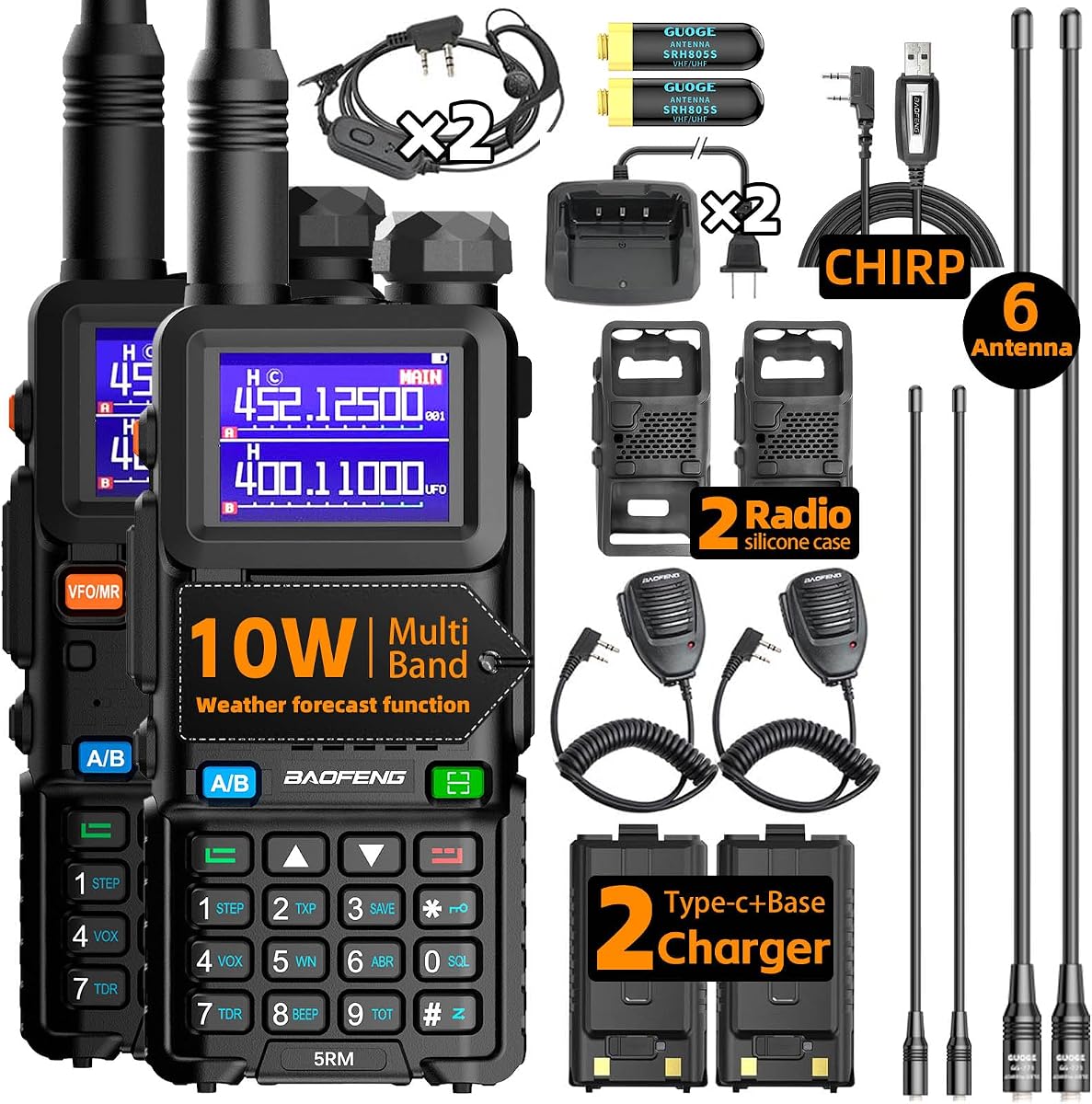
This UV-5RM two-pack stands out with the highest supplied rating, 4.8, and a well-rounded set of portable-radio functions. It includes two radios, 2500mAh batteries, USB-C charging, desktop charging, NOAA reception, 999 channels, a 1.77-inch color screen, and CHIRP programming support.
We may earn a commission when you buy through this link, at no additional cost to you.
The AR-5RM platform is described as an upgrade to the UV-5R with multiband reception, aviation AM reception, FM reception, CTCSS and DCS codes, VOX, DTMF, an alarm, a flashlight, a time-out timer, and quick frequency copying. Reception spans 108-136MHz, 136-174MHz, 220-260MHz, 350-390MHz, and 400-520MHz, while transmission is confined to 144-148MHz and 420-450MHz.
There are no stated GPS or digital DMR functions, so operators who need position reporting or compatibility with digital infrastructure should look elsewhere. Aviation reception supports manual AM input but cannot be written as programmable channels according to the listing. Users should also search for the correct 5RM model profile when using CHIRP.
Despite those limitations, this is a compelling choice for POTA operators who want two capable analog radios, flexible charging, extensive listening, and emergency functions in one pair. It works well for coordinated activations, portable events, camping, hiking, and maintaining a backup channel.
The radio concentrates on analog voice and broad receive coverage rather than digital voice or mapping. That focus can make operation easier for newcomers and dependable in areas where a simple local repeater net is the main requirement.
A paired radio provides immediate flexibility for separate channels or a backup unit. Matching batteries and chargers also simplify charging logistics at base camp and reduce the chance of one radio becoming unusable during a long activation.
We may earn a commission when you buy through this link, at no additional cost to you.
The UV-32 builds on the UV-5RM with 10-watt-listed output, three selectable power levels, GPS, AM reception, frequency duplication, and a tactical-style antenna. Its 4.4 rating and two-pack configuration make it a notable choice for POTA operators who want location awareness in a conventional analog handheld.
We may earn a commission when you buy through this link, at no additional cost to you.
GPS can provide a useful positional reference during a park activation, while the listing also identifies NOAA forecasts, extreme-weather alerts, an LED flashlight, alarm sound, FM radio, stopwatch, DTMF, VOX, and a 2500mAh battery. Frequencies can be copied through side keys or written through an app, offering both quick and structured configuration paths.
The 18.89-inch antenna is the most significant physical compromise. It can improve signal characteristics but makes the radio awkward for small packs and prolonged belt wear. The listing mentions GPS but not APRS, so users should not assume that position data can be sent through a compatible amateur packet system or displayed on a map.
This model is best for users who prioritize antenna reach and a built-in position fix over compactness. It suits experienced POTA participants, hiking groups, and operators who can accommodate a large handheld in their pack.
A built-in GPS can tell an operator where the radio is, which is helpful for documenting a portable activation or coordinating a group. Confirming whether a specific firmware version supports position transmission is essential before assuming APRS capability.
High, medium, and low power settings let operators balance coverage against battery consumption. Lower output can be sensible during nearby contacts, while higher output may be more appropriate for broad station coverage where regulations and conditions allow.
We may earn a commission when you buy through this link, at no additional cost to you.
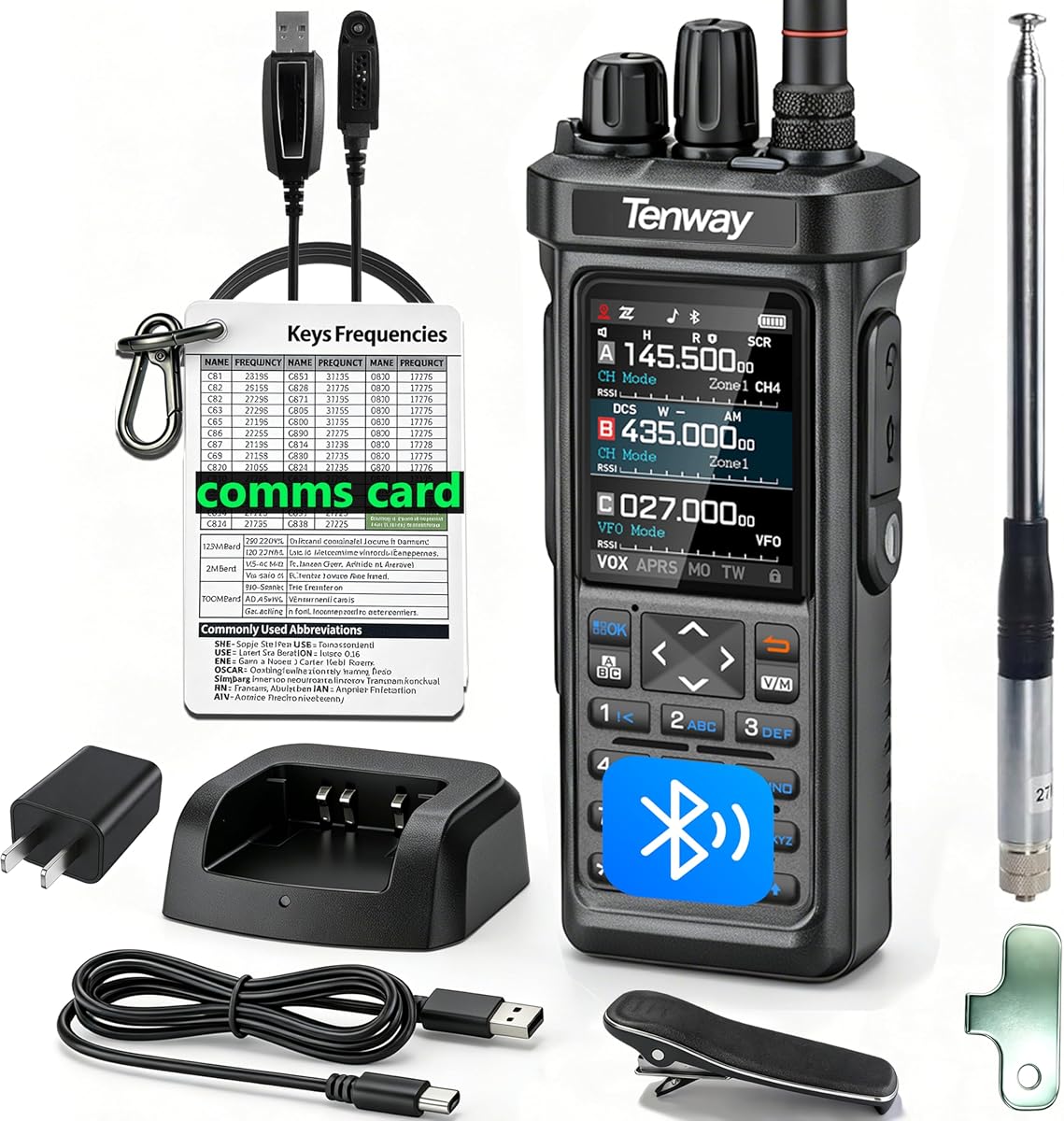
The Tenway TP-900 Pro combines 10-watt FM transmission with GPS, APRS, NOAA reception, wideband listening, and smartphone programming in a single handheld. Its 5.0 rating is the highest supplied score, and its feature concentration makes it particularly interesting for operators who want more than conventional local repeater communication.
We may earn a commission when you buy through this link, at no additional cost to you.
For POTA coordination, GPS APRS can provide real-time location sharing while NOAA channels help operators monitor changing weather. Bluetooth app programming removes the need for complicated cable operation during setup, and the spectrum analyzer offers a way to view nearby signal activity and identify clearer frequencies before calling a park or local channel.
The radio extends beyond common handhelds by receiving AM, FM, shortwave, medium-wave, and long-wave signals. Transmission is more restrained: the listing states up to 10 watts and FM operation on 27MHz, so operators must confirm exact band and power permissions under their license and applicable rules. It is a feature-rich device with a steeper learning curve than a basic UV-5R.
This is the premium choice for an experienced operator who wants integrated APRS and convenient smartphone configuration. It is especially useful for coordinated POTA teams, travel activations, and expeditions where position reporting and situational awareness justify a more capable platform.
Integrated GPS and APRS distinguish this model from ordinary analog handhelds. Position information can help team members track portable stations, coordinate arrivals, and provide a shared operational picture during a larger POTA event.
Smartphone programming can be more convenient than connecting a cable in the field. Operators should still maintain a local channel backup and verify settings before leaving, since software versions and radio behavior can change.
We may earn a commission when you buy through this link, at no additional cost to you.
The Retevis RT85 is a rugged, dual-band two-pack with a 4.5 rating and a 200-channel capacity. Its reinforced housing is designed to withstand shock and vibration, making it a sensible option for POTA activities involving hiking, climbing, camping, or work in demanding outdoor environments.
We may earn a commission when you buy through this link, at no additional cost to you.
Five-watt output, repeater support, A/B independent band operation, dual-channel display, VFO, DTMF, and CHIRP programming provide a conventional analog foundation. An SOS alarm and flashlight add emergency utility, while the ability to display and answer calls on two channels helps teams coordinate more than one contact.
It does not list GPS, NOAA reception, digital voice, or extensive wideband monitoring, and 200 memories are fewer than several newer competitors offer. The 5-watt output also differs from the 10-watt-listed models, making it worth comparing expected coverage and battery use before deciding whether extra power is necessary.
For a beginner, a club member, or an operator seeking a durable matched pair without advanced digital features, the RT85 is a balanced recommendation. It is especially appealing when physical resilience and straightforward team communication matter more than navigation data.
A stronger housing is valuable when a radio may be dropped, packed tightly, or carried over uneven ground. It cannot prevent every type of damage, but it adds confidence compared with a radio designed primarily for controlled indoor use.
Independent A/B band operation and dual-channel display help operators monitor two activities simultaneously. This is useful when a POTA contact shares a park with another team or when a local repeater and simplex channel both need attention.
We may earn a commission when you buy through this link, at no additional cost to you.
The Baofeng DM-32 is the only handheld here centered on DMR as well as conventional analog FM. It has a 4.3 rating, up to 4,000 channels, a full keypad, a 2.0-inch screen, 10-watt maximum output, GPS, APRS, NOAA reception, and Type-C connectivity.
We may earn a commission when you buy through this link, at no additional cost to you.
Its dual-mode design lets operators participate in digital systems while retaining analog compatibility. TDMA dual-time-slot capability can improve frequency efficiency, while text messaging, call recording, remote monitoring, and customizable side keys support professional or coordinated team workflows. FM, AM, and NOAA reception add situational awareness beyond voice communications.
The radio is more complex than a basic analog handheld, and useful digital operation depends on compatible systems, correct talkgroups, programming, and coverage. Encryption claims should never be treated as a substitute for lawful operation. The listing includes one radio, so a second unit may be needed for a matched personal or team setup.
Choose the DM-32 when digital interoperability, high channel capacity, GPS APRS, and advanced functions justify the learning curve. It is a strong option for technical POTA participants and teams that already operate on DMR or need a mix of digital and analog communications.
Dual-mode operation offers flexibility when a local group uses different systems. An operator can move between DMR and analog depending on the contact, while keeping one familiar handheld in the pack.
APRS, text messaging, remote monitoring, recording, and programmable controls provide useful tools for organized teams. These features also demand attention to privacy, security, local policies, and correct configuration.
We may earn a commission when you buy through this link, at no additional cost to you.
Choosing a POTA radio involves balancing coverage, battery life, programmability, navigation, portability, and the communications features used at your typical activation sites.
Begin with the amateur bands you expect to use. Most VHF and UHF POTA work involves 144-148MHz and 420-450MHz, while the BF-F8HP PRO adds tri-band operation and the Tenway TP-900 Pro supports FM operation on 27MHz. Wide receiver ranges can be useful for monitoring aviation, broadcast, weather, and public-service traffic, but reception does not grant transmit authority.
Always check your license class, local band plans, output restrictions, and any park-specific rules. Transmit only within your privileges and supported bands, and remember that a nominal 10-watt listing does not override regulatory or equipment limitations.
Output power can help a handheld reach a distant repeater or portable station, but higher power also consumes more battery and may not improve reception. The listed radios range from five watts for the RT85 to 10 watts for several UV-5RM variants, the K5PLUS, UV-32, TP-900 Pro, and DM-32.
Compare the stock antenna as well as power. The K5PLUS includes a flexible high-gain antenna, while the UV-32 lists an 18.89-inch tactical antenna. Long antennas may improve signal characteristics but reduce portability, so balance radio capability with how comfortably the unit fits your pack or belt.
GPS can record or display an operator's position during a POTA activation. APRS adds a protocol for transmitting position information and is especially useful for group coordination. The BF-F8HP PRO offers direct radio-to-radio location sharing, the UV-32 includes GPS, and the TP-900 Pro and DM-32 list GPS with APRS.
Do not treat every GPS radio as a full APRS mapping device. The BF-F8HP PRO specifically lacks APRS, mapping, continuous tracking, and emergency-location service. If a digital map is essential, verify APRS packet support, compatible software, and data flow before purchasing.
POTA operators often need local repeaters, nearby parks, national calling frequencies, simplex channels, and personal favorites. The 999- and 1,000-memory models provide ample capacity, while the UV-5R offers 128 channels and the DM-32 supports up to 4,000. Capacity alone does not guarantee organization, so named zones, scan lists, and readable displays matter.
Most options support some form of computer programming, with CHIRP named for the UV-5R variants, K5PLUS, UV-32, and RT85. The BF-F8HP PRO uses BTECH CPS or supported CHIRP-next with a separately sold PC03, while the TP-900 Pro offers Bluetooth app programming. Choose the workflow you can actually maintain.
A NOAA receiver can provide weather forecasts and emergency alerts without relying on cellular service. It is valuable for exposed hiking areas, remote parks, and changing weather, but it is not a substitute for checking official forecasts, maintaining an emergency plan, or carrying essential survival equipment.
The UV-5RM variants, K5PLUS, UV-32, TP-900 Pro, and DM-32 list NOAA reception. The BF-F8HP PRO also receives NOAA channels, while the RT85's listing emphasizes an SOS alarm and flashlight rather than NOAA. Consider local weather exposure when deciding whether weather reception deserves priority.
A POTA activation may last several hours, so battery capacity and realistic power level matter. The 5RM variants, UV-32, and DM-32 list 2500mAh batteries, and most listed radios support USB-C or USB charging. The BF-F8HP PRO and TP-900 Pro also use convenient modern charging connections.
A desktop base charger is useful at home or base camp, while USB charging allows recharging from a power bank, vehicle adapter, laptop, or wall supply. Carry the cable type you expect to use and avoid leaving a battery at a low charge before a remote activation.
Most amateur handheld use remains analog, and nine of the listed models are centered on conventional FM voice. The DM-32 adds DMR digital operation, text messaging, recording, and remote monitoring. Digital can be valuable for efficient coordinated groups, but it also requires compatible infrastructure and correct programming.
Choose analog for simplicity, broad repeater compatibility, and an easier learning curve. Consider digital when your club already uses DMR, your group needs text or remote monitoring, or you want one radio to cover both modes.
The best radio is one you will comfortably carry. A large display, external speaker microphone, long antenna, and full keypad can improve operation while adding bulk. The RT85 emphasizes a reinforced housing for shock and vibration, whereas the UV-32's tactical antenna and accessories create a notably larger footprint.
Consider belt clips, straps, earpieces, speaker microphones, and available case space. For hiking and climbing, weight and balance may matter more than an extra function; for a fixed park table, a full keypad and larger screen may be more useful.
Begin by programming the radio with accurate local repeater offsets, tones, permitted power levels, and channels relevant to your planned activation. Create separate channel groups or zones for nearby parks and home-area repeaters, then save a simple contact channel that another operator can easily reach. Identify the exact radio model in the programming software and verify every field after transfer.
At the park, inspect the radio, antenna, connector, battery, and belt attachment before setting up. Begin with a low power level where adequate, increase it only when necessary, and follow all applicable licensing and park rules. Announce your call sign clearly, keep notes for logging, and avoid changing transmit settings in a way that could interfere with other stations.
After the activation, power down the radio, clean dirt and moisture from the controls and connector area, and recharge the battery rather than leaving it depleted for long periods. Store it in a dry location with the antenna secured, inspect cables for damage, and preserve a backup channel plan. Firmware or programming changes should be performed with the correct model-specific software and instructions.
The Baofeng UV-5R is among the simplest choices because it uses conventional analog voice, has a familiar keypad and display, and supports CHIRP programming. The Retevis RT85 is another approachable dual-band option with a reinforced housing and two-radio package. New operators should focus on learning local repeaters, simplex frequencies, and their own call sign before adding advanced features.
Not for basic park-to-park communication, because conventional voice radio can work perfectly well. GPS or APRS becomes more valuable for team tracking, coordinated activations, documentation, or reporting position through compatible packet systems. Confirm that a radio supports the exact APRS behavior you want rather than assuming every GPS handheld provides mapping.
Higher output can improve your ability to reach distant stations or repeaters, but the actual result also depends on antenna performance, terrain, and the other station's setup. It consumes more battery and may be restricted locally. Many successful POTA contacts use lower power, so choose a setting that provides reliable communication without exceeding applicable limits.
You can use the hardware where lawful, but the frequency ranges, channel plans, power rules, and acceptable modes vary by country. A radio capable of transmitting a band is not automatically authorized to use it. Check the rules for your location, obtain any required amateur license, and avoid transmitting on frequencies outside your permitted allocations.
Program the needed channels before leaving, carry a written backup frequency list, and fully charge the battery. Bring an appropriate spare battery if the activity will last long enough to need one, along with a compatible charging cable and a way to recharge from a power bank. Also bring conventional emergency supplies because a radio does not replace first-aid, weather planning, navigation, or food and water.
Analog FM uses conventional continuous voice communication and is compatible with many traditional repeaters and local simplex contacts. DMR organizes digital traffic into timeslots and can support text, efficiency, and group-oriented workflows. DMR requires compatible radios and systems, correct programming, and sufficient coverage, so it should complement rather than replace a reliable analog setup for many operators.
A longer antenna may improve signal behavior compared with a very short stock antenna, but it also makes the radio less compact. The K5PLUS and UV-32 are especially notable for long antennas. Consider the activation style, pack space, and local power regulations before choosing, and never equate a larger antenna with unlimited legal output.
A two-pack is convenient for teams, family activations, contest-style logging, and immediate backup capability. It also reduces the effort needed to source matching batteries and accessories. A single radio may be sufficient for a solo operator who wants to minimize weight, especially if a reliable backup channel or borrowed equipment is available.
The Baofeng UV-5RM two-pack stands out for its broad analog feature set, wide reception, flexible charging, and strong supplied rating. The original UV-5R remains a sensible budget starting point, while the Tenway TP-900 Pro takes the premium path with integrated GPS APRS, Bluetooth programming, and a spectrum analyzer.
Prioritize the features that directly support your operating style. Beginners may get more from simple analog operation and accessible programming, while experienced teams may value channel organization, position reporting, broad listening, or digital compatibility. Always consider antenna size, battery needs, local rules, and the type of parks you plan to visit.
Ratings, bundles, firmware, accessories, and prices can change, so check the current listing and exact model before purchasing. Confirm transmit bands, programming cable requirements, included antennas, battery specifications, and local authorization. With a properly programmed radio and realistic operating plan, any well-chosen handheld can become a dependable POTA companion.