
THINKWARE U3000 4K Dual-Channel Dash Cam
4.0Editor score
4K front, 2K rear
Built-in radar parking mode
Remote app access
Our Thinkware Dash CAM guide compares ten front and rear dash cameras, comparing video resolution, night performance, parking features, GPS, displays, and
Thinkware Dash CAM systems are designed for drivers who want dependable road recording, useful parking surveillance, and clear evidence when an unexpected event occurs. A strong dash cam should balance image quality, front-and-rear coverage, low-light performance, storage handling, installation complexity, and accessible smartphone controls.
This guide compares ten Thinkware and closely related dual-camera options across resolution, sensor technology, viewing angle, parking modes, GPS data, driver alerts, displays, app support, and included accessories. It covers single-camera and dual-channel models so readers can compare resolution, coverage, and complexity without overlooking practical installation details.
Each selection below highlights the feature that makes the model most appropriate for a particular need, while the comparison table provides a quick overview of the complete field. Ratings and specifications can change with firmware and production updates, and prices change frequently, so shoppers should confirm current listings and compatibility before purchasing.
4.0Editor score

4.9Editor score

4.0Editor score
The following side-by-side comparison covers recording resolution, camera coverage, night-vision technology, parking protection, positioning, and connectivity across all ten models reviewed in this Thinkware Dash CAM guide.




The THINKWARE ARC Dash Cam 2K is a balanced dual-camera system with a 4.1 rating, offering 1440p recording from both the front and rear cameras at 30fps. Its 125-degree viewing angles, IPS touchscreen, GPS, Wi-Fi, and parking surveillance create a well-rounded feature set for everyday evidence gathering.
We may earn a commission when you buy through this link, at no additional cost to you.
The model records from two lenses at 1440p and uses Super Night Vision 2.0 to improve brightness and reduce image noise in low-light situations. The included GPS antenna supports speed and red-light camera warnings while embedding speed, time, and location information into the footage. On-camera playback and setting changes are convenient through the 2.7-inch IPS display.
Its main limitation is that 2K is no longer the highest resolution in this category. The ARC800, ARC700, ARC900, U3000, and ROVE R2-4K offer 4K-class front imagery, while several also provide higher rear resolution. Buyers should also expect a more involved installation than a compact single-camera model because a rear camera must be connected and routed.
The ARC Dash Cam 2K is a strong choice for drivers who value an integrated touchscreen, balanced front-and-rear resolution, and extensive parking options without moving to the most complex flagship platform. It is especially useful for people who want a complete installation package, including a memory card, hardwiring cable, mounts, cable holders, and trim tool.
Overall, this is an accessible and thoughtfully equipped all-rounder. It may not lead the list in raw resolution or remote connectivity, but it delivers the core combination that many motorists actually need: clear two-camera recording, GPS information, night performance, incident protection, and direct on-device control.
Recording 1440p video from both cameras preserves useful detail while giving drivers evidence from ahead and behind. The matching 125-degree angles help the system capture adjacent lanes and surrounding traffic without relying on a rear camera that only records at lower resolution.
Motion and impact detection, time-lapse recording, energy-saving mode, and smart parking surveillance expand protection beyond active driving. The included hardwiring cable supports more dependable parking operation, while the external GPS antenna adds route data and camera warnings.
We may earn a commission when you buy through this link, at no additional cost to you.
The THINKWARE ARC800 stands out with a 4.9 rating, the highest among the products in this guide. It pairs 4K UHD front recording at 30fps or 2K QHD at 60fps with a Full HD 1080p rear camera, creating a strong combination of detail, frame-rate flexibility, and two-direction coverage.
We may earn a commission when you buy through this link, at no additional cost to you.
Its Sony STARVIS 2 sensor and AI image signal processing are the defining advantages. These technologies are intended to reduce noise and improve visibility during nighttime driving and parking surveillance. Dual HDR balances exposure when bright headlights, deep shadows, and changing outdoor light meet in the same frame. HEVC recording and dewarping add further refinement.
The ARC800 is not the highest-resolution option for every channel. Its rear camera records at 1080p, while the ARC700, ARC900, and dual U3000 pair 4K front recording with 2K rear recording. Buyers who prioritize night visibility, touchscreen operation, and expandable storage may still find the ARC800's sensor and processing more significant than rear-channel resolution.
This model is best for drivers seeking a premium dual-camera system with a particularly strong low-light proposition, a 2.3-inch IPS touchscreen, built-in GPS, and Wi-Fi management through the THINKWARE Dash Cam Link app. Support for microSD cards up to 512GB is useful for people who retain longer recordings or use time-lapse parking modes.
Our recommendation is the ARC800 for discriminating drivers who want high-resolution front coverage, refined night performance, and a manageable two-camera feature set. It combines premium imaging specifications with familiar local controls, making it a strong all-around recommendation without requiring an optional connectivity module.
Sony STARVIS 2 and AI signal processing work together to improve low-light detail and reduce noise. The result is especially relevant for evening commutes, parking surveillance, and roads where headlights create a sharp contrast with dark surroundings.
Drivers can select 4K at 30fps for maximum front detail or 2K at 60fps for smoother motion. Support for cards up to 512GB reduces the need for frequent file transfer and works well with recording modes that retain extended parking footage.
We may earn a commission when you buy through this link, at no additional cost to you.
The THINKWARE ARC700 is a dual-camera model with a 4.1 rating that records 4K UHD at 30fps from the front and 2K QHD at 45fps from the rear. That rear-channel resolution gives it an edge over systems pairing 4K front video with a Full HD back camera.
We may earn a commission when you buy through this link, at no additional cost to you.
Dual HDR is the key imaging feature, helping the cameras retain visible information in scenes with bright and dark areas. A Sony STARVIS sensor supports low-light recording, while built-in GPS adds speed, time, and location stamps to saved video. Speed-camera and red-light-camera alerts provide additional value for regular drivers.
Compared with the ARC800, the ARC700 does not list a touchscreen or a 2.3-inch IPS display. App-based control is the primary route for reviewing, downloading, and managing footage. Buyers who prefer physical on-device menus may find the ARC800 more convenient, while those prioritizing 2K rear footage may favor the ARC700.
The ARC700 is appropriate for drivers who want high-resolution coverage in both directions but do not need advanced radar parking or optional cellular features. Motion and impact detection, time-lapse operation, smart parking mode, thermal sensors, and supercapacitors support dependable use in different seasons and parking environments.
We recommend the ARC700 as a strong high-resolution dual system for users who will review recordings through the THINKWARE DashCamLink app. Its balance of 4K front capture, 2K rear capture, GPS alerts, and parking tools gives it broad everyday appeal.
Recording 2K QHD at 45fps from the rear camera provides more detail and temporal smoothness than a basic 1080p rear channel. It is a meaningful advantage when the goal is to identify vehicles, road conditions, or events behind the car.
Wi-Fi connectivity lets drivers use the THINKWARE DashCamLink app to view, download, and manage recordings. This keeps the main unit uncluttered and makes it easier to retrieve important clips without routinely removing the memory card.
We may earn a commission when you buy through this link, at no additional cost to you.
The THINKWARE ARC900 is a high-end 4K-front and 2K-rear system with a 4.1 rating. It uses Sony IMX678 and IMX675 STARVIS 2 sensors in the front and rear cameras, while Dual HDR seeks to preserve road detail under rapidly changing exposure conditions.
We may earn a commission when you buy through this link, at no additional cost to you.
A 3.5-inch IPS LCD touchscreen is among the larger displays specified in this group and supports direct playback and quick setting changes. Built-in GPS provides conventional route and alert data. The model's standout extension is optional LTE connectivity, which can add live view, remote access, impact alerts, and GPS tracking when paired with the separately sold module.
LTE functionality requires both the optional module ASIN B0FSGHLDM4 and firmware version 1.01.03 or later. Buyers who want immediate remote access must account for that additional component and update. Parking protection otherwise relies on motion and impact detection, so it remains useful without subscribing to a cellular plan.
The ARC900 fits drivers who want a polished, high-resolution Thinkware system with a large touchscreen and a path to remote connectivity. It is less convenient for buyers seeking a simple plug-in system because the optional module, firmware process, and dual-camera wiring add complexity.
Our recommendation is the ARC900 for drivers who value premium imaging hardware, generous controls, and future remote-monitoring flexibility. Those who never need cellular access can still benefit from the dual STARVIS 2 sensors, Dual HDR, 4K front recording, and 2K rear coverage.
The 3.5-inch IPS display offers a convenient way to review footage and change settings without reaching for a phone. Its size is particularly helpful for users who rely on the dash cam as a rear-view-mirror-style display.
With the compatible optional LTE module and required firmware, owners can access live viewing and remote information away from the vehicle. The feature adds flexibility for fleet, family, or security-conscious applications without being necessary for standard local recording.
We may earn a commission when you buy through this link, at no additional cost to you.
The Thinkware F70 PRO is a compact single-camera model with a 4.0 rating. It records 1080p Full HD video and focuses on straightforward installation, parking protection, and app-assisted review rather than multi-camera resolution or large displays.
We may earn a commission when you buy through this link, at no additional cost to you.
Super Night Vision brightens low-light scenes, while Smart Parking Mode provides motion and impact detection with a 20-second incident clip. Time-lapse and Energy Saving options extend parking coverage. A three-axis G-sensor protects incident files, anti-file corruption supports recording integrity, and thermal protection with supercapacitors helps the system endure demanding conditions.
Its biggest limitation is the absence of a rear camera. Drivers who need evidence from behind the vehicle must consider a dual-channel model. GPS is also optional through a separate antenna, meaning the standard configuration does not inherently provide speed and red-light warnings or embedded route data.
The F70 PRO is a sensible choice for new drivers, rideshare operators, and anyone wanting a small front camera with meaningful parking features. The package includes the mount, 12-volt power cable, 32GB memory card, and adhesive cable clips, making setup straightforward and visually unobtrusive.
We recommend the F70 PRO for buyers who value simplicity and compactness over maximum resolution. It provides a credible blend of Full HD recording, night enhancement, incident locking, and smartphone control in a package that should be easier to install and position than a wired dual-camera system.
The compact form is less likely to distract the driver and can sit neatly near the rear-view mirror. A single camera also avoids the need to route a cable through the vehicle to a rear camera, reducing installation complexity.
Smart Parking Mode combines motion detection, impact detection, time-lapse recording, and energy saving. The supplied 32GB card and straightforward mounting hardware make it convenient to begin using the system without sourcing several separate accessories.
We may earn a commission when you buy through this link, at no additional cost to you.
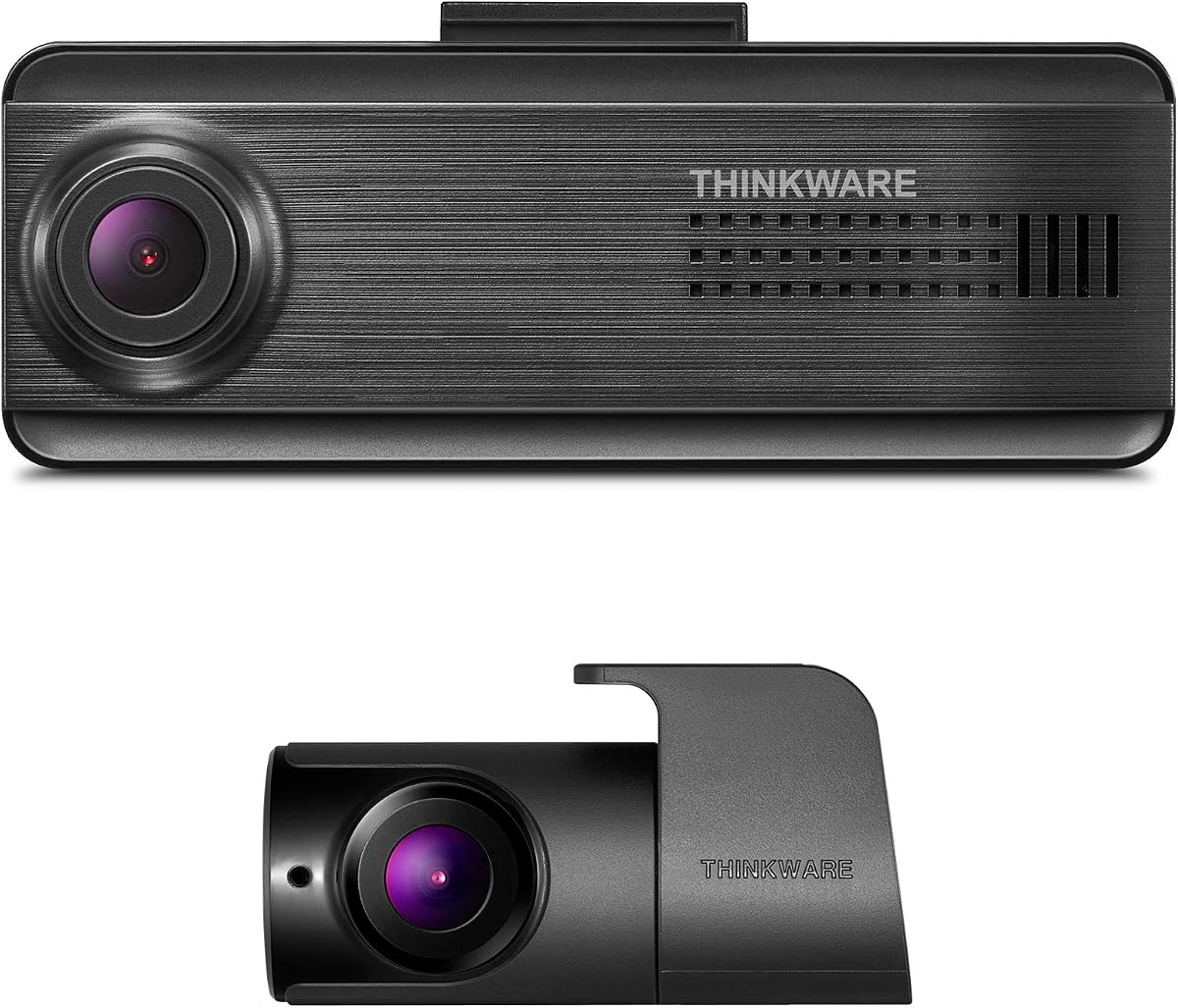
The dual-channel THINKWARE U3000 is a feature-rich flagship with a 4.0 rating. It records 4K video from the front camera and 2K from the rear, using a Sony STARVIS 2 sensor, Super Night Vision 4.0, and an adjustable bitrate for control over file detail and storage use.
We may earn a commission when you buy through this link, at no additional cost to you.
Its defining feature is built-in radar for parking mode. Radar can monitor movement with lower power consumption than a conventional parking approach, while buffering captures footage before an incident. When movement or impact is detected, the system saves a 20-second clip containing ten seconds before and ten seconds after the event.
Remote functions are available through the THINKWARE CONNECTED app, including live viewing and impact notifications, although an internet connection is required and carrier charges may apply. Local pairing and footage management use the Thinkware Link app and Bluetooth. The included OBD-II cable and optional hardwiring route support flexible parking installation.
This is not a minimalist system. Radar setup, OBD connection, cable routing, app accounts, and cellular requirements can make installation more demanding than a standard dual-camera arrangement. Buyers should also distinguish this two-channel U3000 from the separate single-front-camera U3000 listing later in the guide.
We recommend the dual U3000 for drivers who want the strongest parking-focused feature set in the group. Its pre-event buffer, radar detection, adjustable bitrate, high-resolution channels, and remote access make it well suited to people who regard a dash cam as both a driving recorder and a security system.
The built-in radar is designed to monitor parking-area motion with low power use. This can make extended parking surveillance more practical than relying exclusively on optical motion detection, particularly when a vehicle remains unattended for long periods.
Saving ten seconds before and ten seconds after an event means an incident clip contains more than the instant of impact. That context can help show how an event unfolded, what happened immediately beforehand, and what occurred afterward.
We may earn a commission when you buy through this link, at no additional cost to you.
The THINKWARE Q200 is a front-only 2K QHD dash cam with a 3.7 rating. It records at 30fps and combines Wide Dynamic Range with Super Night Vision 2.0, targeting clear evidence in glare, daylight, and low-light conditions.
We may earn a commission when you buy through this link, at no additional cost to you.
Its 125-degree lens is dewarped to reduce the fish-eye distortion commonly associated with wide viewing angles. The result is intended to cover lanes, nearby vehicles, and road signage while keeping edge-to-edge imagery more natural. ADAS features also support more informed driving with warnings for relevant forward-road events.
The 3.7 rating is lower than those of the other Thinkware models in the list, although it does not by itself reveal the reason. The larger trade-off is coverage: there is no rear camera, so it cannot document the road behind the vehicle. Buyers seeking comprehensive evidence from both directions should look at a dual-channel option.
Smart Parking Mode includes motion and impact detection, time-lapse, energy-saving operation, and high-heat power reduction. The three-axis G-sensor saves a 20-second incident clip with ten seconds before and after the detected impact, while anti-file corruption helps protect stored recordings.
The Q200 is best for drivers seeking a capable single camera with 2K resolution, a broad but dewarped view, and useful parking features. It is also a practical option for vehicles in which a rear-camera cable would be inconvenient, particularly when Wi-Fi-based review is preferred over a built-in screen.
Dewarping corrects the bowed appearance often produced by very wide lenses. The result can make vehicles and road markings easier to interpret, which is useful when footage may be reviewed as evidence rather than only watched casually.
ADAS warnings add driver-assistance context, while the parking suite covers several ways of monitoring a stationary vehicle. A hardwiring cable or optional OBD-II cable is needed to enable continuous parking protection.
We may earn a commission when you buy through this link, at no additional cost to you.
The THINKWARE F200 PRO is a Full HD front-and-rear system with a 3.7 rating. Both cameras record at 1080p, and the front lens provides a 140-degree viewing angle designed to cover more of the road and reduce blind spots.
We may earn a commission when you buy through this link, at no additional cost to you.
Wi-Fi allows access to recordings through the THINKWARE DASH CAM LINK app, so users can view, download, and share clips without removing the memory card. The included Cradle GPS tracks speed, time, and routes, enables speed and red-light camera alerts, and supplies additional context to saved footage.
Its resolution is below the 2K and 4K models featured elsewhere in the guide. The rear camera also does not list a high-resolution specification. Nevertheless, dual-channel recording can be more valuable than a single superior front camera for drivers who want to investigate parking impacts, rear-end collisions, or traffic following closely behind.
ADAS features include warnings related to lane departures, collisions, and front vehicle movement. Parking protection supports incident monitoring, and the included hardwire kit enables continuous operation without keeping the vehicle's accessory socket permanently occupied.
The F200 PRO is a sensible choice for budget-conscious drivers who prioritize front-and-rear coverage, GPS alerts, and a complete installation package. It suits cars, minivans, and RVs according to the supplied product information, and the included memory card, charger, mount, GPS cradle, and hardwire kit simplify setup.
A rear camera records the view drivers cannot see directly. That additional perspective can be decisive in parking disputes, following incidents, and cases where a vehicle in the rear lane behaves unexpectedly.
The included Cradle GPS supplies speed, time, and route information while activating camera alerts. Because GPS is part of the specified package, owners do not need to determine which additional antenna or cable is required.
We may earn a commission when you buy through this link, at no additional cost to you.
The ROVE R2-4K Dual is a two-channel system with a 4.4 rating and a storage-focused feature set. Its front camera records at 2.5K QHD and upscales to 4K for playback, while the rear records at Full HD 1080p. The product information is explicit that the 4K front output is upscaled rather than native.
We may earn a commission when you buy through this link, at no additional cost to you.
The front Sony STARVIS 2 IMX675 sensor, wide F1.5 aperture, and HDR support better low-light capture. The rear uses an F1.8 aperture. A three-inch IPS screen displays real-time speed and compass information, while built-in GPS stamps routes, locations, and speed onto recordings for later viewing with the supplied GPS player option.
Dual-band 5GHz and 2.4GHz Wi-Fi can transfer files at speeds stated up to 20MB per second, which is helpful when moving large clips to a phone. The ROVE app also handles settings, footage management, and over-the-air firmware updates. The included 128GB card provides a generous starting capacity, and the system supports microSD cards up to 1TB.
The main caution is the distinction between upscaled 4K and native 4K. The front image is still designed to be sharper than standard 1080p footage, but buyers who prioritize native recording resolution should understand the processing difference. The hardwire kit required for the custom parking mode is also not included.
We recommend the ROVE R2-4K Dual for drivers who value included storage, quick wireless transfers, and a large display with GPS information. It is a well-equipped alternative in this comparison, particularly for users who do not want to select and install a large memory card separately.
The included 128GB card offers ample room for daily and parking recordings, while support for cards up to 1TB provides a considerable expansion path. This is particularly useful for time-lapse parking modes that can generate footage over extended periods.
Dual-band Wi-Fi is designed to speed up transfers to compatible phones, reducing the wait involved in downloading important clips. The dedicated 5GHz band also helps separate high-volume video transfers from other wireless traffic on the same network.
We may earn a commission when you buy through this link, at no additional cost to you.
The front-only THINKWARE U3000 is a premium road-focused model with a 4.0 rating. It uses a Sony STARVIS 2 sensor for 4K recording, combining detailed daytime imagery with improved sensitivity for low-light conditions and WDR for varied lighting.
We may earn a commission when you buy through this link, at no additional cost to you.
The built-in GPS tracks speed and time and enables warnings for upcoming red-light and speed cameras. That information can make the camera more useful during regular travel, particularly on unfamiliar roads, while also adding location context to saved recordings.
Bluetooth pairing through the Thinkware Link app allows owners to replay recent driving videos and manage settings on a compatible Android or iOS device. The THINKWARE CONNECTED app adds remote access functions, including live viewing and impact notifications, but requires an internet connection and carrier charges may apply.
This listing covers a single front camera rather than the dual-channel U3000. As a result, it does not provide the same rear coverage as the dual U3000 model. Buyers comparing the two listings should verify the number of cameras, included cables, and parking functionality rather than assuming both share an identical configuration.
We recommend the front U3000 for drivers who want a high-resolution forward view and premium sensor performance without installing a second camera. It is particularly appealing when road detail, night visibility, and GPS-based alerts matter more than documenting what happens behind the vehicle.
Combining 4K recording with a Sony STARVIS 2 sensor provides a strong foundation for both daytime identification and nighttime visibility. WDR further helps maintain usable detail when strong light and deep shadow appear together.
The Thinkware Link app provides convenient local management through Bluetooth pairing, while the THINKWARE CONNECTED app supports remote features. This gives owners a useful combination of everyday playback control and optional away-from-the-car access.
We may earn a commission when you buy through this link, at no additional cost to you.
Choosing a Thinkware dash cam involves balancing recording channels, image quality, parking capabilities, power installation, connectivity, and the convenience of local controls. The most important starting point is deciding what evidence and coverage you actually need.
A single-camera model is simpler to install and concentrates recording capacity on the road ahead. It is a sensible choice for new drivers, older vehicles, or anyone who dislikes routing a cable to a rear camera. A dual-channel system provides simultaneous evidence from ahead and behind, making it more useful for parking incidents, rear-end collisions, and comprehensive trip review. Dual systems require more careful cable placement and usually involve a more involved installation.
The guide includes 1080p, 2K QHD, and 4K-class front recording, with some dual systems using 2K for the rear camera. Higher resolution can make license plates, signs, and vehicles easier to inspect, but frame rate also affects how smoothly fast movement appears. The ARC800 can record its front channel at 4K 30fps or 2K 60fps, offering a useful choice between detail and temporal smoothness. Review the stated output of each channel rather than relying only on a 4K label.
Night footage depends on more than resolution. Sony STARVIS sensors, wide apertures, HDR processing, and Thinkware night-vision modes can improve how vehicles, pedestrians, and road markings appear in darkness. The ARC800 combines STARVIS 2 with AI processing, the U3000 uses STARVIS 2 with Super Night Vision 4.0, and the ROVE R2-4K Dual uses a STARVIS 2 IMX675 with a wide F1.5 aperture. Each offers a strong night-oriented foundation, but actual results also depend on glare, street lighting, and camera placement.
Motion detection, impact detection, time-lapse, energy-saving mode, and buffered recording each serve a different purpose. Motion detection can conserve storage by starting after activity, impact detection protects a clip when a collision occurs, and time-lapse creates a condensed view of longer periods. The U3000 dual adds radar and pre-event buffering, while the ARC900 can use an optional LTE module for remote monitoring. Confirm whether a hardwire, OBD-II connection, or other installation is required.
GPS can add speed, time, and location to recorded video, while warning systems can alert drivers about speed cameras and red-light cameras. Some models include GPS hardware, while the F70 PRO lists GPS as optional and the F200 PRO includes a Cradle GPS. Embedded data strengthens the context of a clip, but it does not replace camera alerts. Buyers should verify whether their usual routes justify these features and whether the relevant antenna or cradle is included.
Dash cams write large files, so card capacity, format support, and file-integrity features are essential. The ARC800 supports microSD cards up to 512GB, the ROVE R2-4K Dual supports up to 1TB, and the F70 PRO and F200 PRO include 32GB cards. Anti-file corruption and event locking help preserve important recordings. Owners should also check whether the card in the package is adequate for the selected parking mode, because time-lapse and high-bitrate recording can fill storage faster.
Wi-Fi and Bluetooth simplify footage review, settings, and sharing, while an IPS touchscreen offers quicker local playback and menu changes. The ARC Dash Cam 2K and ARC900 have touchscreens, and the ARC800 uses a smaller 2.3-inch IPS display. Remote cellular access is a separate level of functionality that may require optional hardware, an app connection, and ongoing service. Decide whether phone-based control is enough or whether a physical screen and remote access justify added complexity.
A cigarette-lighter power connection is straightforward, but a hardwire or OBD-II connection may be necessary for parking surveillance. Dual-camera models also require a rear-camera cable routed carefully along the headliner and trim. The ARC Dash Cam 2K, F200 PRO, and U3000 dual include relevant hardware, while the ROVE R2-4K Dual requires a separate hardwire kit for its custom parking mode. A trim tool can reduce installation damage, and all wiring should be checked for safe placement.
Begin by choosing a suitable memory card, formatting it in the dash cam, and testing the system before extended use. Mount the front camera high enough to avoid blocking the driver's view, clean the glass, and keep the lens clear. For dual models, route the rear cable without leaving loose sections near controls or airbags, and check the completed installation in both live view and playback.
For daily operation, review the date, time, recording resolution, and storage status, then confirm that Wi-Fi or Bluetooth pairing works with the compatible app. Set the preferred parking mode, event sensitivity, and any GPS or camera-alert options. To protect important clips, save incident files before loop recording can overwrite them, and use the supplied viewer or a compatible player when GPS information needs to be displayed.
Care also involves heat management and cable checks. Avoid leaving the device in a hot vehicle when unnecessary, inspect the power connection, and use thermal protection and energy-saving modes as intended. Keep the lens clean, update firmware when required for compatibility or added functions, and periodically check that recordings remain readable and that the memory card has enough capacity for the selected modes.
Yes, for many drivers a single front camera is sufficient because it directly records the road ahead and is simpler to install. It becomes less suitable when you need evidence of a parking impact, a vehicle approaching from behind, or incidents in the lane behind you. A dual-channel system provides more complete coverage at the cost of additional wiring and installation effort.
Native 4K is captured directly at 2160p, while upscaled 4K starts with a lower-resolution image and enlarges it to a 4K output. The ROVE R2-4K Dual explicitly records 2.5K and upscales for 4K playback, so it should not be compared directly with the natively recorded 4K front channels of the ARC800, ARC700, ARC900, and U3000 models. Upscaling can improve presentation and detail relative to standard 1080p, but it does not create source detail that was never recorded.
Most parking surveillance features require continuous power, which usually means a hardwire or compatible OBD-II installation rather than a temporary cigarette-lighter connection. The ARC Dash Cam 2K and F200 PRO include hardwiring equipment, the U3000 dual includes an OBD-II cable and supports hardwiring, and the ROVE R2-4K Dual requires a hardwire kit that is not included. Check the model listing and vehicle-specific installation instructions before purchase.
Yes. Models with Wi-Fi can use the THINKWARE Dash Cam Link or DashCamLink app to view recordings, download clips, and change settings. The F70 PRO uses Bluetooth pairing through the Thinkware Dash Cam Link app. Remote viewing through THINKWARE CONNECTED is a separate function requiring internet access and may involve carrier charges, so local app control and remote cellular access should not be treated as the same feature.
No. The ARC800, ARC700, ARC900, dual U3000, and front U3000 include GPS, and the F200 PRO includes a Cradle GPS. The F70 PRO lists GPS as an optional accessory. Models with GPS can embed speed, time, and location in footage and may provide speed-camera or red-light-camera warnings, but the availability of physical GPS hardware should be verified for each exact listing.
The required capacity depends on resolution, frame rate, bitrate, and whether time-lapse parking mode is active. The ARC800 supports cards up to 512GB, while the ROVE R2-4K Dual supports up to 1TB. The F70 PRO and F200 PRO include 32GB cards, which may require more frequent review and file management. A larger card generally provides more retention, but it should be compatible and formatted correctly before use.
Many owners can install these systems using the supplied mounts, cables, and trim tools, but the difficulty depends on the vehicle and the selected power method. A front-only model with a cigarette-lighter plug is usually straightforward, while a dual camera may require careful headliner routing and a hardwire or OBD-II connection. Follow the product instructions, avoid obstructing airbags, and ensure cables cannot interfere with driving controls.
Dual HDR and Wide Dynamic Range help a camera preserve detail in scenes containing both bright and dark areas. This is useful around strong headlights, tunnels, shaded buildings, or sudden transitions in daylight. The effect works best when combined with a capable sensor and clean lens, and it complements rather than replaces good night-vision hardware.
The THINKWARE ARC800 is the strongest all-around recommendation because it combines 4K front recording, Sony STARVIS 2 low-light performance, Dual HDR, GPS, Wi-Fi, a touchscreen, and broad storage support. For the most sophisticated parking protection, the dual-channel U3000 adds radar, buffered incident recording, adjustable bitrate, and remote-access options. The F70 PRO is the most approachable choice for buyers who want a compact, simple front camera with meaningful parking features.
The right model depends on the coverage and workflow you value most. Choose 4K and advanced sensors for maximum front-road detail, 2K rear recording for better evidence behind the car, a large touchscreen for local control, or radar and LTE for advanced monitoring. Think carefully about wiring, memory-card capacity, parking power requirements, and the app ecosystem before making a final choice.
Ratings, package contents, firmware functions, and prices can change, and exact configurations may differ between closely related model names. Before buying, verify the camera count, resolution of each channel, included GPS or power accessories, current firmware, storage requirements, and parking-mode compatibility on the retailer listing and manufacturer support materials.