
Frost King ACF19 Foam Coil Cleaner
4.6Editor score
Heavy-duty foaming detergent
Cleans coils and filters
Neutralizes standing-water odors
No-rinse cleaning action
Our HVAC Coil Cleaner guide compares 10 foaming cleaners and spray tools by rinse needs, coverage, odor control, application, and ease of use at home.
HVAC coil cleaners remove dust, grease, mold-related residue, and other deposits that can restrict airflow and reduce cooling performance. A good cleaner should penetrate narrow fin spaces, break down stubborn buildup, control odors, and suit the coil type, rinse requirements, and maintenance habits of the household or service team.
This guide compares ten products based on their stated cleaning actions, intended applications, spray format, rinse guidance, odor treatment, and useful equipment features. It includes aerosol foams for evaporator and condenser coils, a multi-can option, and an automatic foaming sprayer for users who want more control over dilution and application.
Each selection highlights a different practical approach, from a compact budget aerosol to a hose-connected application system. Ratings and product information reflect the supplied listings, while availability and pricing change over time, so readers should confirm the current listing details before making a purchase.
4.6Editor score

4.6Editor score

4.6Editor score
The comparison covers aerosol foams, multipack options, and a hose-fed application system, with each product evaluated by its stated cleaning coverage, application method, rinse guidance, and practical maintenance features.
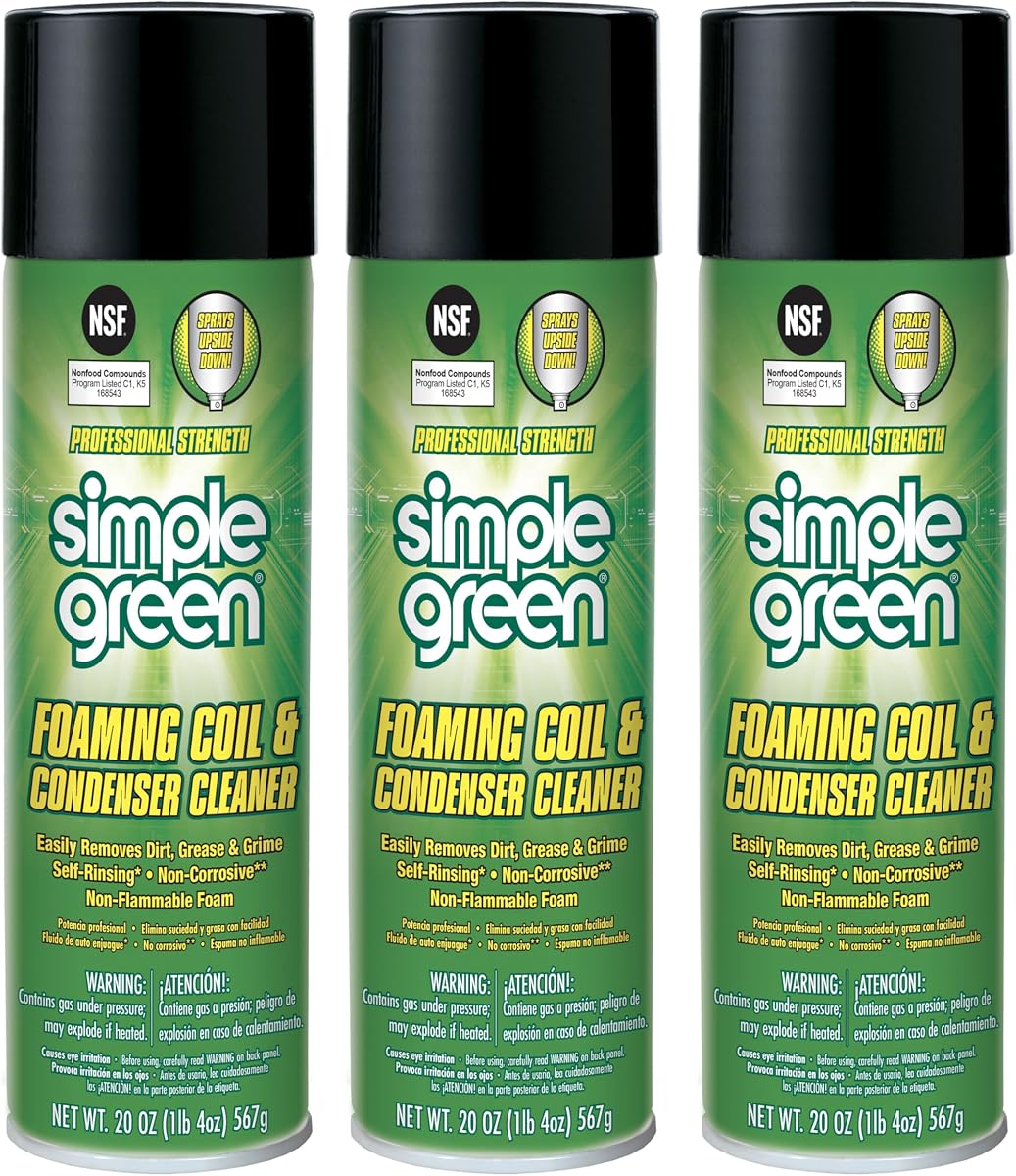



This Simple Green three-pack earns a 4.5 rating and stands out as a versatile HVAC coil cleaner for households, service technicians, and maintenance teams. Its professional-strength, self-rinsing foam is intended for condensate-producing coils, while the non-caustic, non-flammable formula makes it suitable for a broad range of routine cleaning tasks.
We may earn a commission when you buy through this link, at no additional cost to you.
The stated application list is one of its strongest attributes. It can be used on HVAC units, evaporator and condenser coils, fan blades, blowers, heat exchangers, vents, grills, electronic filters, refrigerators, and freezers. Dirt, grease, and built-up grime are targeted because these deposits can clog airflow paths and impede heat transfer.
The NSF registration for C1 and K5 applications adds useful context for operators working in or around food-processing environments. Self-rinsing behavior also simplifies some applications, although users should still verify the product instructions for the specific coil and equipment involved. A three-can package gives owners of larger systems or frequent maintenance schedules more ready supply than a single smaller can.
This is a strong all-around choice for users who want one cleaner to address several HVAC surfaces rather than a narrowly specialized aerosol. It is less flexible than a hose-fed dilution system because the user cannot adjust mixing ratios or precisely control application volume, but its wide material list, moderate rating, and convenient multipack format make it especially useful for regular maintenance.
The cleaner is not limited to coils. Its listed uses extend to fan blades, blowers, heat exchangers, filters, vents, grills, and refrigeration equipment, helping owners address several buildup-prone components during one maintenance session.
Professional-strength cleaning, self-rinsing performance, and NSF registration make this option relevant to more than casual household users. Those traits also justify checking equipment compatibility and local application requirements before use.
We may earn a commission when you buy through this link, at no additional cost to you.
The Frost King ACF19 is a compact 19-ounce aerosol with a 4.6 rating, making it a practical budget-oriented choice for routine household maintenance. Its heavy-duty foam is formulated to dissolve stains, loosen dirt, and remove grease and oil from coils, fan blades, and reusable air filters.
We may earn a commission when you buy through this link, at no additional cost to you.
Its odor-control feature is particularly relevant in seasonal air-conditioning systems where standing water in drain pans can contribute to unpleasant smells. The low-VOC formula and lemon fragrance provide a fresh scent after cleaning, and the product states that no rinse is necessary. That convenience can make it attractive for homeowners who want a straightforward spray-and-clean maintenance product.
The trade-off is capacity and application precision. A 19-ounce aerosol is well suited to targeted jobs but may require multiple cans for a large ducted system or several connected indoor units. Because the formula is delivered through a fixed aerosol format, users have less control over dilution and volume than they would with a hose-connected sprayer.
For a compact, no-rinse cleaner addressing coils, fan blades, filters, and drain-pan odors, Frost King is a strong fit. It is less appropriate for operators who need large-volume commercial coverage or precise proportional mixing, but for an individual homeowner or a quick seasonal clean, the formula covers several common maintenance points.
The stated no-rinse performance simplifies routine care, especially when cleaning an indoor evaporator or related components. Users should still follow the complete label instructions and ensure the equipment is positioned so runoff does not create a moisture or drainage issue.
The ability to clean fan blades and reusable air filters expands the product's usefulness. It also helps address drain-pan odors, making this aerosol more of a compact maintenance kit than a single-purpose coil treatment.
We may earn a commission when you buy through this link, at no additional cost to you.
This three-pack version of Leak Saver Foam Blaster carries a 4.6 rating and is built around a distinctive delivery sequence. Rather than forming an immediate surface blanket, the product uses a focused, higher-pressure spray intended to drive cleaner into the coil before the active foam expands and liquifies trapped grime.
We may earn a commission when you buy through this link, at no additional cost to you.
That delayed action addresses a common limitation of ordinary foaming cleaners, which can sit primarily on top of the coil instead of reaching deposits below the surface. The formula is made for evaporator and condenser coils, with no rinsing required for evaporators and light rinsing with water required for condensers. The listing also identifies drain-pan deodorization as a use.
The product is not limited to residential air conditioners. Its stated applications include HVAC units, refrigeration systems, automotive radiators, fan blades, metal filters, mini-split systems, car air-conditioning systems, and refrigerator coils. That flexibility is useful for users who maintain several types of cooling or heat-transfer equipment.
The three-pack format supports recurring maintenance, while the no-rinse evaporator guidance improves convenience. The tradeoff is that condenser work still requires a light rinse, and the focused spray pattern may be less forgiving than a broad foam when covering large surfaces. It remains a compelling choice for users who value penetration over maximum coverage speed.
The focused spray and delayed foam are designed to place cleaner deeper into the coil before expansion occurs. This may help users reach hidden buildup, provided the can is aimed properly and given the distance recommended by the manufacturer.
Evaporator use is described as no-rinse, while condenser use calls for a light rinse with water. Understanding this distinction prevents users from applying the wrong finishing step to either side of the system.
We may earn a commission when you buy through this link, at no additional cost to you.
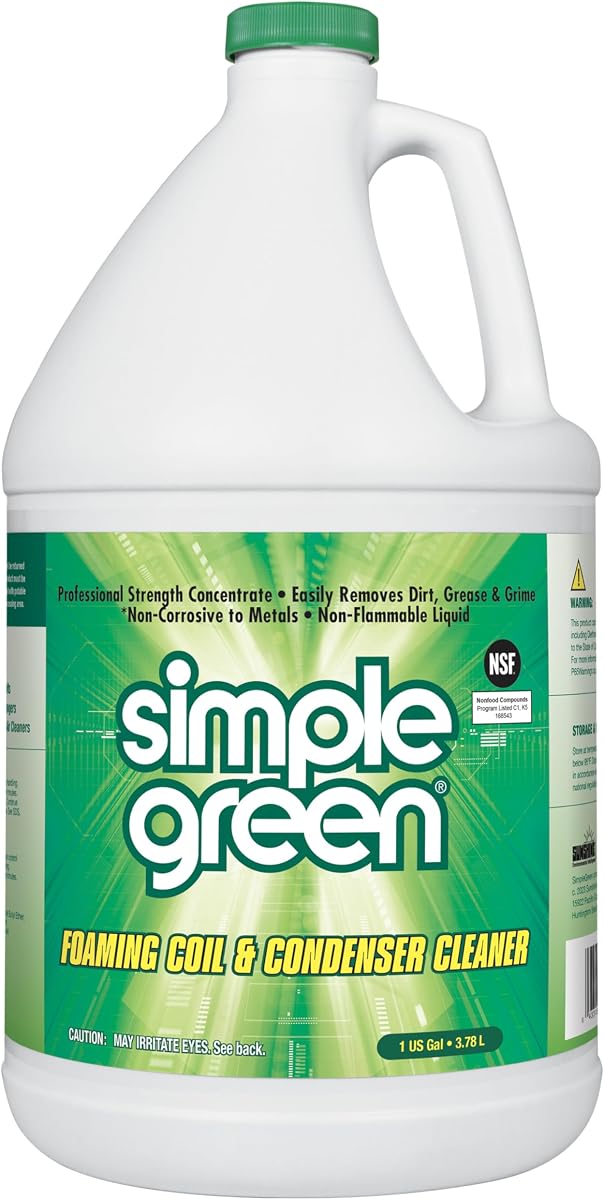
Simple Green's 128-fluid-ounce foaming coil cleaner provides a noticeably larger container than the aerosol options in this guide. It receives a 4.5 rating and is categorized as a cleaning agent, with listed package dimensions of 8 by 8 by 12 inches and a package weight of five pounds.
We may earn a commission when you buy through this link, at no additional cost to you.
The gallon format makes this product appealing to maintenance teams or households that routinely service more than one coil. A larger supply can reduce the need to purchase multiple small cans, particularly for larger residential equipment or scheduled commercial cleaning routines. The foaming format also aligns with the familiar spray-on, dwell, and rinse workflow common to coil maintenance.
What stands out in the supplied information is what is not stated. The listing does not provide specific application surfaces, rinse directions, ingredient characteristics, or odor-control details. As a result, buyers should not assume that this gallon container performs identically to the separate Simple Green 20-ounce aerosol simply because both use the same brand and general foaming-cleaner format.
The product is a sensible choice when container size is the priority and the seller's label provides adequate instructions. Users should read the can before application, particularly if they need NSF registration information, low-flammability characteristics, or detailed compatibility for a particular coil material. It is best suited to users who prioritize bulk supply over having every performance attribute summarized in the listing.
A 128-fluid-ounce container is more substantial than a standard aerosol and may serve repeated cleaning tasks. It can be a practical choice for property managers, facility teams, and households maintaining several pieces of cooling equipment.
The provided listing focuses on format, dimensions, and weight rather than detailed cleaning claims. Reviewing the actual label for application, rinsing, and safety guidance is essential before treating a coil.
We may earn a commission when you buy through this link, at no additional cost to you.
Nu-Calgon 417175 Evap Foam is an aerosol coil cleaner built around fast-breaking, self-rinsing foam. It holds a 4.5 rating and is formulated to liquefy dirt, grease, oil, and other residues quickly, then wash the emulsified material away from the treated surface.
We may earn a commission when you buy through this link, at no additional cost to you.
A notable technical feature is its corrosion-inhibitor fortification. The product is described as safe for use on metals and other materials, although that statement should not be treated as a blanket approval for every coating, seal, or unusual component. Its NSF registration for coil cleaning in and around food-processing areas provides another reason for commercial buyers to pay close attention to the label and local requirements.
The aerosol is associated with model 417175 and is described as a genuine replacement part, with Whirlpool also noted in the supplied data. That specificity may appeal to technicians or property managers who recognize the product within refrigeration and HVAC service work. A pleasant lemon scent is another feature, though fragrance is separate from the underlying residue-removal performance.
This is a good fit for users who prioritize self-rinsing action, material-conscious formulation, and recognized coil-cleaner status. It is less obviously a one-product solution for every component because the name and stated function focus on evaporator foam. The best candidates are technicians, maintenance teams, and homeowners who understand their system and want a targeted evaporator treatment.
The foam is designed to break quickly and carry emulsified residue away. This self-rinsing characteristic can make the cleaning process more direct, provided the spray is applied evenly and the directions are followed.
Corrosion inhibitors support use on metal surfaces, while NSF registration is useful for relevant food-processing environments. Even so, users should verify the product label for the specific coil and application.
We may earn a commission when you buy through this link, at no additional cost to you.
The PURAFILTER 2000 is a commercial and professional-grade foaming cleaner designed for both HVAC condenser and evaporator coils. Its 4.4 rating is the lowest in this group, but the product's practical features are clearly defined: foaming action penetrates and lifts soils, and the residue can be rinsed or wiped away.
We may earn a commission when you buy through this link, at no additional cost to you.
Its most distinctive feature is the 360-degree nozzle, which is described as working even when the can is upside down. This can improve access to overhead evaporator sections, recessed coil faces, and other awkward positions where maintaining a conventional upright can would be difficult. That flexibility is valuable for technicians working around ductwork, ceilings, and confined equipment areas.
The product also presents itself as a tool for maintaining system efficiency and extending equipment life by reducing heavy soil on coil surfaces. Those are sensible maintenance goals, although actual equipment performance depends on installation, airflow, refrigerant charge, filter condition, and other factors that a cleaner cannot correct by itself.
PURAFILTER 2000 is most appropriate for users who value access and flexible finishing options. Its rating is slightly lower than the rest of the field, and the supplied description offers fewer details about fragrance, ingredient characteristics, or registration. Even so, the universal nozzle and dual-coil compatibility make it a practical professional-style option.
The 360-degree nozzle is particularly useful when a coil cannot be approached with the container upright. Inverted spraying can help service recessed and overhead surfaces more consistently.
Because the foam can be rinsed or wiped away, users can select the finishing method that best suits the equipment and maintenance area. Direction and runoff should still be planned before spraying.
We may earn a commission when you buy through this link, at no additional cost to you.
This single-can Leak Saver Foam Blaster combines a 4.6 rating with a focused, high-pressure spray pattern. Instead of producing a broad foam immediately, it directs cleaner toward the coil and delays expansion, allowing the formula to move into narrow spaces and reach buildup hidden below the surface.
We may earn a commission when you buy through this link, at no additional cost to you.
Once activated, the heavy-duty foam expands and is intended to liquify dirt, grime, and residue. The product is made for evaporator and condenser coils. Evaporators require no rinsing, with condensate described as the rinsing mechanism when the unit operates, while condensers require a light rinse with water.
Its application range extends well beyond household air conditioners. The listing includes HVAC units, refrigeration systems, automotive radiators, fan blades, metal filters, mini-split systems, car air-conditioning systems, refrigerator coils, evaporator coils, and condenser coils. A mild fresh scent remains after cleaning.
This is a strong single-pick option for users who want penetration-focused performance and broad surface compatibility. Compared with the three-pack, it is more convenient for an initial targeted job, while larger systems may require additional units. The difference in rinse instructions between the evaporator and condenser is the main point to remember.
The focused spray is designed to reach the coil before foaming, which can improve access between narrow fins. Careful, even application remains important because concentrated spray requires attention to coverage and runoff.
Beyond conventional HVAC coils, the product is listed for automotive radiators, refrigeration systems, filters, and fan blades. That versatility makes it suitable for maintenance workers with varied service needs.
We may earn a commission when you buy through this link, at no additional cost to you.
This 57-ounce Foaming AC Coil Cleaner is explicitly positioned for household air-conditioning maintenance. With a 4.5 rating, it focuses on a straightforward need: loosening dust buildup, grease, and residue from evaporator and condenser coils in common residential cooling systems.
We may earn a commission when you buy through this link, at no additional cost to you.
Its no-rinse foam is designed to reach across coil surfaces and into narrow fins, helping simplify seasonal upkeep. The product is suitable for central air systems, wall-mounted mini splits, window air conditioners, and other residential equipment. That compatibility focus makes it approachable for homeowners who do not want to sort through several specialized aerosol formulas.
The application method is uncomplicated: a spray design applies foam across the surface, where it is intended to loosen accumulated material and support smoother airflow. Users should still consider access, drainage, and the condition of the system. No-rinse does not mean that every installation can be left with zero residual runoff, particularly if the coil is dirty or poorly draining.
This product is a practical option for routine residential care, especially for users who want a larger container than a small aerosol. The supplied information does not mention fragrance, food-processing registration, material compatibility, or a precise nozzle design, so buyers should review the physical label. Its strongest case is convenient maintenance of common home AC equipment.
The product is tailored to central systems, mini splits, window units, and other residential cooling equipment. This makes its application guidance easier to relate to for common household maintenance.
A no-rinse foam and spray format reduce some of the work involved in routine cleaning. Users should still provide suitable airflow, protect surrounding surfaces, and follow local equipment instructions.
We may earn a commission when you buy through this link, at no additional cost to you.
The HVAC Guys Coil Cannon is an automatic foaming mixing sprayer rather than a ready-to-use cleaning aerosol. It earns a 4.6 rating because it gives users more control over how coil cleaner is diluted, mixed, and delivered across larger surfaces. A standard garden hose supplies the water, while the device automatically combines it with the selected cleaner.
We may earn a commission when you buy through this link, at no additional cost to you.
Five industry-standard dilution ratios are available: 3:1, 4:1, 6:1, 9:1, and 10:1. The chemical-resistant two-quart bottle has a large mouth for easier filling and enough capacity to clean longer without frequent refilling. Its foaming wand is designed to produce thick, penetrating foam for evaporator and condenser coils.
Chemical compatibility is another major strength. The sprayer is listed as compatible with acidic and alkaline cleaners, detergents, disinfectants, and foaming solutions. It can also be used for washing cars and boats and tackling exterior home-cleaning tasks, which adds flexibility beyond HVAC maintenance.
This is the premium choice for users who regularly clean large systems, work across multiple properties, or want adjustable concentration. The setup is less convenient than an aerosol because it requires a hose, water, and proper mixing. In return, it offers greater coverage, more consistent proportional dilution, and the ability to choose among several ratio settings.
Selecting a dilution setting allows the user to match the spray mixture to the cleaner and job. Automatic proportioning reduces manual measuring, although users must correctly connect the device and follow each chemical's instructions.
The two-quart bottle reduces interruptions during extended cleaning. Combined with hose-fed water flow, the system is better suited to large outdoor coils and repeated maintenance than a small aerosol can.
We may earn a commission when you buy through this link, at no additional cost to you.
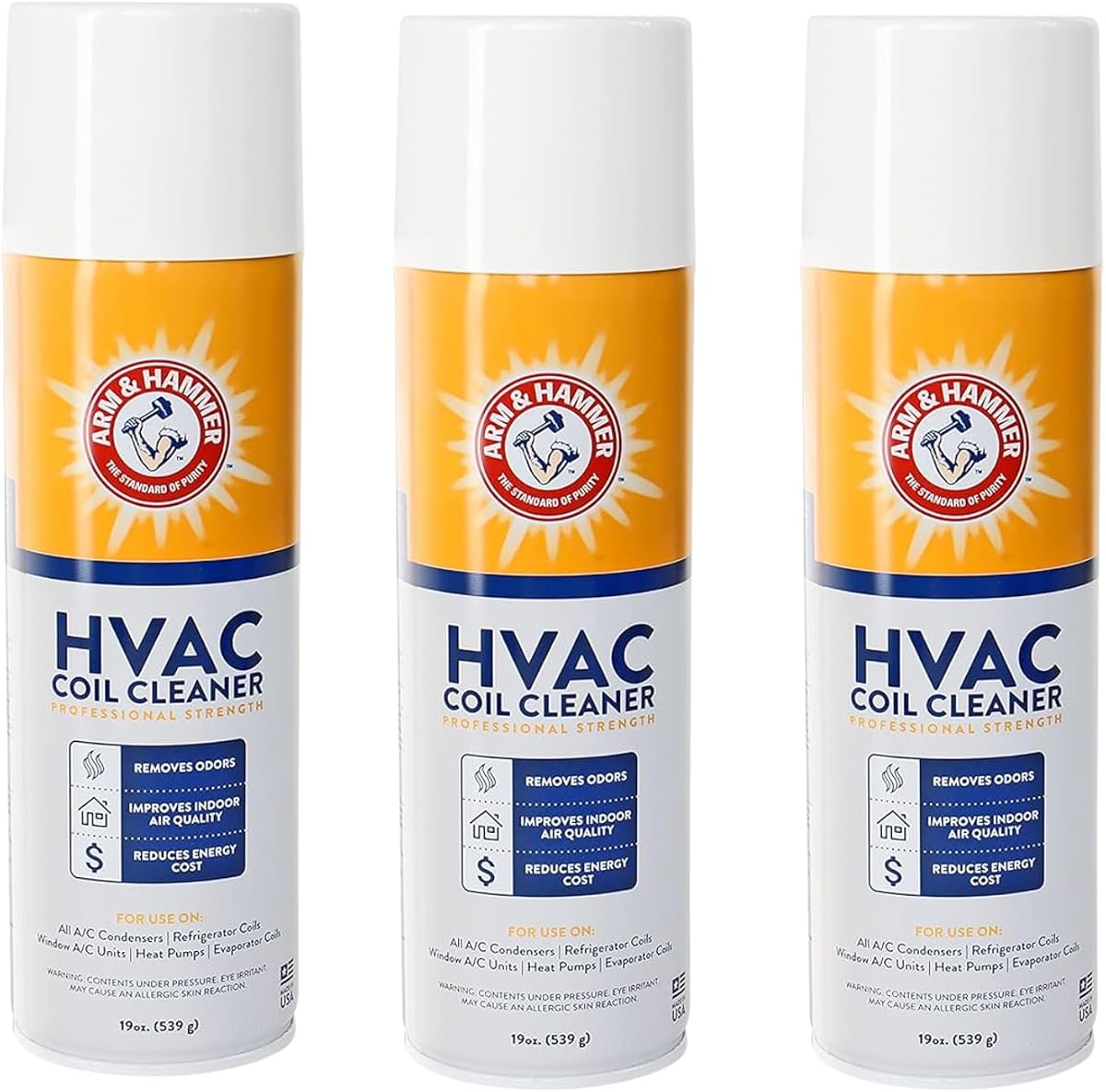
The Arm & Hammer AC Coil Cleaner three-pack holds a 4.6 rating and combines heavy-duty foaming with a strong emphasis on odor control. Its self-expanding formula is intended to remove dirt and buildup from coils while leaving a fresh-smelling environment after maintenance.
We may earn a commission when you buy through this link, at no additional cost to you.
The product is positioned as environmentally friendly, claiming to meet or surpass an industry standard for green products. Because the supplied listing does not identify the specific standard or certification behind that statement, shoppers should review the can and manufacturer information before relying on the claim for a particular environmental or indoor-air objective.
Like several leading options in the guide, it separates evaporator and condenser instructions. Evaporators are described as no-rinse, with condensate from an operating unit carrying away dirt, debris, and product. Condensers require a light rinse with water. This makes the same multipack useful for both sides of a typical cooling system.
A three-can package provides a ready supply for repeated seasonal cleaning, while the familiar aerosol format is easy to store and use. The product is a strong contender for homeowners who prioritize a fresh smell along with residue removal. Its less certain point is the broad environmental claim, which should be evaluated against the specific label language rather than the marketing shorthand alone.
The cleaner targets contaminants while emphasizing a fresh post-cleaning atmosphere. That makes it appealing where standing moisture and accumulated residue have contributed to musty odors in the indoor unit.
Three cans provide useful supply for multiple units or seasonal upkeep. Consumers should evaluate the product's specific environmental claim and confirm compatibility with their equipment before purchasing.
We may earn a commission when you buy through this link, at no additional cost to you.
The right coil cleaner depends on the equipment being serviced, the type and location of buildup, the need for odor control, and the user's preferred level of application control. These factors help separate convenient household aerosols from professional-style mixing systems.
Choose a product whose label clearly covers your equipment type, and verify any special requirements for mini splits, window units, refrigeration systems, or other applications.
Prioritize products that describe both how the foam reaches the coil and how the broken-down residue is removed afterward.
Match the finishing instructions to the installation, and never assume that a no-rinse label eliminates the need to prevent moisture from reaching electrical parts, finishes, or building materials.
Choose a product that explicitly targets drain-pan odors if odor is your priority, rather than relying only on fragrance language.
Match container size and delivery method to the scope of the job rather than choosing a larger format that will be awkward to store or difficult to use.
Always follow the manufacturer's application and safety directions, ventilate the work area, and keep cleaning chemicals away from incompatible surfaces.
Choose the level of sophistication that matches the maintenance schedule and the user's experience, rather than paying for equipment features that will not be used.
Check the full application list and confirm each surface separately, especially when coils share an area with electrical equipment, painted parts, filters, or seals.
Before cleaning, identify which coil you are servicing and read the complete product label. Turn off the HVAC system, use appropriate protective equipment, and ensure the work area is ventilated. Move or cover nearby furnishings and electronic components, clear access to the coil, and position runoff so water and cleaner cannot reach electrical parts or enter an unwanted area.
Apply the cleaner according to its stated method. For an aerosol, hold the can at the distance and angle specified by the manufacturer, spraying sections evenly rather than soaking one location. For a hose-fed sprayer, select the appropriate dilution, verify the hose connection, and test the mixture on a small area. Allow the product to dwell for the stated period and keep the system de-energized during that interval.
Finish according to the coil type and label. An evaporator may be described as no-rinse, but any remaining runoff still needs to be managed carefully. A condenser may require a light rinse, and some cleaners can be wiped away instead. Restore the equipment only after surfaces are dry and components are in their normal operating position, then schedule the next cleaning based on visible buildup and the manufacturer's service guidance.
Only if the product label specifically states that it is suitable for both coil types. Many cleaners offer no-rinse or light-rinse directions for an evaporator but require a water rinse on a condenser. Always follow the separate instructions for each side, because outdoor condensers and indoor evaporator coils can have different drainage and runoff conditions.
A no-rinse label means the product is designed to be removed by a specified mechanism rather than washed with a separate stream of water. On an operating evaporator, that may be condensate from the unit. You still need to protect surrounding surfaces, manage residual runoff, and never allow cleaner or moisture to contact electrical components.
Coil cleaning can improve airflow and heat transfer when restricted fins are the actual cause of reduced performance. It will not correct every cooling problem, such as low refrigerant charge, compressor issues, dirty filters, or airflow restrictions elsewhere in the duct system. Persistent performance changes should be evaluated by a qualified HVAC professional.
A broad foam spreads quickly across a surface, while a focused spray is designed to reach a smaller area with more pressure before the foam expands. Focused delivery may be useful for narrow coil fins and recessed equipment, but it requires careful aiming. Broad foam may be easier for covering large, open surfaces evenly.
Coil cleaners are primarily intended to remove dirt, grease, dust, residue, and related buildup. Some formulations may improve conditions around microbial growth, but spraying a coil is not a substitute for a complete mold-remediation plan. If growth is extensive, moisture is unresolved, or contamination has reached ducts and indoor surfaces, professional assessment is appropriate.
The appropriate interval depends on equipment type, filter condition, local dust and pollen, pet exposure, humidity, and visible buildup. Many household systems benefit from regular visual inspections and periodic cleaning, while commercial equipment may have a documented maintenance schedule. Clean more often when fins are visibly dirty, airflow is restricted, or odors develop.
No. A high customer rating is useful, but fit matters more. Consider label approval, rinse instructions, application method, surface compatibility, odor needs, and the size of the job. A compact no-rinse aerosol may be ideal for one indoor unit, while a dilution-controlled sprayer may be more suitable for repeated large-system maintenance.
Read the label, ventilate the area, avoid inhaling spray or fumes, and wear the protective equipment recommended by the manufacturer. Do not spray near energized components, direct runoff toward people or plants, or combine the cleaner with other chemicals unless the instructions expressly permit it. Store the container upright and away from heat when the label requires it.
The Simple Green three-pack is the strongest overall choice for broad HVAC component coverage, professional-strength cleaning language, and multipack convenience. Frost King ACF19 stands out as the budget pick for a compact, no-rinse aerosol that also addresses fan blades, reusable filters, and drain-pan odors.
When penetration and application control matter most, Leak Saver Foam Blaster offers a focused spray and delayed foam action, while the HVAC Guys Coil Cannon is the premium option for adjustable dilution, larger coverage, and repeated maintenance. The right choice ultimately depends on whether you need a simple seasonal aerosol or a hose-fed system for regular professional work.
Before purchasing, verify the current label, compatibility, rinse directions, and any registration relevant to your environment. Product details, availability, and pricing can change, so check the live listing and current user feedback before ordering. A coil cleaner works best as part of a broader maintenance routine that also addresses filters, airflow, drainage, and professional service when needed.
