
Aluminum Horizontal Vertical Dual Camera Mount
5.0Editor score
Horizontal and vertical pairing
Cnc-machined aluminum body
Two and three-prong compatibility
Microphone and light expansion
A dual action camera twin mount lets creators capture two perspectives at once, pair cameras with a light or microphone, and reposition action cameras without replacing an entire rig. The best options balance secure attachment, dependable adjustment, broad compatibility, and enough strength for travel, cycling, motorsports, vlogging, and other active pursuits.
We compared all ten products by examining their mounting styles, supported camera arrangements, construction, included hardware, portability, and stated compatibility. The list covers dedicated aluminum adapters, plastic twin mounts, kits with an extendable selfie stick, and a clamp-based alternative for people whose cameras need broader physical placement options.
Each review explains where the product stands out, where its design is less convenient, and which creators it suits best. The top recommendations balance versatility, value, and adjustability, while the remaining entries show important alternatives. Product details and availability can change, so confirm the current listing and camera fit before buying.
5.0Editor score
4.4Editor score

4.5Editor score
As an Amazon Associate we earn from qualifying purchases.
The table below compares all ten options by their mounting approach, construction, camera compatibility, and most useful secondary feature. It highlights the balance between dedicated dual-camera adapters, complete shooting kits, and the more adaptable clamp included in the lineup.


The HSU Aluminum Dual Twin Mount stands out as the most adaptable option in this guide, earning a 4.4 rating from customers. It combines a two-camera platform with a removable adapter that rotates through 90 degrees, allowing the cameras to cover front, back, left, and right positions. Its aluminum body also provides a more substantial feel than lightweight plastic solutions.
We may earn a commission when you buy through this link, at no additional cost to you.
The most important feature is the removable dual-camera section. Once removed, the remaining piece functions as a cold shoe mount, while the standard 1/4-20 hole underneath provides a conventional attachment point for tripods and other accessories. That layered design lets the mount move from a shared camera arrangement to a more conventional accessory configuration without requiring a completely different support.
The trade-off is that a removable component introduces another piece that must be kept organized and checked before use. The mount also uses small angle screws, so the included wrench matters during installation. These are reasonable compromises for the unusually broad range of configurations, particularly for creators who want front-and-rear coverage, camera comparisons, or a camera-and-light pairing.
This is the strongest all-around recommendation for users who value flexibility more than a one-purpose adapter. It suits GoPro and DJI Osmo Action users, vloggers, cyclists, and travelers who want one mount to handle several shooting arrangements. For a single-purpose dual-camera bracket, it may be more than necessary, but for a flexible modular mount it offers excellent utility.
The removable adapter can be turned to 90 degrees, allowing the two camera positions to be reorganized for forward, backward, left, right, side-by-side, or opposing views. This makes it practical for simultaneous perspective capture rather than merely duplicating a front-facing angle.
A standard 1/4-20 hole and the separate cold shoe feature broaden the support options. The mount can work with tripods and conventional accessories while preserving a practical route to camera-and-light or camera-and-microphone pairings.
We may earn a commission when you buy through this link, at no additional cost to you.
This Aluminum Dual Twin Mount Adapter earns a 4.3 rating and focuses on broad camera compatibility with a rigid, high-strength aluminum body. It supports two action cameras at once, including GoPro and DJI Osmo Action models, and the square connector can be adjusted to shoot from the front, back, left, or right.
We may earn a commission when you buy through this link, at no additional cost to you.
Its strongest argument is compatibility without sacrificing the basic purpose of a twin mount. The stated camera list covers GoPro Hero 13 through Hero 8 Black, DJI Osmo Action 6, 5 Pro, 4, and 3, plus Campark, AKASO, and SJCAM cameras. The mount can also combine one camera with a fill light or other accessory when a low-light recording setup is needed.
The adapter does not provide the same removable cold shoe versatility as the first-ranked HSU model, and its compatibility depends on the camera's mounting pattern. Mounting two sizable cameras also increases weight and can shift the center of gravity, particularly when the assembly is attached to a helmet, bicycle, or selfie stick. Users should distribute the load carefully.
This is a strong choice for households or teams using cameras from several supported brands. It is especially attractive to users who need reliable front, rear, and lateral coverage but do not require a cold shoe. The aluminum construction and adjustable connector make it a dependable general-purpose twin adapter for active shooting.
The listed support spans GoPro, DJI Osmo Action, Campark, AKASO, and SJCAM models. This makes the adapter useful for creators who own more than one action camera ecosystem or maintain equipment for different members of a filming group.
Adjusting the square connector changes the shooting direction without requiring an entirely different bracket. The ability to use front, back, left, and right positions is useful for cycling, motorsports, travel, and over-the-shoulder vlogging.
We may earn a commission when you buy through this link, at no additional cost to you.
This Aluminum Dual Twin Mount Adapter has a 3.9 rating and emphasizes durable, lightweight construction for travel, vlogging, and FPV-style setups. Its CNC-machined aluminum body is designed to resist wear, corrosion, and impact while adding less bulk than a large metal bracket.
We may earn a commission when you buy through this link, at no additional cost to you.
The twin layout provides two connection points that can hold two cameras or combine a camera with a light. Standard thumbscrews make installation straightforward without a separate tool. The adapter also integrates with common action camera support systems, including helmet straps, chest harnesses, handlebar clamps, tripods, and suction cups.
Its 3.9 rating is lower than those of the leading aluminum options, so buyers should pay close attention to fit and build quality. The supplied description also contains a few typographical errors and truncated compatibility language, which makes the current product page worth reviewing carefully. It is less specialized than the HSU mount because it does not add a cold shoe or removable rotating section.
This adapter is a good fit for users who want a compact aluminum bracket that can be carried between activities without feeling bulky. It works particularly well for travel vlogs, handlebar-mounted footage, and compact action-camera assemblies. Those prioritizing a cold shoe, broader physical support, or a more specialized articulation system should compare the other options first.
The product is designed to add minimal bulk while retaining aluminum durability. That balance makes it relevant to travel creators and FPV users for whom weight distribution and packing space are important considerations.
Standard thumbscrews and compatibility with common mounting systems simplify installation. A creator can move the adapter among a helmet setup, chest harness, handlebar clamp, tripod, or suction cup without changing the underlying support.
We may earn a commission when you buy through this link, at no additional cost to you.
The HSU Aluminum Dual Twin Mount is a 4.4-rated, highly flexible adapter for creators who need more than a fixed twin bracket. Its removable rotating adapter can be repositioned to 90 degrees, and its integrated cold shoe gives users another way to organize cameras, lights, and other supported accessories.
We may earn a commission when you buy through this link, at no additional cost to you.
Two cameras can be mounted at the same level, but the hardware also supports mixed pairings. A camera can sit alongside a fill light or microphone, useful for travel, interviews, night activities, and compact vlogging rigs. The aluminum construction is described as rustproof, rugged, and durable, while the supplied angle screws and wrench allow controlled adjustment.
The larger number of removable parts means more opportunities for a screw to be omitted or installed at the wrong angle. Exact alignment also matters more than with a fixed mount, particularly when two cameras need to point in different directions. Users should tighten the screws firmly but avoid forcing the rotating section against its intended stops.
This is an excellent option for technically minded creators who want the mount to evolve with different recording needs. It works particularly well for mixed action-camera collections, front-and-rear recordings, and accessory-heavy configurations. It is less suitable for someone wanting the simplest possible two-camera holder.
Taking off the dual-camera adapter exposes a cold shoe and opens several ways to combine supported equipment. The rotating section also makes it easier to establish rear-facing coverage without buying a second bracket.
The rigid aluminum body is well suited to motorcycle, bicycle, and other active uses where a plastic bracket may feel less secure. The result is a stable platform without making the entire support excessively heavy.
We may earn a commission when you buy through this link, at no additional cost to you.
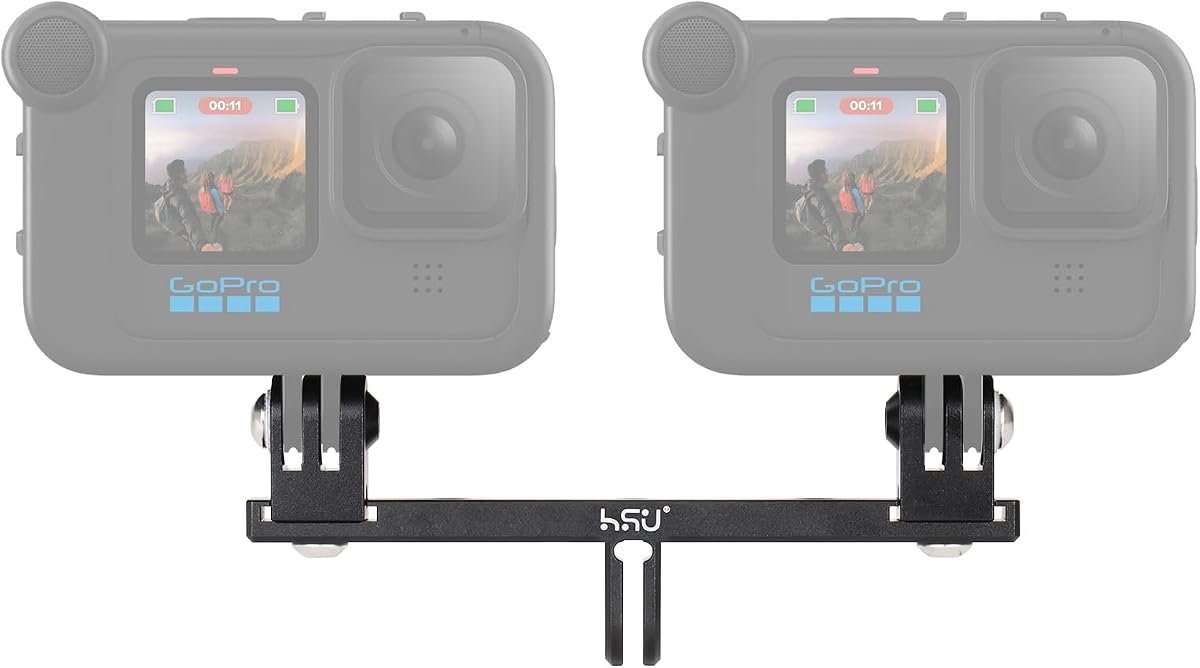
The Aluminum Horizontal Vertical Dual Camera Mount has a 5.0 rating and provides a distinctive arrangement for simultaneous landscape and portrait recording. Instead of placing both cameras in the same orientation, it supports one horizontally and one vertically, allowing a creator to preserve a main point of view and a side view in formats suited to different platforms.
We may earn a commission when you buy through this link, at no additional cost to you.
Its premium construction uses precision-machined aluminum for rigidity and long-term durability. The bracket supports standard two-prong and three-prong interfaces and is stated to fit GoPro Hero 13 through Hero 9, DJI Action 6 through 3, and Insta360 Ace and Pro-series cameras. It can also work with selfie sticks, tripods, and handle grips.
The product cannot be used with an extra camera frame housing, which is a meaningful limitation for owners whose cameras are permanently installed in large frames. Cameras and other accessories are not included. Users must also confirm that their chosen support exposes the correct standard connection and can carry the combined load.
This is the most specialized premium option in the list. It is ideal for social creators who deliberately alternate between widescreen and vertical formats, particularly when filming vlogs, sports, or travel sequences. Those who need identical front-facing camera positions may prefer a standard twin adapter, but creators prioritizing mixed orientation will find the design compelling.
The horizontal-and-vertical layout supports content planning that would otherwise require separate assemblies. It is especially useful when a main camera needs a conventional view while a second camera captures a side angle for vertical viewing.
Support for two-prong and three-prong interfaces gives the bracket a useful compatibility range. Buyers should still inspect their camera's mounting area, especially if a protective frame or housing changes the available connection points.
We may earn a commission when you buy through this link, at no additional cost to you.
The Dual Mount Twin Adapter has a 5.0 rating and offers a lightweight approach to adding a second action camera or accessory. It can hold another action camera, dive light, or other device alongside a main camera, while the included two-in-one quarter-inch and cold shoe adapter expands the ways the assembly can connect to a tripod or other support.
We may earn a commission when you buy through this link, at no additional cost to you.
Compatibility is broad for a plastic adapter. The stated camera list covers numerous GoPro Hero models, including compact and Max variants, DJI Osmo Action models, and AKASO devices. Three thumb screws are included, so the basic installation does not require a separate tool.
Plastic does not offer the same rigidity, dent resistance, or premium feel as CNC-machined aluminum. A second camera can also occupy connection points that might otherwise be used by a light, microphone, or other accessory. The bracket is better suited to everyday recording than to demanding rigs where vibration and impacts are constant.
This adapter is best for travelers and everyday creators who value low weight, simple handling, and a useful collection of included hardware. It is also a practical choice for testing a second perspective before committing to a larger aluminum system. For high-vibration motorsports or heavy-duty production work, a metal alternative may be more reassuring.
The included two-in-one adapter combines a quarter-inch and cold shoe connection. This gives the twin mount a route into familiar tripod, handgrip, or accessory arrangements without requiring the entire bracket to be redesigned.
The bracket can pair a main action camera with another camera, dive light, or compatible accessory. That makes it practical for experiments, social content, and situations where a supplementary light or angle is more valuable than a second identically positioned camera.
We may earn a commission when you buy through this link, at no additional cost to you.
The SOONSUN Dual Twin Mount Adapter has a 3.3 rating but offers one of the most varied physical configurations in the guide. Its defining feature is the inclusion of both a 90-degree elbow adapter and a straight joint, allowing the twin mount to be rearranged for front, rear, side-by-side, horizontal, or vertical shooting.
We may earn a commission when you buy through this link, at no additional cost to you.
The elbow changes mounting direction, while the straight joint provides additional clearance for larger cameras. The dual mount can be attached to a tripod, selfie stick, handgrip, head strap, chest harness, or another standard action-camera support. The rigid plastic body is intended to remain lightweight while preserving a useful accessory ecosystem.
The product's 3.3 rating is the second-lowest result in the comparison, which deserves attention before purchase. The separate plastic components also create more opportunities for loss, misalignment, or uneven tightening. Its long compatibility list is useful, but buyers should confirm that their camera is not enclosed in a frame that prevents a direct connection.
This adapter is most appropriate for users who value the included elbow and straight joint more than they value metal construction. It can be especially useful in vlogging and travel setups where one camera points backward while another remains forward. Riders and high-impact users may prefer a more rigid aluminum option for peace of mind.
The two included joints solve different physical problems. The elbow changes direction, while the straight connector creates separation that can help accommodate larger camera bodies without forcing an awkward angle.
The adapter can connect to tripods, selfie sticks, handgrips, head straps, chest harnesses, and standard action-camera mounts. This makes the kit easy to redistribute between stationary, handheld, and body-mounted filming.
We may earn a commission when you buy through this link, at no additional cost to you.
The YD029 Dual Mount and Selfie Stick Kit combines an aluminum twin adapter with a compact extendable selfie stick, earning a 5.0 rating. The stick retracts from 6.7 inches to 18.9 inches and includes a soft rubber grip, twist-lock mechanism, and wrist strap, creating a more complete kit for travel and vlogging.
We may earn a commission when you buy through this link, at no additional cost to you.
The adapter supports simultaneous camera mounting for front-and-rear views, camera comparisons, or a camera paired with a light or microphone. Its listed compatibility includes GoPro Hero 13 through 9+, multiple Insta360 ranges, DJI Osmo Action, and other action cameras. The selfie stick also has a standard quarter-inch threaded hole at its base for tripod connection.
The included stick is specifically short, so it may not offer enough reach for every filming position. Users must also confirm that their camera and chosen support are physically compatible with the kit. While the aluminum adapter is rugged, the selfie stick adds weight and another attachment point to manage.
This is the most convenient option for a creator who wants both a dual-camera adapter and a compact handheld support in one package. It is well suited to travel, vlogging, and everyday social content, particularly when front-and-rear coverage is desired. Experienced users with dedicated support gear may prefer to purchase the adapter separately.
The bundle removes the need to assemble a separate short stick, twin adapter, and basic fastening hardware. It can be unpacked for a complete front-and-rear setup or used in a simpler configuration when only one camera is needed.
The stick folds to a pocket-friendly length and extends when a wider view is required. A soft grip and wrist strap add handling security, while the threaded base provides a route to tripod support for stationary filming.
We may earn a commission when you buy through this link, at no additional cost to you.
The momerch Aluminum Dual Twin Mount has a 2.8 rating, the lowest in this comparison, but it delivers a focused front-and-rear camera arrangement in an aluminum body. Two action cameras can be installed on the same horizontal plane, and the bracket can also be used to combine one camera with a fill light.
We may earn a commission when you buy through this link, at no additional cost to you.
The product emphasizes durable, stable aluminum construction and includes two CNC aluminum thumb screws. Its stated compatibility includes GoPro Hero 12, 11, 10, 9, 8, 7, 2018, 6, and 5 Black models, along with SJCAM and DJI Osmo Action cameras. The included metal fasteners align with the bracket's overall rigid approach.
The low 2.8 rating suggests that some buyers have been less satisfied with fit, finish, or performance. The compatibility description also provides less detail than several competing products and does not list every recent camera generation. Users with newer or less common cameras should confirm that the standard connection remains accessible.
This is a basic option for users who specifically want a metal front-and-rear bracket and do not need cold shoe, elbow, or vertical-rotation features. It can also support a camera and light in dark environments. Given the rating, buyers should inspect recent customer feedback and verify the mounting dimensions before committing.
Keeping both cameras on the same horizontal plane creates a predictable arrangement for rear-facing coverage or side-by-side comparison. Aluminum construction gives the bracket a more durable foundation for travel and active recording.
The included CNC aluminum thumb screws complement the body and provide a stronger fastening option than ordinary plastic screws. They are simple to install but should still be checked periodically during demanding shoots.
We may earn a commission when you buy through this link, at no additional cost to you.
The UTEBIT Double Super Crab Clamp takes a different approach to the twin mount category, earning a 5.0 rating. Rather than placing two cameras directly on a shared bracket, it provides two adjustable arms with ball heads and a built-in universal quarter-inch mount for attaching compatible cameras and equipment.
We may earn a commission when you buy through this link, at no additional cost to you.
Its double clamp can secure to light stands, reflectors, tripods, crossbars, motorcycle or bicycle handlebars, selfie sticks, umbrellas, tables, railings, and other suitable objects. The double ball-head design allows 360-degree horizontal rotation and 180-degree vertical folding, while non-slip rubber pads help protect the clamped surface.
This product does not reproduce the direct front-and-rear functionality of a conventional twin adapter, and it requires a solid object of the correct size and shape. The stated maximum load is approximately 5 pounds, or 2.3 kilograms, so total equipment weight and balance need careful attention. Clamping near a vibration-prone location can also affect image stability.
The clamp is an excellent alternative for creators who want cameras placed around a table, vehicle, railing, or other structure. Its two-arm layout can support separate cameras or equipment with far more spatial freedom than a compact bracket. For straightforward action-camera pairing, one of the dedicated twin adapters will be more direct.
The two independently adjustable arms can position cameras around an environment rather than on a single shared plate. This is valuable for interviews, tabletop demonstrations, vehicle-mounted recordings, and multi-angle live setups.
A removable three-part clamp and single-nut ball adjustment allow one person to attach or reposition the system quickly. The rubber pads improve grip and help prevent scratches on the selected support.
We may earn a commission when you buy through this link, at no additional cost to you.
The most useful twin mount is one that matches your cameras, support hardware, recording angles, and expected activity. Consider fit, adjustment range, material, load limits, and the type of secondary equipment you need before choosing a model.
Start by identifying the connection standard used by your cameras and the frames or housings around them. Many action cameras use the familiar two-prong arrangement, while some newer or third-party models rely on three-prong connections or their own proprietary adapters. A stated compatible model list is useful, but it does not guarantee that an external protective frame, waterproof housing, or bulky housing will still allow the camera to attach.
Also consider whether you use one brand or several. Broad listings that mention GoPro, DJI Osmo Action, AKASO, Campark, SJCAM, and Insta360 can simplify equipment planning, while dedicated designs may support the same general standard but provide a more specialized layout. If you use an extra frame, verify that the frame is not blocking the fingers or threaded socket.
Confirm that your chosen camera model and any housing can physically clear the second camera, accessory, and neighboring mount. Compatibility is ultimately a combination of the attachment standard, body dimensions, and available clearance. Review the current product images and listing details before ordering.
Decide whether the second camera needs to face the opposite direction, point sideways, sit in a vertical orientation, or simply duplicate the main view. A basic dual bracket usually keeps both cameras on the same horizontal plane and works well for front-and-rear coverage. A rotating or removable adapter offers more directional control, while a horizontal-and-vertical bracket serves creators producing both landscape and portrait content.
Consider how quickly the angle must change. Fixed mounts are simple and consistent, but may require replacing the entire bracket to alter the arrangement. Modular elbows, straight joints, and removable sections can save money and space when a user regularly changes between front, rear, and side views.
Choose based on your actual production pattern rather than the number of possible positions alone. A mount with a few well-designed configurations is often easier to use repeatedly than a complicated system that offers every theoretical combination.
Aluminum is generally the preferred material for mobile and high-vibration use because it offers rigidity, impact resistance, and a secure feel without the bulk of a large steel bracket. CNC-machined aluminum can provide especially consistent shapes and dependable threaded interfaces. Quality plastic remains suitable for everyday travel, vlogging, and lighter supports, but it may feel less secure in demanding motorcycle, bicycle, or extreme-sports environments.
Material alone does not determine stability. Screw tightness, camera weight, vibration frequency, support quality, and correct balancing all influence the final result. A rigid bracket attached to a flexible strap can still produce shaky footage, while a lightweight plastic bracket on a stable tripod may perform adequately.
Match the construction to the environment. Choose aluminum for frequent travel, frequent mounting changes, or high-vibration activities. Consider plastic when minimizing weight and cost matters more and the assembly will remain on a stable, moderate-duty support.
A dual mount can often carry one camera and one accessory rather than two cameras. A compact fill light can improve footage in dark environments, while a microphone may add useful audio to short-form content. Some brackets also provide a cold shoe, and one listed option combines a quarter-inch and cold shoe adapter for broader support compatibility.
Remember that using the second position for an accessory means it cannot simultaneously hold another camera. A modular solution is valuable when this choice changes from one shoot to the next. Check the size and weight of the light, microphone, or other device so it does not block the camera controls or pull the assembly out of balance.
Owners of a full accessory ecosystem should prioritize standardized 1/4-20 and cold shoe connections. Users with only two cameras can focus on a secure, aligned twin-camera layout and may not need a more elaborate modular bracket.
A good twin mount should connect to the way you already shoot. Common action-camera supports include tripods, selfie sticks, handgrips, helmet straps, chest harnesses, handlebar clamps, and suction cups. Some products include a 1/4-20 hole, cold shoe, or telescoping stick, while others rely entirely on the standard camera interface and an existing support.
A clamp-based option offers a different advantage: it can attach to tables, railings, light stands, crossbars, and vehicle or bicycle handlebars. This gives cameras more physical placement freedom but requires a suitable clamping surface and careful attention to load and balance. A compact bracket is more convenient for carrying in a bag.
Review the included hardware as well as the underlying standard. A threaded base can expand the mount into a stable tripod setup, while a long thumb screw may be easier to tighten with gloves. The right choice depends on whether portability, placement freedom, or speed of assembly is your priority.
Travel rigs benefit from compact, lightweight components, but an action camera is only one part of the system. Two cameras, mounting fingers, thumb screws, light bodies, and long extension hardware can quickly make a setup cumbersome. The stated materials and overall design offer a basic indication of weight, though the included accessories matter just as much.
Kits that include a short extendable selfie stick can be particularly convenient for travelers who do not already own one. The stick provides a ready-made handheld support and can retract for packing. However, it also adds a length and connection point that some specialized rigs do not need.
If you already have a complete support system, purchasing only the adapter may keep the kit lighter and more flexible. If you are starting from one action camera and one support, a bundled option can be more economical and convenient than sourcing each component separately.
Two cameras, adapters, lights, and cables can place substantial stress on a mount. More weight is not automatically a problem, but it can overwhelm a helmet strap, suction cup, lightweight selfie stick, or small clamp. Always check the support's own load rating rather than relying on the action camera mount alone.
Balance is equally important. Keeping the combined weight close to the support and distributing it evenly helps prevent twisting, sagging, and accidental release. A clamp with independently adjustable arms requires particular care because one poorly positioned camera can shift the entire assembly.
The UTEBIT clamp states a maximum load of approximately 5 pounds, or 2.3 kilograms. Other dual adapters do not provide stated load figures in the supplied information, so users should judge them by build quality, fastener security, camera weight, and the demands placed on the support. Test an assembled rig before a critical shoot.
Aluminum, CNC machining, threaded fasteners, and included hex keys are signs that a product is intended for repeated adjustment and demanding use. Tool-free thumb screws are faster for quick changes, while small angle screws and hex keys can offer more controlled positioning. Neither approach is universally better, and each has a different balance of speed, convenience, and security.
Check the package contents carefully. Depending on the model, the box may include one dual adapter, two or three thumb screws, a long thumb screw, an elbow joint, a straight joint, a hex wrench, or a complete selfie stick. Missing hardware can prevent a user from realizing the mount's intended configurations.
Inspect the threads and moving sections after assembly, and check them periodically during active shooting. Small fasteners can loosen under repeated vibration, while adapters rotated into new angles can shift if they were not fully tightened.
Begin by choosing the support that will carry the assembly. Install that support securely and test it with the intended camera configuration before moving to an active environment. Identify the fingers or threaded points on each camera, confirm that no housing blocks the connection, and attach the adapter or clamp to the support using the appropriate standard interface.
Arrange the cameras before tightening everything. For front-and-rear coverage, point the main camera toward the action and rotate the second toward the opposite direction. For mixed-orientation footage, mount one camera horizontally and the other vertically. Install the chosen elbow, straight joint, or rotating adapter, then tighten the relevant screws evenly so the cameras remain aligned without being forced out of position.
For care, wipe the mount with a soft dry cloth after outdoor use and check for grit around the screws and ball joints. Avoid flooding the threads with abrasive cleaner, and do not use a metal tool that could scratch the camera mounting fingers. Before every important recording, confirm that the cameras, adapter, and underlying support are secure, then recheck the assembly after sustained vibration or any impact.
A dual action camera twin mount holds two action cameras on one support so they can record simultaneously. Common arrangements include front-and-rear coverage, matching side-by-side views, comparison footage, and one camera paired with a fill light or microphone. Some models also rotate or separate to support vertical, side, and mixed-orientation recording.
Many listed models support both GoPro and DJI Osmo Action cameras because they use compatible standard mounting interfaces. Compatibility still depends on the exact model, adapter configuration, and any protective frame or housing around the camera. Check the current camera list and confirm that the mount can physically reach the camera's attachment points before purchasing.
Aluminum is generally preferable for high-vibration activities, frequent repositioning, and two-camera rigs because it feels more rigid and resists deformation. Plastic can still work well for travel, vlogging, and lighter-duty use while keeping weight and bulk down. The best choice depends on your support, camera weight, and how often the mount is handled.
Yes. Several products can pair one action camera with a compatible fill light, microphone, or other accessory. This can be useful for low-light footage or audio-focused content. Make sure the accessory fits the available connection, does not obstruct the camera, and does not make the assembly too heavy or unbalanced for the support.
A twin mount places two cameras directly on a shared bracket, generally keeping their positions close together and aligned. A double clamp uses two adjustable arms to place cameras around a larger space, often on a table, railing, light stand, or handlebar. A clamp offers more placement freedom, while a twin mount is usually more compact and directly suited to two-camera recording.
A cold shoe is useful when you want to connect microphones, lights, or other compatible accessories and may want more freedom in arranging the rig. It is not essential for mounting two cameras. If your main goal is simply front-and-rear action-camera footage, a secure standard twin adapter may be sufficient.
Secure the underlying support first, tighten every camera and adapter connection, and distribute the weight evenly. Avoid over-tightening small screws, and check that cameras are not pulling the mount out of alignment. For clamps, choose a firm surface, keep the load within the stated limit, and position the arms to minimize leverage.
Most action-camera twin mounts connect to standard support systems through the usual camera-mounting interface. Some models add a 1/4-20 hole, cold shoe, or telescoping selfie stick for more direct tripod and handheld use. Verify the included hardware and the connection on the support before assembling the rig.
The HSU Aluminum Dual Twin Mount is the most adaptable overall option because its removable rotating adapter, cold shoe, and 1/4-20 connection support several camera and accessory arrangements. The Aluminum Horizontal Vertical Dual Camera Mount stands out for mixed landscape and portrait capture, while the standard HSU Aluminum Dual Twin Mount offers an efficient, durable way to record opposing views or pair a camera with a light.
Prioritize the configuration you will actually use. Choose a fixed or simple twin bracket for reliable front-and-rear footage, a modular adapter for changing angles and accessories, and a horizontal-and-vertical model for mixed-format content. A clamp or bundled selfie stick makes more sense when placement freedom and a complete support system matter more than compactness.
Before ordering, verify the current camera compatibility, mounting clearance, included screws, and load of the complete support. Product details and availability can change, so check the latest listing and recent customer feedback to confirm that the chosen dual action camera twin mount still fits your intended setup.