Coast PX20 Dual Color
4.5Editor score
Dual white and red output
Focused spot with halo
Simple utility fixed beam
This Aviation Flashlight guide compares 10 options for red-light night vision, beam control, durability, power options, and cockpit suitability.
An aviation flashlight should provide controlled illumination without disrupting a pilot’s night-adapted vision. Red output, adjustable brightness, focused beams, compact construction, and dependable power are more important than raw brightness alone. The best models also support chart reading, checklists, cockpit navigation, and outdoor operations in changing conditions.
We compared ten flashlights using their stated output, color modes, beam adjustment, power systems, dimensions, water resistance, and intended aviation uses. The list includes dedicated red lights, dual-color lights, rechargeable models, a headset-mounted cockpit light, and versatile general-purpose flashlights suitable for aviation-related tasks.
Each review explains the product’s strongest features, practical limitations, and ideal user profile to help you match the flashlight to your routine. Specifications and availability can change over time, so confirm the current listing details and compare current prices before making your final purchase.
4.5Editor score

4.6Editor score

4.6Editor score
This side-by-side comparison highlights red and white output, beam control, power configuration, portability, and the aviation tasks best suited to each flashlight.


The Upgraded Red Flashlight offers a balanced combination of red-light utility, white-light versatility, memory, and adjustable beam control. Its three modes consist of white light, bright red light, and low red light, allowing users to move from ordinary illumination to dark-adapted chart and checklist reading. The 4.6 rating reflects a well-rounded feature set for pilots, astronomers, and outdoor observers.
We may earn a commission when you buy through this link, at no additional cost to you.
Its strongest aviation feature is the mode-memory function. Once a preferred lighting mode is selected, the flashlight restores it after use, reducing the need to cycle through settings when checking a chart or consulting a checklist. A half-press control also provides quick access to alternate modes. The zoom function changes both intensity and coverage, allowing a broad beam for a kneeboard or a narrower beam for a specific instrument.
The principal trade-off is reliance on three AAA batteries, which are not included. That means you should carry spare cells or a separate charging solution for extended trips. White light remains useful for general tasks, but pilots should reserve it for situations where preserving night adaptation is not important. The stated water resistance adds useful outdoor protection without suggesting that the light is intended for underwater use.
This is the most balanced choice for someone seeking one compact tool across flying, astronomy, hiking, and general night work. Its mode memory, low red setting, and adjustable beam make it particularly useful for recurring cockpit tasks. Choose it if you value flexible operation and a compact design more than the convenience of a built-in rechargeable battery.
Bright and low red modes let you select a level appropriate for reading a chart without automatically exposing yourself to a harsh white beam. Mode memory makes that adjustment more practical during repeated cockpit checks.
The zoomable lens changes the beam from a wider area of illumination to a focused spot. That versatility is useful when moving between a kneeboard, chart, checklist, and a specific instrument.
We may earn a commission when you buy through this link, at no additional cost to you.
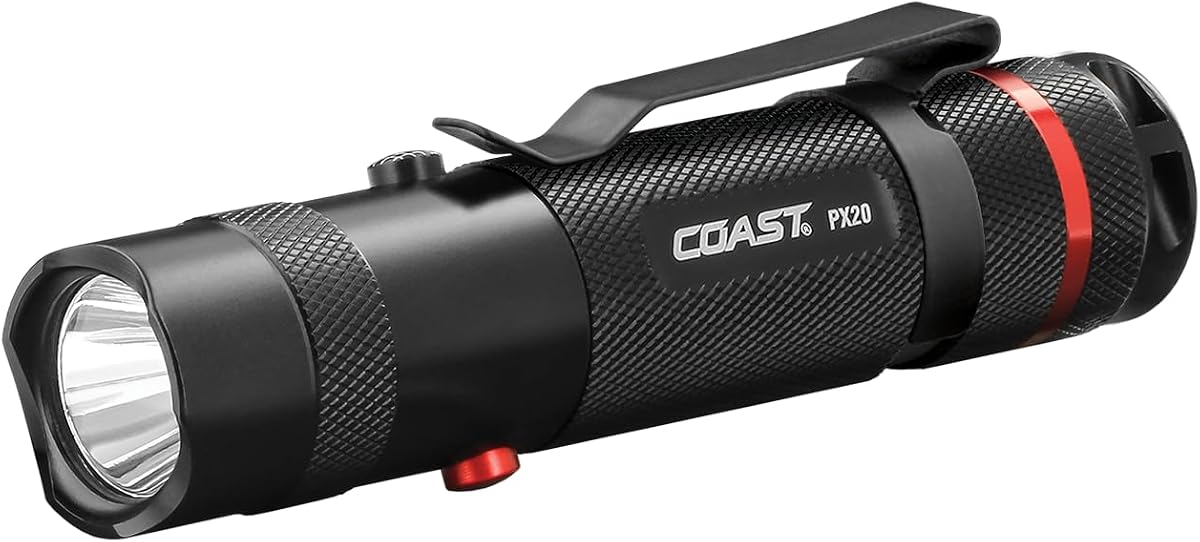
The Coast PX20 Dual Color is a straightforward aviation flashlight for users who want reliable red and white illumination without a complicated control system. It produces white and red beams from one body and has a 4.5 rating. The combination makes it practical for pilots, flight crews, and anyone who alternates between normal lighting and dark-adapted work.
We may earn a commission when you buy through this link, at no additional cost to you.
The Bulls-Eye Spot Beam Optic creates a bright, centered hot spot with a consistent halo. That design provides a clearly defined center for reading while retaining peripheral visibility. The stated 315-lumen maximum is adequate for outdoor work, although pilots should use red output when preserving night adaptation matters.
Unlike several adjustable models in this guide, the PX20 uses a fixed utility beam. There is no zoom or stepless dimming, so users rely on the color choices to adapt the illumination. Its simplicity can be an advantage for anyone who prefers direct operation and does not need to fine-tune beam shape or brightness.
The Coast PX20 is a compelling option for budget-conscious buyers seeking a recognized dual-color format. It is especially useful for ground crews, student pilots, and frequent travelers who want a simple light for charts, equipment checks, and ordinary nighttime tasks. It is less suitable for users who require fine brightness control or a built-in USB charging system.
White and red outputs are built into the flashlight, so there is no need to carry a separate red filter. This makes the PX20 convenient for pilots who alternate between cockpit and outdoor tasks.
The centered hot spot helps users direct attention to a chart or instrument. The surrounding halo adds context, making it less disruptive than a narrow, tightly confined beam.
We may earn a commission when you buy through this link, at no additional cost to you.
The Rechargeable Red Flashlight combines three lighting modes, a mode-memory system, and USB-C charging in a compact aviation-oriented design. Its 4.6 rating and balanced feature set make it especially appealing to travelers who prefer not to carry loose batteries. White, bright red, and low red modes cover routine work, dark-adapted viewing, and brighter observation.
We may earn a commission when you buy through this link, at no additional cost to you.
Its control scheme is unusually clearly defined. Clicking within five seconds cycles through white, bright red, low red, and off. Clicking after five seconds turns the light off and preserves the current mode, which the next power-on restores. A low-profile status LED in the tailcap provides an additional night-vision-friendly indication without requiring the main beam.
The built-in high-capacity battery is rated for approximately two hours of continuous runtime depending on the selected mode. That figure makes the light best suited to intermittent checks rather than all-night illumination. USB-C fast charging is convenient, but pilots should establish a charging routine before departure because the light cannot be revived with disposable cells if the battery empties.
Choose this model if rechargeability and operation consistency matter most. It is well suited to reading maps, charts, and checklists as well as supporting aviation-related outdoor work. The mode memory and low red setting make it more versatile than a basic single-output red light, while the lack of a numeric runtime for every mode leaves users needing to manage power carefully.
The integrated battery and USB-C port simplify packing for flights and overnight operations. A full charge before departure avoids the inconvenience of finding compatible spare cells while away from home.
The timing-based control scheme distinguishes mode cycling from turning the light off. Once a mode is saved, it returns automatically, which is convenient for users who rely on a consistent red setting.
We may earn a commission when you buy through this link, at no additional cost to you.
The RECHOO Red Light Flashlight is designed around pure red output with high, low, and strobe modes. Its 4.4 rating reflects a versatile red-light package for aviation, astronomy, wildlife observation, boating, and other nighttime activities. Unlike dual-color models, it focuses entirely on red illumination and adjustable beam coverage.
We may earn a commission when you buy through this link, at no additional cost to you.
High and low modes cover different viewing distances, while strobe adds a conspicuous signaling pattern. Sliding the flashlight head changes the beam from a wide area to a longer-distance spot. Its built-in battery can provide up to six hours of steady output on low, and the red and green charging indicators make the power state easier to identify.
The body is described as military-grade aluminum with impact and corrosion resistance. Its stated IPX4 rating supports use in rain and fog, although it should not be submerged. At 4.76 inches and 0.24 pounds, it is portable enough for a jacket pocket, flight bag, or belt. A pocket clip and lanyard are included for convenient carry options.
This is a good match for a pilot who strongly prefers red light and wants a strobe option for visibility signaling. It also suits astronomers, campers, and wildlife observers. The main limitation is the absence of white light, so it works best as a dedicated night-vision tool rather than a complete replacement for an everyday household flashlight.
Dedicated red output reduces the need to switch away from a color that can disrupt night adaptation. High and low settings let users match brightness to the task and viewing distance.
The stated six-hour runtime on low is useful for extended observation periods. Keeping the light on a lower setting can also reduce the need for repeated full-intensity use during charts or maps.
We may earn a commission when you buy through this link, at no additional cost to you.
The FlightPro Pilot Flashlight is the most cockpit-specific option in the guide. It combines a red light, SOS strobe, adjustable beam, and a headset mount that clips to several popular aviation headsets. Its 3.5 rating is lower than the other products’ ratings, so buyers should pay particular attention to compatibility and expected features.
We may earn a commission when you buy through this link, at no additional cost to you.
The headset mount is the defining feature. It is stated to fit Bose A20 and A30, Lightspeed Zulu, David Clark H10-13.4, Rugged Air RA200, and Lightspeed Sierra headsets. Once mounted, the light follows the wearer’s line of sight, reducing the need to hold a light while working with charts, checklists, or controls.
A twist of the lens moves the beam between a broad flood and a focused spot. Steady red supports ordinary reading, while the SOS strobe provides an emergency signaling option. The compact all-aluminum body, waterproof construction, and single AA battery make the unit simple to transport, with no charging cable required.
The FlightPro Pilot Flashlight is best for a pilot who prioritizes hands-free use and already owns one of the listed compatible headsets. Its lower rating and narrower feature set make it less versatile outside the cockpit. Check the headset model before ordering, and verify whether the mounting arrangement suits your preferred headset position.
The headset-mounted design keeps the beam aligned with the wearer’s attention. This is useful during chart checks because the user does not have to alternate between holding a flashlight and manipulating papers or cockpit controls.
Steady red supports low-disruption chart and checklist reading, while the SOS strobe provides a distinct visual signal. The two-output design serves both routine and emergency functions in one compact unit.
We may earn a commission when you buy through this link, at no additional cost to you.
The Stepless Dimming Red Flashlight offers a level of brightness control that is difficult to find in simpler red lights. It produces 620-630nm red output and can be dimmed continuously from full power to five percent. Its 4.6 rating reflects a focused design for astronomers, aviators, and night observers who need precise illumination levels.
We may earn a commission when you buy through this link, at no additional cost to you.
Rotating the tail button changes brightness smoothly, and pressing that button switches the light on or off. This arrangement lets a user find a comfortable level rather than selecting among fixed presets. A very dim setting is especially useful for preserving sensitivity to dim light, making it practical for close reading of charts, checklists, and documents.
The beam is adjustable as well, allowing the user to alter focus for different working distances. The red-only design supports dark adaptation, although the absence of white light makes it less useful for general searching, repairs, or other tasks that do not require night-vision protection.
The flashlight uses three AAA batteries, which are not included, so spare cells should be added to a flight bag or aviation kit. It is an excellent choice for users who dislike abrupt brightness transitions. Choose it when smooth adjustment and a specified red wavelength matter more than rechargeability or multi-color output.
The five-percent minimum lets the user reduce the beam substantially for close reading. That fine control is valuable when full red output would still feel unnecessarily bright.
The stated 620-630nm wavelength keeps the product focused on red illumination. It is a strong option for users whose priority is reading aviation documents without white-light glare.
We may earn a commission when you buy through this link, at no additional cost to you.
The Coast XP11R is the brightest and most general-purpose option in this comparison, with a stated 2600-lumen standard output and 3000-lumen Turbo Mode. It has a 4.6 rating and is built for users who need strong illumination for ramp inspections, equipment checks, outdoor navigation, and emergency preparedness.
We may earn a commission when you buy through this link, at no additional cost to you.
Slide Focus transitions between an Ultra View Flood Beam and a Bulls-Eye Spot Beam, with reach stated at up to 280 meters. Four standard modes plus Turbo provide flexibility across close-range work and long-distance visibility. The real-time power indicator helps prevent an unexpected shutdown, and the dual-power system accepts the included rechargeable battery or compatible alkaline batteries.
Its major limitation for cockpit use is that no red mode is specified. White light is highly disruptive to dark adaptation, so pilots would need to avoid the main beam during nighttime cockpit tasks. It is better viewed as a high-output field, ramp, and emergency flashlight than as a dedicated night-vision aviation light.
Choose the XP11R when maximum output, long beam reach, and flexible power options are more important than red illumination. It is a valuable addition to a general aviation safety kit for outdoor and ground-support duties. For night cockpit use, however, pair it with a separate red light or reserve it for situations where preserving vision adaptation is not necessary.
The high lumen output and long-reaching focused beam support tasks beyond the cockpit. It is well suited to nighttime ramp checks, campsite navigation, roadside response, and equipment searches.
The dual-power design reduces the risk of being stranded with one incompatible power source. Users can recharge before travel or carry compatible alkaline batteries when extended independence is more important.
We may earn a commission when you buy through this link, at no additional cost to you.
The SureFire Aviator is a premium, dual-output flashlight built for demanding users who value robust construction and controlled light. It combines 250-lumen high and 5-lumen low white output with 39-lumen high and 1-lumen low red output. Its 4.6 rating makes it one of the strongest all-around choices for aviation and field use.
We may earn a commission when you buy through this link, at no additional cost to you.
The regulated output and separate high and low levels give pilots useful choices. White high is suited to ordinary illumination, while white low supports longer use at a softer level. Red high provides stronger visibility, and red low is suitable for preserving dark adaptation while reading documents or checking equipment.
Construction is based on mil-spec hard-anodized aerospace aluminum, an optically coated tempered window, and O-ring and gasket seals. The tail-cap switch supports momentary high, constant high, and low operation, allowing a user to choose between a brief flash and sustained illumination.
The Aviator is ideal for pilots, flight instructors, and aviation professionals who want a premium tool capable of both general and night-vision work. Its higher-end construction may be unnecessary for casual use, and the product data does not specify rechargeable power. Still, the combination of rugged materials, regulated output, and four brightness-color combinations supports long-term ownership.
Independent high and low levels for both white and red provide more choices than a simple color switch. This allows the user to match brightness and color to chart reading, equipment checks, or outdoor illumination.
Hard-anodized aerospace aluminum, a coated tempered window, and sealed joints support durability in demanding environments. These construction details suit frequent aviation and field users.
We may earn a commission when you buy through this link, at no additional cost to you.
The Energizer Vision PRO is a high-output general-purpose flashlight designed for emergencies, camping, outdoor work, and aviation support tasks. It has a 4.4 rating and a stated output of 1300 lumens on high and 250 lumens on low. The included six AA batteries make it ready to use as part of an emergency kit.
We may earn a commission when you buy through this link, at no additional cost to you.
Digital focus gives the user control over beam shape, while the high and low modes cover bright search illumination and softer general use. The stated IPX4 water resistance and impact resistance up to one meter support use in rain and demanding conditions. Aircraft-grade aluminum is used for the body, providing a durable feel despite the larger battery configuration.
The key limitation is the absence of a stated red mode. This means it should not replace a dedicated red aviation flashlight for nighttime cockpit checks. It is better suited to emergency preparation, hangar work, outdoor operations, and power outages where preserving a pilot’s night vision is not the immediate objective.
Choose the Energizer for high output and immediate readiness rather than specialized cockpit use. The included batteries remove the need to purchase cells separately, although carrying six AA batteries can take more space than a compact AAA model. For pilots, it works well as a secondary emergency light alongside a smaller red flashlight.
The included six MAX AA batteries make the light convenient to place in a flight bag, hangar kit, or household emergency box. Users can verify the batteries periodically and replace the set when needed.
The 1300-lumen high setting supports rapid searching, while the 250-lumen low setting is easier on the eyes for routine tasks. Digital focus adds control over how the light is distributed.
We may earn a commission when you buy through this link, at no additional cost to you.
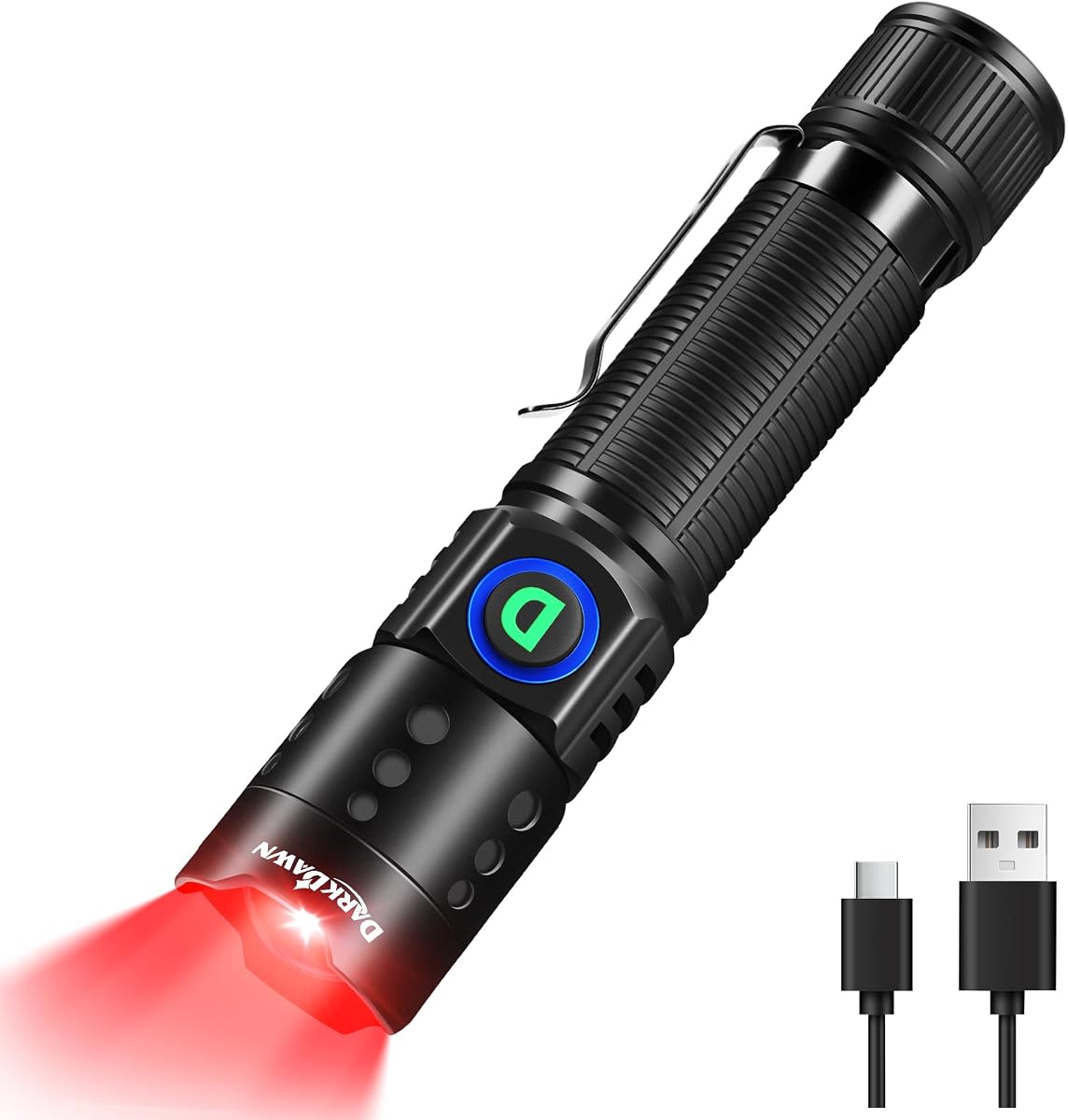
The DARKDAWN Red Light Flashlight is a compact, rechargeable red light intended for aviation, astronomy, wildlife observation, night walks, photography, and other low-light activities. It has a 4.4 rating and distinguishes itself through a telescopic lens that adjusts beam reach using one-handed operation.
We may earn a commission when you buy through this link, at no additional cost to you.
Pulling the lens out creates a narrower, longer-reaching beam, while pushing it in provides broader flood illumination. That range makes the light useful for scanning the distance, illuminating a wider campsite, or reading a nearby chart. The product data cites three to six hours of continuous operation depending on use, and a full charge takes approximately four hours through a USB-C connection.
A red charging indicator provides a low-glare reminder to recharge, changing to green when charging is complete. The aluminum alloy body includes a stated three-foot drop and impact protection plus IPX4 water resistance. These features make it practical for travel, outdoor observation, and emergency-car use, provided it is not exposed to standing water.
This is a good choice for users who want a dedicated red light in a small package and do not need white illumination. It works well for chart reading, astronomy, aviation-related field tasks, and low-light observation. For cockpit work requiring bright white or focused dual-color output, one of the more specialized models in the guide will serve better.
The small, lightweight design is easy to keep in a palm, pocket, or clipped to a bag. It is a practical way to carry dedicated red illumination without the bulk of a multi-battery general-purpose flashlight.
USB-C charging works with a laptop, power bank, or compatible adapter. The red-to-green indicator gives a simple visual cue of charging progress, helping reduce the chance of an unnoticed depleted battery.
We may earn a commission when you buy through this link, at no additional cost to you.
The right aviation flashlight depends on whether you need cockpit illumination, outdoor search capability, emergency signaling, or a compact red light. Color output, beam control, power, mounting, and resistance to the environment deserve careful attention.
Red light is the defining feature of most night-vision-friendly aviation flashlights because it is less disruptive to dark adaptation than white light. A dual-color model gives you red for charts, checklists, and cockpit checks alongside white for general searching and equipment inspections. A red-only model can be quieter to operate and prevents accidental white-light exposure, while a high-output white flashlight is best reserved for tasks where visual adaptation does not matter.
Useful illumination is not always the same as maximum brightness. Low red output is valuable when reading charts in a dark cockpit, while stronger output helps locate distant objects or illuminate an outdoor work area. Preset high and low modes are simple and dependable, while stepless dimming provides finer control. The ability to dim the beam without changing to a brighter white setting can improve comfort and reduce spill onto nearby people or equipment.
A flashlight beam may be fixed, adjustable by sliding or twisting the lens, or controlled electronically. A wide flood is useful for a kneeboard, map, or close work area, while a focused spot reaches farther and highlights a specific instrument or object. Aviation users benefit from a model that can move between both patterns, particularly when switching between cockpit paperwork and outdoor ramp or campsite tasks.
Disposable batteries offer familiarity and the ability to carry spares, while rechargeable models reduce loose battery management and often include USB-C charging. Check whether batteries are included, because several compact products require three AAA cells that the buyer must provide. Runtime claims can vary substantially by mode, so the highest figure may apply only to the dimmest setting. Frequent travelers should balance convenience against access to spare power.
A compact body is important for pilots, who may carry a flashlight in a flight bag, pocket, or chart case. A pocket clip and lanyard can improve access and reduce accidental loss. A headset-mounted light is another category, designed to keep the beam aligned with the user’s gaze while leaving both hands free. Before choosing a mount, confirm the exact headset model and compare the mounting position with your glasses, headset, and seat setup.
Aviation equipment is exposed to baggage handling, vibration, rain, temperature changes, and occasional impact. An aluminum body adds durability, while a stated water-resistance rating gives useful guidance for wet conditions. IPX4 generally indicates resistance to splashing water rather than submersion. A product described as waterproof may still have manufacturer-specific limitations, so review the instructions and avoid treating any light as suitable for underwater use unless that use is explicitly permitted.
A steady beam is enough for routine chart reading, but a strobe can make a light more conspicuous in an emergency. Some models use a dedicated SOS pattern, while others offer a general strobe mode. A red beacon can help indicate your presence, but a signaling light should never be treated as a substitute for approved aircraft emergency equipment. Use it alongside appropriate safety gear and established emergency procedures.
A simple interface matters when a light is used in a dark cockpit or with gloved hands. Large controls, straightforward color changes, and mode memory reduce repeated adjustments. A model that restores the last red setting can be more practical than one that always starts in white. Timed mode controls may be convenient, but users should read the instructions before departure so they understand how to cycle, save, and turn off the light.
Before a flight or nighttime outing, install the correct batteries, test every mode, and confirm that a red setting is readily accessible. Charge a rechargeable model fully and carry spare cells for a disposable-battery model. Learn the switch sequence, including how mode memory or timed clicks work, and check that a pocket clip, lanyard, or headset mount remains secure.
Use red light for charts, checklists, instruments, and other close work performed in darkness. Avoid white light until you have moved to an area where preserving night adaptation is no longer important. Widen the beam for a kneeboard or map, narrow it for a specific instrument, and use the lowest comfortable red brightness for extended reading.
Store the flashlight dry, remove batteries if it will sit unused for a long period, and inspect the contacts and seals for dirt or damage. Clean the lens with a soft cloth, avoid harsh chemicals, and recharge a USB-C model periodically. Do not submerge a water-resistant light, and replace batteries as a complete set when their output declines.
Red light is less likely to interfere with dark adaptation than white light. That makes it easier to continue seeing dim details after checking a chart, checklist, or instrument. A pilot can therefore use a red beam for repeated cockpit tasks while reserving white illumination for conditions where night adaptation does not matter.
A dual-color design is more versatile than a red-only model. Red handles cockpit and night-observation tasks, while white is useful for searching, outdoor work, and ordinary illumination. Choose a dedicated red light if avoiding accidental white output is more important than access to general-purpose lighting.
The best setting is the lowest red level that still provides a clear view of the print. Stepless dimming gives you the most precise control, although preset low modes can also work well. Start at minimum brightness and increase only as needed to preserve comfortable dark adaptation.
They can be highly practical because USB-C charging works with many common cables and power banks. The main tradeoff is dependence on the internal battery, which cannot be replaced with disposable cells. Charge before departure and carry a backup light if uninterrupted operation is mission-critical.
IPX4 indicates protection against water splashing from multiple directions. It does not mean the flashlight can be submerged. Aviation lights with this rating are generally suitable for rain, mist, and damp operating conditions, provided the battery compartment and seals are properly closed.
A headset-mounted light can be better when you need both hands free and want the beam to follow your gaze. It also removes the risk of dropping or setting down a handheld light. Compatibility with your exact headset is essential, however, and a handheld model may be more flexible for tasks outside the cockpit.
A dual-color flashlight with adjustable focus and a compact body is the most adaptable choice. Use red light for cockpit work and white light for outdoor searching or equipment checks. If maximum output matters more than red-light capability, a high-lumen flashlight can serve ground duties but is less suitable for preserving night vision.
That depends on the model and how you plan to use it. Included batteries are helpful for immediate use and emergency storage, while models that use common AAA cells are often easier to keep powered. Always check the listing because some compact aviation flashlights do not include the batteries shown in product photographs.
The Upgraded Red Flashlight is the strongest overall choice because it combines white, bright red, and low red modes with memory and an adjustable beam. The Coast PX20 Dual Color delivers a simpler and more economical route to dual-color illumination, while the SureFire Aviator stands out as the premium option with rugged construction and controlled high and low outputs.
Your priorities should guide the final choice. Choose a headset-mounted light for hands-free cockpit work, stepless dimming for precise chart reading, and a dedicated red-only model for compact night observation. For ground operations and emergencies, a brighter white-light flashlight with rechargeable power may be more useful than a red-focused alternative.
Before ordering, verify battery inclusion, charging requirements, headset compatibility, beam controls, and the stated water-resistance rating. Features and availability can change, and current prices vary, so check the latest product listing and compare the final cost with the priorities identified in this guide.