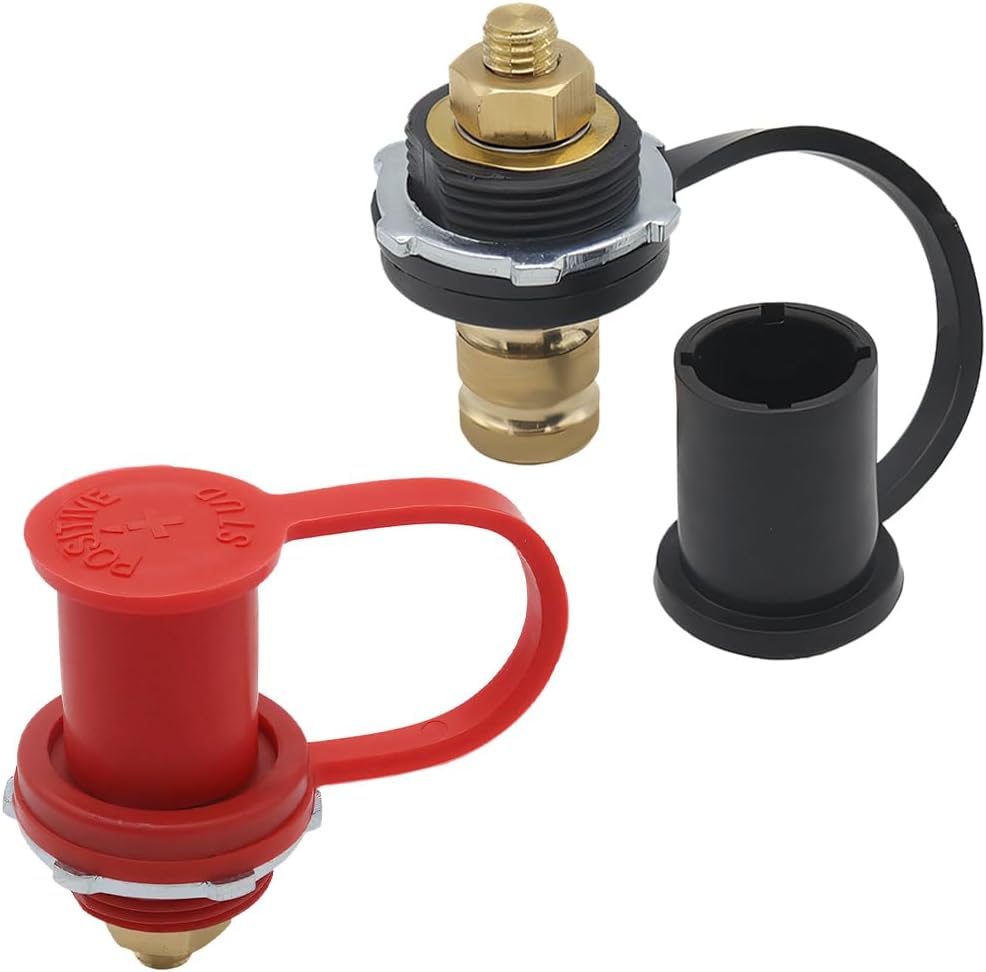
Car Remote Battery Terminal 2PCS
4.8Editor score
250A current rating
12V operating rating
Brass terminal construction
Remote battery terminals make a vehicle’s starting battery easier to reach for charging, jump-starting, maintenance, or relocation. A useful set balances a secure stud connection, dependable current handling, protected contacts, straightforward mounting, and enough cable or hardware for the intended installation.
This guide compares ten products using the specifications and feature information supplied for each listing. It covers complete relocation kits, panel-mount posts, compact stud connectors, copper terminal sets, and options designed for UTVs, trucks, boats, RVs, solar equipment, and other electrical systems.
The list shows where each option stands out, from bundled brackets and covered terminals to compact two-piece designs and higher-capacity claims. Ratings and availability can change over time, and current prices should be checked on the linked product pages before making a purchase.
4.8Editor score

4.7Editor score

4.7Editor score
As an Amazon Associate we earn from qualifying purchases.
The comparison below organizes every listed option by its most practical attributes, including connector size, current rating, mounting approach, included components, and stated applications. Products with incomplete listing information are included for completeness, but the available specifications should be verified before purchase.


This Joinfworld kit is the most complete remote-terminal package in the supplied list, combining two battery posts, a heavy duty steel mounting bracket, 4-gauge wiring, mounting hardware, insulated protector boots, and black heat-shrink tubing. Its 4.7 rating reflects a generally favorable buyer response, while the component list makes it especially appealing for a relocation or accessible-jump-post installation.
We may earn a commission when you buy through this link, at no additional cost to you.
The main advantage is integration. Instead of buying a terminal, bracket, cable set, and protective pieces separately, the installer receives a package designed around a 3/8-inch stud and 250A-rated battery-charging post. The approximately 53-inch cables add meaningful routing flexibility, although the listing states they can accept a maximum of 150A, so the lower cable limit should guide real-world load expectations.
There are trade-offs. A complete kit can be unnecessary for a simple panel connection, and the heavy duty bracket may require more installation space than a compact standalone post. The separate 250A post rating and 150A wire capacity also mean the complete assembly should not be treated as a uniformly 250A system. Confirming the intended current, panel thickness, and cable route before ordering is important.
This is a strong recommendation for UTV, ATV, RV, truck, boat, and Can-Am users who want a complete relocation-oriented setup. It is also appealing to DIY installers because most of the necessary pieces are already in the box. The kit makes the most sense when the extra cable length and robust mounting hardware solve a real access or routing problem in the vehicle.
The bracket, cable set, hardware, boots, and heat-shrink tubing reduce the need for separate accessory shopping. That completeness is especially helpful when the battery is being relocated or the original jump points are difficult to reach.
The red and black protector boots help distinguish the positive and negative sides while shielding exposed contacts from dust and accidental contact. The covers are a sensible finishing touch in a vehicle compartment where exposed metal is undesirable.
We may earn a commission when you buy through this link, at no additional cost to you.
This two-piece remote battery terminal set has a 4.8 rating, the highest numerical rating among the products with complete data. It uses brass terminal components, 3/8-inch brass studs and nuts, nylon exterior parts, and flame-retardant PVC insulating caps. The stated 250A current and 12V operating ratings make it a strong fit for ordinary 12-volt vehicle charging and jump-start connections.
We may earn a commission when you buy through this link, at no additional cost to you.
Its strongest feature is flexibility. Two posts are included, allowing one to serve as a daily connection while the other remains available as a replacement or backup. The terminals can also be used separately for charging posts, jumper connections, or cable bulkhead applications. An opening of 1-1/4 inches and a panel limit of 0.3 inches make the installation relatively approachable once the dimensions are confirmed.
The design is more compact than the complete Joinfworld relocation kits, but that compactness comes with trade-offs. It does not include long battery cables, so installers need suitable conductors and appropriate wire ends. The stated panel-thickness limit also means the posts are not universal solutions for thick walls or unusual firewall structures. Proper sealing, fusing, and strain relief remain essential in a working electrical installation.
This set is best for buyers who already have suitable wiring or need a straightforward panel-mounted charging post. It also works well for RV, ATV, truck, sedan, and other 12-volt applications. With two posts, protective caps, and a high stated current rating, it offers an appealing balance of useful capacity and installation simplicity.
Including two terminals creates a useful spare and lets the installer use matched posts for separate connection points. That is particularly handy for a system where a damaged, worn, or contaminated connector could otherwise interrupt access.
The stated dimensions of 2.68 by 3.39 by 1.73 inches keep the posts manageable in tight spaces. A 1-1/4-inch mounting opening and a 0.3-inch panel limit should be checked against the intended firewall, bulkhead, or enclosure before drilling.
We may earn a commission when you buy through this link, at no additional cost to you.
This Joinfworld remote-terminal set is a more focused alternative to the brand’s bundled relocation kits. It has a 4.7 rating and consists of brass posts with 3/8-inch studs, a stated 250A and 12V rating, and a protective cover. The product is designed to put a convenient battery-charging or jump-start connection in an accessible location.
We may earn a commission when you buy through this link, at no additional cost to you.
The cover is a particularly important feature. It shelters the exposed contact from dust and water while reducing the chance of accidental contact when the post is not being used. The 3/8-inch stud design also permits larger wire sizes than a smaller post, supporting the listing’s emphasis on high-current use. Automotive, truck, marine, boat, ATV, and Can-Am applications are all listed.
Unlike the complete bracket kits, this set does not provide a heavy duty bracket or a set of long 4-gauge cables. That makes it potentially more flexible for a custom installation, but it also places more responsibility on the installer to source and correctly terminate conductors. Panel-mounting through a 1-1/4-inch opening in material up to 0.3 inches thick is the stated configuration.
This set is a good fit for someone who needs robust posts and protective covers but already has a mounting plan and suitable wiring. It is less convenient for a first-time builder seeking an all-in-one relocation package. The clear 250A, 12V specification and protected stud design make it a compelling choice for marine and high-output vehicle projects.
The cover helps keep dust and water away from the conductive stud when the terminal is not connected. It also reduces the risk of touching the exposed contact during normal vehicle use.
The stated 250A rating and roomy 3/8-inch stud support applications involving battery charging and jump starting. Actual performance still depends on the attached cables, fuse, contact quality, and overall electrical system.
We may earn a commission when you buy through this link, at no additional cost to you.
The Jiozermi set consists of two stud connectors, one red and one black, and carries a 4.8 rating. Each connector measures 1.69 inches, or 43 millimeters, with a 1/4-inch screw diameter and a 0.39-inch, or 10-millimeter, threaded hole. That compact geometry is useful when panel space is limited and a full remote-terminal kit would be excessive.
We may earn a commission when you buy through this link, at no additional cost to you.
Pure copper is the defining material choice. The listing describes the terminal blocks as rust- and corrosion-resistant, with bakelite insulating materials providing separation between the conductive and insulated portions. Color identification also simplifies correct polarity during installation, which is particularly valuable in crowded engine compartments or equipment cabinets.
The important limitation is that no numerical current rating is supplied. Although the set is described for charging generators, trucks, welding machines, ships, vehicles, and solar cells, those broad uses do not establish a safe load limit. The 1/4-inch stud is also smaller than the 3/8-inch posts offered by several Joinfworld products, so the installer should confirm cable size and mechanical strength.
This pair is best for compact custom connections, generator distribution, or a small project where two color-coded copper stud terminals solve the need without adding a bracket and extensive wiring kit. It suits experienced DIY users who can assess the current requirements and build the surrounding cable system correctly.
The compact 1.69-inch length and 1/4-inch stud make this pair practical where a larger post would be inconvenient. The dimensions also simplify fitting into a small enclosure or custom bulkhead.
One red and one black connector reduce the chance of reversing the battery connection. This straightforward visual cue is useful during installation and later troubleshooting.
We may earn a commission when you buy through this link, at no additional cost to you.
This Joinfworld relocation kit is built around extending a battery connection to a more accessible point. It includes a mounting bracket, a pair of approximately 53-inch 4-gauge wires, and red and black protective covers. Its 4.5 rating is solid, though lower than the scores recorded for several smaller or more specialized alternatives in the list.
We may earn a commission when you buy through this link, at no additional cost to you.
The relocation format is the defining benefit. Extending the battery terminals makes charging and jump starting easier, particularly in Can-Am Maverick X3, car, UTV, ATV, and boat installations where the original battery may be surrounded by other components. The heavy duty bracket is intended to make the post easier and quicker to mount, while the long cables provide routing freedom.
The supplied wire specification deserves attention. The listing states that the cables can accept a maximum of 150A, which is lower than the 250A ratings associated with some of the individual posts in the wider category. That difference is not necessarily a problem for ordinary jump-starting or charging tasks, but it should guide the intended use and the size of any connected equipment.
This kit is a sensible choice for a complete relocation project, particularly when the goal is to move the service point away from a crowded battery compartment. It is less suitable for buyers who only need a small panel connector and do not want to accommodate a bracket, longer cables, and a more involved routing job.
A relocated post brings the charging and jump-start connection closer to the operator. That convenience can reduce the time and effort required for routine battery service or an emergency start.
The roughly 53-inch cable length provides room to move the remote point around obstacles. It is especially useful where the battery and accessible panel are separated by a substantial distance.
We may earn a commission when you buy through this link, at no additional cost to you.
The GUMRA battery jump post kit is tailored to UTV and ATV use, including Can-Am X3 and Polaris RZR configurations with two or four seats. Its 4.6 rating indicates favorable feedback, and the package includes two pure copper terminals, two 1.2-meter connecting cables, terminal insulating rubber caps, a black PVC insulating bracket, and four mounting screws.
We may earn a commission when you buy through this link, at no additional cost to you.
The standout feature is the stated IP67 waterproof cable standard. In an off-road machine, cables are exposed to mud, rain, wash water, vibration, and repeated flexing, so protected conductors are valuable. The 7 AWG cable and stated voltage capability up to 450V add technical substance, while the red-and-black arrangement makes polarity easier to identify and reduces the chance of crossed leads.
The product also addresses installation space. The bracket was improved to take up less room, and an insulating cap under the bracket helps prevent exposed metal fittings. One potential point of confusion is that the listing emphasizes a 450V figure without prominently providing a conventional amperage rating. Buyers should not interpret the voltage figure as proof that the kit is suitable for any high-current load.
This kit is an excellent match for off-road owners who want a protected, accessible jump point for a UTV. The included screws, bracket, terminals, and cables create a more convenient starting point than assembling those elements separately. It is less suitable for someone who needs a clearly stated high-current rating for a demanding electrical system.
The IP67 cable specification adds confidence for installations exposed to weather and mud. It is a meaningful advantage in recreational vehicles where the jump posts are often mounted where they can be reached without opening the bodywork.
The compact bracket and color-coded leads are designed for straightforward installation in a Can-Am or Polaris setup. A remote connection can save time during recovery work or routine battery maintenance.
We may earn a commission when you buy through this link, at no additional cost to you.
The MARSTEK package contains eight 1/4-inch remote battery junction posts, divided into four red and four black pieces. Its 4.5 rating reflects a generally favorable response, and the assortment is aimed at projects needing multiple distribution points rather than a single basic jump-post pair.
We may earn a commission when you buy through this link, at no additional cost to you.
The screws are made from brass, with the listing emphasizing conductivity and wear resistance. The insulation is described as flame retardant and resistant to high temperatures and corrosion. A detachable design allows connectors to be removed, tightened, and reassembled, which is useful when wiring must pass through a panel or be serviced later.
The set is especially relevant to welding machines, voltage stabilizers, charging generators, ships, RVs, trucks, automobiles, and solar-cell systems. That flexibility comes from having multiple matched posts, although the broad application list should not substitute for an individual current rating. No numerical amperage figure is supplied, and the relatively compact 1/4-inch studs may not be ideal for every high-current starter connection.
This kit is best for builders assembling a multi-panel distribution system or who want spare posts available for future expansion. It is less practical for a simple two-terminal vehicle jump installation, where the extra pieces may remain unused. Users should pair it with correctly sized cables, strain relief, and suitable overcurrent protection.
Eight posts allow several connections to be organized in a larger electrical layout. Four color-matched pairs can simplify distribution across separate equipment functions or provide backup capacity.
The removable construction supports installation, tightening, and future servicing. This is useful in enclosed panels where replacing a complete fixed post would be inconvenient.
We may earn a commission when you buy through this link, at no additional cost to you.
The Amper M10 remote battery terminals provide a straightforward way to connect two or more wires and relocate a battery jumper post. They have a 4.6 rating, brass construction, and stated ratings of 250A and 12V. The product is designed to mount in a panel or battery box and can accept wiring routed from inside or outside the enclosure.
We may earn a commission when you buy through this link, at no additional cost to you.
Two sets of nut systems support extension, tightening, and assembly. That flexibility is helpful for installers who need to accommodate different wire arrangements rather than work with a fixed terminal design. The M10 stud size is also distinctive within this list, offering a larger thread than the 1/4-inch alternatives while remaining smaller than some common 3/8-inch vehicle-post configurations.
The key caution is that the listing recommends professional installation. A remote post becomes part of the vehicle’s high-current starting circuit, and incorrect cable sizing, loose hardware, poor grounding, or missing fusing can create safety and reliability problems. This is not a reason to avoid the product, but it does mean that installation competence matters.
This set is a good fit for car, RV, boat, battery-box, and solar applications where a simple brass jumper post is needed. It suits an installer who already has the cable, enclosure, fuse, and mounting plan prepared. For a DIY buyer with no electrical experience, a complete covered kit may provide a more guided path.
The stated 250A current rating and 12V operating rating make the post’s intended class easy to identify. Those figures should still be treated as product specifications rather than a guarantee of full-system performance.
The terminals can be installed in a panel or battery box, with wires connected from either side. This makes them adaptable to custom relocation and distribution layouts.
We may earn a commission when you buy through this link, at no additional cost to you.
This listing is included in the roundup because it appears within the supplied set of remote battery terminal products, but its title, rating, image, and description are unavailable. As a result, there is no factual basis here for comparing its stud size, current rating, mounting method, material, or included components.
We may earn a commission when you buy through this link, at no additional cost to you.
That lack of information is itself an important buying consideration. A remote battery terminal may look similar from a distance while differing significantly in contact area, thread size, insulation, corrosion resistance, and suitability for a starting circuit. Without verified specifications, a shopper cannot safely assume that it is equivalent to the documented 250A or 150A options elsewhere in the guide.
The appropriate approach is to open the linked Amazon page and review the current manufacturer information, customer feedback, dimensions, included parts, and mounting instructions before adding it to a project. Pay particular attention to the conductor size it accepts and whether the listing includes covers, nuts, cables, or a bracket.
This listing may ultimately prove useful, but the present information supports only a cautious recommendation. It should not be selected over a fully documented option until the missing details are confirmed. For a straightforward purchase, a product with explicit material, current, voltage, and panel-mounting information is the safer starting point.
Check the live listing for the stud diameter, maximum current, mounting-hole size, panel limit, and included hardware. These details determine whether the product can safely fit the intended installation.
Confirm that the terminal is intended for the vehicle, charger, generator, or other system involved. A broad product title alone does not establish that it can handle starter current or the required cable size.
We may earn a commission when you buy through this link, at no additional cost to you.
This final product also has no title, rating, image, or descriptive information in the supplied dataset. Although it belongs to the remote battery terminal category, there is no verified evidence about its dimensions, electrical rating, mounting requirements, or the accessories included with it.
We may earn a commission when you buy through this link, at no additional cost to you.
Choosing a battery terminal without those details would be risky because the visible stud size does not tell the whole story. Material, contact construction, insulation, hardware quality, and stated load capacity all affect how safely the connection performs under cranking current, charging current, or repeated use.
A buyer should review the product page for the complete specification sheet and installation instructions. It is also helpful to examine recent customer feedback for comments about fit, contact quality, included pieces, and resistance to corrosion. If those details remain unclear, contact the seller before installing the terminal in a vehicle or other high-current system.
This product cannot be ranked confidently against the eight documented options based on the available information. It is best treated as a listing requiring further research rather than an automatic recommendation. Buyers who want a lower-risk decision can choose a model whose materials, ratings, dimensions, and mounting provisions are clearly stated.
The product page should be checked for a current rating, voltage rating, stud dimensions, hole size, material, and package contents. Without these details, compatibility cannot be established responsibly.
Consider the battery, charger, vehicle, and cable sizes together. The connector must support the intended load and accept conductors that are appropriate for the installation.
We may earn a commission when you buy through this link, at no additional cost to you.
The right remote battery terminal depends on electrical capacity, conductor size, mounting conditions, exposure, and the degree of installation support provided. The following factors help separate purpose-built vehicle jump posts from compact stud connectors and complete relocation kits.
Choose documented capacity that exceeds the expected load with comfortable margin, and have the wiring and protection designed by a qualified person when the circuit is critical.
Confirm both the thread size and the maximum cable-lug width before drilling a panel or ordering connectors.
Measure thickness, hole diameter, clearance, and access space before ordering; the smallest listed component is not always compatible with every bulkhead.
Choose a bundled kit for a straightforward installation or an individual terminal when you need a custom, compact, or multi-point arrangement.
Favor a well-insulated, easy-open cover for exposed locations, then add appropriate environmental sealing where moisture and corrosion are concerns.
Measure the actual cable route before choosing a kit, and keep the entire cable assembly within its stated current capability.
Use vehicle-specific compatibility as supporting information, but treat dimensions, electrical ratings, and installation requirements as the deciding factors.
Consider the installation environment, use corrosion-resistant hardware, and periodically inspect the connection for looseness, discoloration, or contamination.
Begin with the battery disconnected according to the vehicle or equipment service procedure. Identify the correct positive and negative sides, confirm the remote post’s hole size and panel limit, and mount it in a location that is reachable but protected from moving parts, sharp edges, excessive heat, and standing water. Fit the appropriate fuse or circuit protection before reconnecting the battery, and ensure all fasteners are tightened evenly without damaging the terminal or insulation.
When charging or jump starting, open the protective cover, attach the proper cable lug to the 3/8-inch, 1/4-inch, or M10 stud as applicable, and confirm polarity before energizing the circuit. Do not exceed the current rating of the post, cables, fuse, or overall electrical system. After use, disconnect the equipment, remove any loose cable, and close the cover so the contact is not exposed to dirt or accidental contact.
Periodic maintenance should include checking the nut and cable lug for looseness, inspecting the stud and insulating surfaces for corrosion, and looking for damaged insulation or heat discoloration. Clean only with materials suitable for the terminal and battery area, and keep moisture and metal debris away from the connection. If the terminal becomes hot, discolored, difficult to tighten, or visibly worn, remove it from service and have the wiring and connection inspected.
Remote battery terminals extend a battery connection to a more accessible panel or location. This makes charging, jump starting, maintenance, and connection checks easier when the battery itself is crowded or difficult to reach. They are commonly used in cars, trucks, RVs, UTVs, boats, generators, and battery boxes.
Yes, provided the terminal, cable, fuse, and fasteners are appropriate for the vehicle and load. Use the correct cable gauge and a compatible battery lug, observe polarity, and follow the vehicle manufacturer’s battery-service procedure. A qualified technician is advisable when modifying a starting or high-current circuit.
No. The complete system is limited by its lowest-rated component, which may be the cable, fuse, lug, connector, or installation quality. Some listings in this guide also state a lower maximum for the included wires. Check every part of the circuit and leave suitable margin for the intended load.
A cover is useful because it helps protect the conductive stud from dust, water, and accidental contact. It is particularly helpful in exposed engine compartments, marine installations, and battery boxes. Ensure the cover opens easily and does not prevent the cable lug from seating fully.
Choose a stud and cable lug that match each other physically and electrically. The list includes 1/4-inch, M10, and 3/8-inch options, and the cable must have a ring or fork terminal rated for the conductor and intended current. Do not force an undersized lug onto a larger stud.
They can be, as long as the terminal is suitable for the system voltage, current, mounting surface, and environment. Several listed products explicitly mention UTVs, ATVs, Can-Am, Polaris, boats, and marine use. Water exposure, vibration, corrosion, and access to a suitable panel all deserve careful attention.
Start with a clean connection and compatible metal hardware, then protect the area from moisture and salt with an appropriate corrosion treatment after assembly. Periodically inspect the stud, nut, lug, and cable for discoloration, looseness, or white corrosion deposits. Do not allow excess cable strands or conductive debris to remain around the joint.
It depends on the product and the installation. Complete relocation kits often include a heavy duty bracket, while standalone posts may be intended to mount directly through a panel or inside a battery box. Follow the included instructions and confirm that any bracket is positioned away from moving parts, heat sources, and pinch points.
The Joinfworld bracket kit is the strongest all-around choice when a complete relocation setup is wanted, with a steel bracket, long 4-gauge cables, protected boots, and mounting hardware included. The two-piece Car Remote Terminal set stands out for its 4.8 rating, 250A and 12V specifications, compact design, and useful backup post, while the covered Joinfworld posts offer protected brass construction for custom installations.
Prioritize the complete electrical system rather than the post alone. Confirm stud size, current and voltage ratings, cable capacity, mounting-hole dimensions, panel thickness, insulation, corrosion protection, and the amount of installation hardware included. Larger vehicle projects may benefit from long, heavy-gauge leads, while compact equipment may be better served by 1/4-inch or M10 studs and a multi-post arrangement.
Finally, review the live Amazon listing before ordering because ratings, package contents, availability, and prices can change. For the two products with incomplete supplied information, verify every technical detail directly on the product page. This final check helps ensure that the selected remote battery terminal fits both the installation and the electrical load it will actually serve.