
4K+4K+1080P 3-Channel Dash Cam
4.8Editor score
True three-channel 4K recording
Dual-band WiFi 6 connectivity
Integrated cabin IR lighting
Built-in GPS tracking
Included 128GB memory card
A dash cam for a tractor trailer must do more than record the road ahead. Large commercial vehicles have long blind zones, multiple exterior mounting points, demanding power systems, and a greater need for dependable night coverage. The right system balances front, rear, side, and cabin visibility with rugged cabling, clear evidence, and practical installation.
This guide compares ten multi-camera and commercial-oriented dash cam systems using their stated specifications, including recording resolution, viewing angles, low-light performance, wireless connectivity, GPS, storage support, parking surveillance, and compatible vehicle power. The list covers systems designed for passenger vehicles as well as options expressly marketed for trucks, semis, RVs, and trailers.
Each review identifies the configuration that matters most for a tractor trailer, along with honest installation and equipment limitations. A three-channel system may suit broad exterior coverage, while a four-channel setup can add cabin documentation. Readers should also confirm connector compatibility, power requirements, hardwire availability, and current pricing before buying, as prices and bundle contents can change.
4.8Editor score

5.0Editor score

4.6Editor score
As an Amazon Associate we earn from qualifying purchases.
The table below compares the featured dash cam systems by channel count, resolution, connectivity, and heavy-duty relevance, making it easier to identify coverage and installation trade-offs.
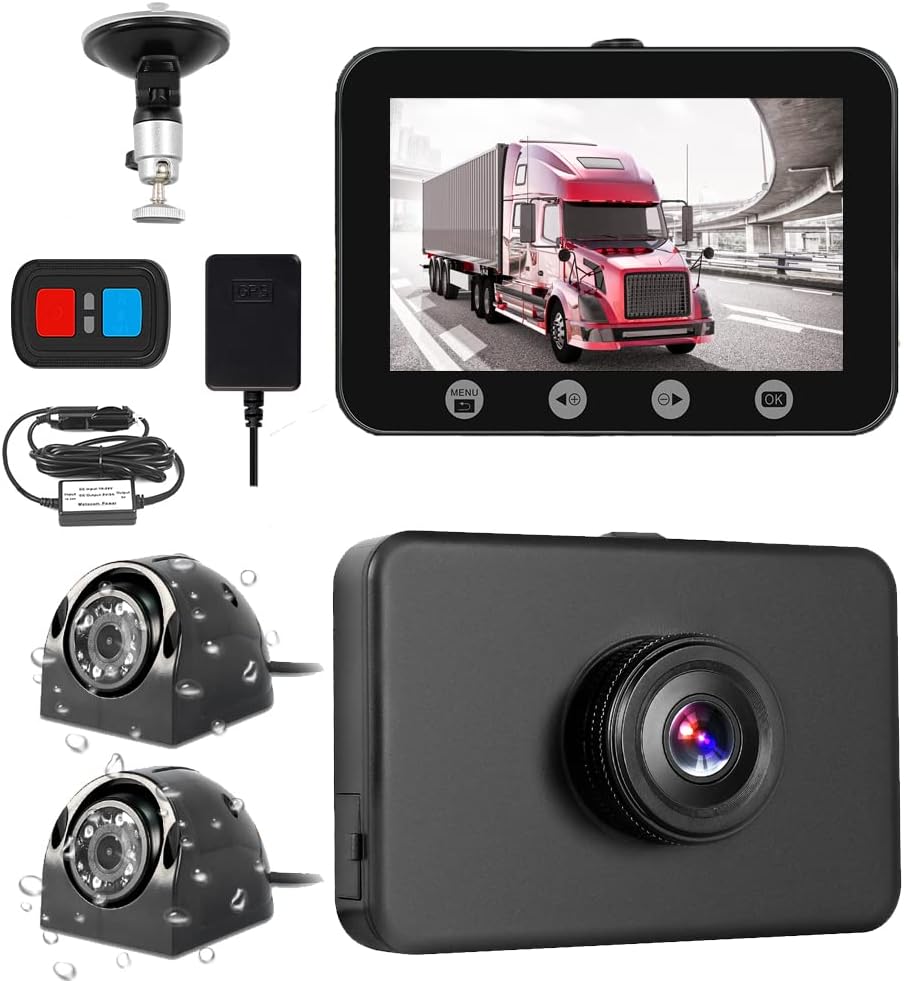


The VSYSTO 3CH WiFi Truck Dash Cam is one of the most explicitly tractor-trailer-oriented systems in this guide. It combines a 1080P front camera with two separate 720P cameras, allowing a rig to record ahead plus two exterior angles at the same time. Its 4.0 rating reflects a useful commercial feature set, although it does not offer the higher sensor and resolution combinations found among the premium multi-channel systems.
We may earn a commission when you buy through this link, at no additional cost to you.
The strongest feature is turn-signal-assisted viewing. Connecting the yellow wire to the vehicle's left or right turn signal causes the split display to change to the corresponding camera. For a tractor trailer, that can reduce uncertainty during lane changes, wide turns, and pull-through maneuvering. The front unit also displays power voltage and speed, while GPS records speed, longitude, latitude, altitude, and atmospheric pressure. WiFi access through the VSYSTO app allows the driver to view, download, edit, and share recordings without removing the memory card.
The separate cameras have waterproof designs and infrared night vision, making exterior mounting more practical than an unshielded passenger-vehicle setup. Loop recording can be configured in several lengths, and the G-sensor locks emergency footage after a collision. The stated emergency-file limit of more than 20 protected clips means an extremely busy sequence can eventually replace the earliest emergency recording. It also supports a post-shutdown recording period of two, four, eight, or twelve hours, provided low-voltage protection is configured appropriately.
This is a sensible choice for owner-operators who want a front-and-sides configuration specifically framed for heavy vehicles. The compromise is image detail: the side feeds are 720P rather than 1080P, and the included information does not identify a memory card in the package. Buyers who can accept somewhat lower side-camera resolution in exchange for waterproof hardware, turn signal switching, and straightforward three-angle recording will find it especially relevant to a tractor trailer.
The display's automatic left and right camera switching makes the system more useful during trailer maneuvers than a static front-and-rear arrangement. Proper trigger-wire routing is essential, so installation instructions should be followed carefully.
Waterproof cameras and infrared illumination make side or rear mounting more realistic on an exposed tractor trailer. Cables still need secure routing and weather protection, particularly around moving suspension and trailer joints.
We may earn a commission when you buy through this link, at no additional cost to you.
The ROVE R2-4K Dual combines a front camera with a 1080P rear camera and earns a 4.5 rating. Its distinguishing specification is the Sony STARVIS 2 IMX675 sensor in the front unit, paired with a wide F1.5 aperture, HDR, and a stated F1.8 rear aperture. The front image is recorded at 2.5K and upscaled to 2160P rather than captured natively at 4K, a distinction that should be considered when evaluating fine detail.
We may earn a commission when you buy through this link, at no additional cost to you.
Its strengths extend beyond resolution. Dual-band 5.8GHz and 2.4GHz WiFi support app-based management and transfers stated at up to 20MB per second. The ROVE app can view recordings, change settings, and provide firmware updates. Built-in GPS adds speed and compass information to the display and stamps routes, locations, and speed onto videos. A 3-inch IPS screen makes those status details visible, while the included 128GB card and support for cards up to 1TB provide practical storage flexibility.
Parking mode is unusually flexible, offering one-frame-per-second time-lapse, motion detection, and collision detection. If an event is recorded, the system saves a one-minute clip in an event folder and provides a voice alert at the next startup. A compatible hardwire kit is required and is not included. The package otherwise contains front and rear cameras, mounts, clips, trim tool, charging and connection cables, and the memory card, making setup more complete than many competing bundles.
This model is a strong choice for a tractor trailer that needs dependable front evidence and a conventional rear view, especially when nighttime driving is common. It does not cover both sides of a long combination, and its front 4K output is upscaled rather than native. Still, the low-light sensor, GPS, fast WiFi, included storage, and three parking approaches make it a refined dual-camera option for drivers who value image quality and convenience over full side coverage.
The STARVIS 2 front sensor, F1.5 aperture, and HDR are intended to improve clarity after dark and around tunnels. Its advantages are most valuable when the rig is regularly operated at night rather than only in daylight.
Fast dual-band WiFi makes it easier to retrieve an event through the app. This is particularly useful when the driver needs to share a clip without repeatedly removing and reconnecting a card in a parked cab.
We may earn a commission when you buy through this link, at no additional cost to you.
The REDTIGER F7N TOUCH is a front-and-rear system with a 4.3 rating, a 4K UHD front recording, and 1080P rear footage. Its front camera uses a STARVIS 2 sensor and a stated 170-degree wide angle, while the rear camera records at 1080P with a 140-degree view. WDR and HDR are included to balance difficult lighting, and the product description emphasizes clearer night footage.
We may earn a commission when you buy through this link, at no additional cost to you.
Control options are unusually varied for a dual-camera dash cam. The integrated touchscreen can lock emergency video, activate WiFi, and capture still imagery, while voice commands offer a hands-free alternative. Physical buttons remain available. The REDTIGER Cam app connects over 5.8GHz WiFi for stated download speeds up to 20MB per second and supports sharing, settings, and review of GPS information such as route, speed, and location.
Continuous loop recording overwrites the oldest ordinary files when the included 128GB card reaches capacity. A G-sensor detects abrupt movement or impact and locks the associated clip so it is not erased during normal loop recording. For parked operation, the system offers collision-detection mode and time-lapse parking mode. A separate hardwire kit is required, which should be budgeted as part of a complete installation rather than treated as an included accessory.
The F7N TOUCH is most attractive to tractor trailer drivers who want a modern, interactive display and strong front-camera specifications but do not need permanent left and right cameras. It offers enough rear coverage for basic incident documentation, although a trailer's length and articulation can make a single rear view less informative than a dedicated trailer-mounted camera. The touchscreen, voice control, 5GHz WiFi, and low-light sensor compensate well for that limitation.
Voice commands, touchscreen access, and conventional buttons let drivers choose the most appropriate method. The most important settings should still be configured before departure rather than adjusted while moving.
The 4K front feed, STARVIS 2 sensor, and 170-degree lens favor road-detail recording. The 1080P rear camera is useful for following traffic, though it may not provide the same fine detail as the front unit.
We may earn a commission when you buy through this link, at no additional cost to you.
The REDTIGER F7NP is a 4K front and 1080P rear dash cam with a 4.1 rating. It combines a STARVIS 2 sensor, an F1.5 aperture, a six-layer optical lens, WDR, and HDR. The front lens has a stated 170-degree view, while the rear lens covers 140 degrees. These specifications target crisp daytime evidence and more balanced visibility in nighttime or rapidly changing light.
We may earn a commission when you buy through this link, at no additional cost to you.
The included 5.8GHz WiFi supports previewing, downloading, and replaying recordings through the Redtiger Cam app at speeds stated up to 20MB per second. Built-in GPS can add route, speed, and location information to the footage. Loop recording maintains continuous use by replacing older files, while the G-sensor protects event clips from being overwritten. The package includes a memory card, allowing immediate setup without purchasing standard storage separately.
Two parking approaches are offered: time-lapse recording for a condensed overview and G-sensor collision detection. A hardwire kit is needed for parking operation. Rather than a lithium battery, the F7NP uses a supercapacitor, which the manufacturer describes as safer and more heat resistant for extended use. An 18-month guarantee also provides more coverage than the one-year warranty listed for the single-camera ROVE model.
This F7NP is a balanced choice for operators who want established front-and-rear hardware without the complexity of four channels. Its 4K front image, strong sensor specifications, and included card make it suitable for highway and yard work, but it does not address a trailer's side blind spots. Buyers should use original or officially recommended cables, follow the installation guide, and avoid prolonged high-temperature exposure to preserve stable operation.
The supercapacitor design is useful in hot parking environments where a lithium-battery approach may be less desirable. It also supports the system's broader parking and event-recording functions.
Fast wireless retrieval and embedded route information make important clips easier to organize and share. Reviewing footage and verifying timestamps before an incident report is still advisable.
We may earn a commission when you buy through this link, at no additional cost to you.
The AProX 3-Channel Dash Cam stands out for recording the front at true 4K UHD, the rear at 4K, and the cabin at 1080P. It carries a 4.8 rating and is the strongest premium choice for operators who want high detail across multiple perspectives. Viewing angles are stated at 170 degrees for the front, 150 degrees for the rear, and 150 degrees for the cabin.
We may earn a commission when you buy through this link, at no additional cost to you.
Low-light performance is addressed through HD night vision, WDR, and four infrared lights in the cabin camera. The laminated 3.18-inch display is designed to reduce reflections, and a screen saver can limit unnecessary visual distraction. Dual-band WiFi 6 supports transfers stated at up to 20MB per second through the TERUNSOUL app, which also handles settings and over-the-air firmware updates. These conveniences make the system straightforward to manage after a long haul.
Storage is well supported: a 128GB card is included, cards up to 512GB are supported, and loop recording overwrites ordinary footage while protecting G-sensor event files. Integrated GPS records speed and location directly into the videos. For parked coverage, the system provides time-lapse recording and collision detection, though a hardwire kit must be obtained separately. The product's three-year guarantee is also longer than the guarantees listed for several competing models.
This is the most compelling premium option when image resolution is the deciding factor. A tractor trailer operator can retain road, following-traffic, and cabin evidence with much greater detail than a conventional 1080P multi-channel setup. The trade-off is greater storage consumption from 4K channels, no included hardwire kit, and a requirement to choose mounting positions that produce useful views. It is particularly compelling for fleets that want consistent multi-angle evidence and fast wireless retrieval.
Unlike an upscaled 4K mode, the stated native 4K front and rear channels retain higher sensor detail. That can help when reviewing vehicles, signs, lane markings, and other fine visual information.
Four infrared lights support interior visibility in darkness, which is useful for documenting driver activity or cabin movement. The cabin camera records at 1080P rather than 4K, so it should not be judged as the system's highest-resolution channel.
We may earn a commission when you buy through this link, at no additional cost to you.
The REDTIGER F17 4K 3CH earns a 4.4 rating with a three-camera arrangement built for broad vehicle coverage. Its front camera uses the STARVIS 2 IMX675 sensor and records at up to 4K, while separate rear and cabin cameras record at 1080P. The stated viewing angles are 150 degrees at the front, 160 degrees in the cabin, and 155 degrees at the rear, offering wide scene capture around the vehicle.
We may earn a commission when you buy through this link, at no additional cost to you.
The front sensor works with HDR and WDR to improve dynamic range and low-light performance. A particularly useful feature is the choice between triple-channel capture and a higher-resolution dual mode. Drivers can operate the front at 2.5K with the other channels, or disable the cabin camera and record the front at 4K alongside 1080P rear footage. That flexibility lets an owner adapt to storage limits or changing coverage needs.
The F17 supports both 2.4GHz and 5GHz WiFi, with the REDTIGER app used for access, transfers, settings, and GPS information. The included 64GB card supports immediate operation, though a tractor trailer running several high-resolution channels will likely benefit from larger storage. Parking protection uses time-lapse and collision-detection modes, but requires an extra hardwire kit. A supercapacitor is used instead of a lithium battery, and the guarantee is 18 months.
This is a strong all-around three-channel system for a rig that needs both exterior and interior evidence. Its wide cabin angle is helpful in commercial vehicles, while the ability to switch resolution modes makes it more versatile than systems that force a single recording configuration. The lower included storage and separate parking accessory are the main trade-offs. It is particularly well suited to owner-operators who want three angles without moving up to the higher-resolution AProX system.
Operators can balance resolution and channel count according to the trip or available storage. The ability to disable the cabin feed is particularly useful for long routes where front-and-rear evidence is the priority.
The 160-degree cabin view is valuable in a spacious tractor cab. Mounting should still be checked for privacy concerns, reflections, and obstructions before recording is relied upon.
We may earn a commission when you buy through this link, at no additional cost to you.
The VSYSTO T5 3-Channel Truck Dash Cam System is the most purpose-built choice for a tractor trailer in the guide. It has a 5.0 rating, three waterproof 1080P cameras, a five-inch IPS touch display, and explicit support for both 12V and 24V vehicle systems. The stated operating input is 9-30V, with separate low-voltage protection ranges for cars and trucks.
We may earn a commission when you buy through this link, at no additional cost to you.
The three cameras cover the front, left, and right, with the side units serving as digital blind-spot views. Connecting the yellow trigger wire to a turn signal causes the display to switch automatically to the relevant side camera, creating a practical alternative to conventional mirrors. The external cameras carry IP67 waterproof ratings and use secure BMW-style connectors. Infrared LEDs and 940nm light sensors on the side cameras improve recording in darkness, while flame-retardant cables are designed for heavy-duty routing.
The central unit adds useful truck-cab features. Bluetooth supports hands-free calling, phonebook access, call logs, and music control. Audio can be sent to the vehicle stereo through the built-in FM transmitter, although the main unit's own speaker is primarily for alerts. A 2.4GHz wireless remote can lock files, switch views, or answer calls. The included GPS module records route, speed, altitude, atmospheric pressure, and compass direction, while 5GHz WiFi supports stated transfers of approximately 10MB per second through the VSYSTO app.
The T5 stands out because it addresses the physical realities of commercial vehicles rather than simply offering a passenger-car camera with more channels. A supercapacitor replaces a lithium battery, H.265 compression conserves storage, and Class U3 cards up to 512GB are supported. The card itself is not included, and the FM-based media-audio arrangement adds another installation step. Even so, this is the strongest overall match for a long, exposed tractor trailer requiring durable exterior cameras and truck electrical compatibility.
The 9-30V input and dedicated 12V and 24V low-voltage thresholds make this system more suitable for commercial power systems than a basic car-only dash cam. The correct protection range should still be configured for the connected vehicle.
Front, left, and right coverage directly addresses major blind areas around a long vehicle. Automatic turn-signal switching makes those exterior angles more accessible during the moments they matter most.
We may earn a commission when you buy through this link, at no additional cost to you.
The ROVE R2-4K single-camera model offers native 2160P UHD recording through an 8MP Sony IMX415 sensor. Its 4.3 rating makes it a credible front-camera option for a tractor trailer, particularly when installation simplicity and road detail matter more than multi-angle coverage. The lens provides a 150-degree view, and a six-glass lens with F1.5 aperture supports the stated low-light performance.
We may earn a commission when you buy through this link, at no additional cost to you.
Built-in WiFi 6 provides app-based viewing and management on iOS or Android, with video downloads stated at up to 6MB per second. GPS records location and speed and can display a driving route in Google Maps through the app or in the ROVE GPS Player. Firmware updates are available over the air, which helps keep the camera current without requiring a computer connection.
The camera includes parking mode, motion detection, time-lapse recording, G-sensor event locking, and loop recording. It uses a supercapacitor and supports microSD cards up to 512GB, although the card is not included. The product information specifically recommends ROVE PRO, ROVE Ultimate, or ROVE Industrial cards and a Class 10 or U3 speed rating. A one-year warranty is included.
This is the most streamlined model in the list, but that simplicity comes with a major limitation for a tractor trailer. It records only the forward view, so it cannot document both sides, the rear, or the interior without adding cameras. A trailer owner who wants a basic visual record of traffic ahead may appreciate the straightforward arrangement, but anyone managing a long combination should prioritize exterior side or rear coverage and hardwire parking capability.
The camera captures 2160P directly rather than producing a 4K label through upscaling. It is a strong choice for forward-facing evidence where signs, lane markings, and surrounding vehicles need detail.
A single-camera arrangement uses fewer cables and mounting points than a multi-channel system. That can simplify a first installation, although it leaves the tractor trailer's other viewing angles uncovered.
We may earn a commission when you buy through this link, at no additional cost to you.
The Icesky S03 delivers four simultaneous channels: 4K at the front and 1080P at the rear, inside, left, and right. Its 4.6 rating and included 128GB card make it an attractive budget-oriented option for complete 360-degree coverage. A three-inch screen supports multi-view display, allowing several camera angles to be reviewed together in the cab.
We may earn a commission when you buy through this link, at no additional cost to you.
The system uses 5.8GHz WiFi 6 for app preview, playback, download, and sharing, with stated transfer speeds up to 20MB per second. GPS records speed, route, location, and time. Left and right cameras have eight infrared lights, and their infrared modes can be controlled independently, allowing one side to be changed without affecting the other. This degree of control is useful when ambient light differs between the two sides of a parked vehicle.
Loop recording replaces older unlocked files when the card is full, while the G-sensor protects event footage after an impact. Parking mode can monitor the vehicle, but it requires a separately sold hardwire kit. Memory support extends to 512GB with a U3 card, providing flexibility beyond the included 128GB card. Voice alerts and a screen saver are also included to support unattended operation and reduce distraction.
The S03 is the strongest value pick when four camera angles are the priority and a full 4K image from every channel is not necessary. It fits sedans, SUVs, trucks, vans, and rideshare vehicles, and its adjustable cameras make it usable on a tractor cab or trailer exterior. The main compromises are 1080P resolution on the three auxiliary feeds, no included hardwire kit, and the need to plan mounting and cable paths for four separate units.
Front, rear, left, and right recording gives a tractor trailer substantially more situational coverage than a conventional dual-camera system. Mounting quality determines how much useful detail each angle actually captures.
Only the front channel records at 4K, while the remaining channels use 1080P. That compromise preserves broad coverage and fast transfers without the storage demands of a multi-4K configuration.
We may earn a commission when you buy through this link, at no additional cost to you.
The PRUVEEO 4-Channel 360 Camera records front, rear, left, and right views simultaneously at 1080P. Its 4.2 rating reflects a straightforward approach to complete vehicle coverage, and the front three cameras have adjustable angles so the operator can tailor views toward the road, trailer body, cargo area, or interior. A 128GB card is included for immediate use.
We may earn a commission when you buy through this link, at no additional cost to you.
The system includes built-in GPS for speed, route, and location logging, plus WiFi access through the app on iOS and Android. This allows recorded material to be reviewed and shared without removing the card. The F1.8 cabin lens and four infrared lights support low-light recording, making the setup more useful when the truck or trailer is parked in darkness.
Parking mode includes a time-lapse option that compresses 60 minutes into one minute, reducing storage use while preserving an overview of activity. Loop recording overwrites older footage, while collision detection locks incident files. An ACC hardwire kit is sold separately and is necessary for continuous parking operation. The camera has no battery, which avoids battery-related heat concerns inside a parked vehicle.
For a tractor trailer owner who wants basic all-around documentation, the PRUVEEO provides a useful package without requiring separate storage. It is less advanced than newer four-channel systems because every camera records at 1080P and WiFi transfer speeds are not specified. It also lacks a stated supercapacitor, multi-band WiFi, or detailed low-light sensor specifications. Even with those limitations, its adjustable four-angle layout, GPS, parking mode, and included card make it a practical entry point.
Moving the front three cameras lets an owner direct coverage toward a trailer body or interior rather than accepting one fixed exterior pattern. The rear and other channels remain useful for broad vehicle context.
Because the package does not include a rechargeable battery, it avoids one source of heat-related degradation in a parked cab. A suitable hardwire kit remains necessary for sustained parking surveillance.
We may earn a commission when you buy through this link, at no additional cost to you.
The right tractor trailer camera depends on the rig's blind zones, electrical system, operating schedule, and incident-evidence needs. These factors help separate a simple front camera from a system suitable for exterior commercial coverage.
Start by mapping the views a tractor trailer actually needs. A dual-channel front-and-rear system is useful for basic road evidence, but it does not cover both sides of a long combination. A three-channel system can place cameras at the front, left, and right, while a four-channel setup may add a cabin or rear view. The best arrangement depends on whether the priority is traffic ahead, trailer sides, following vehicles, driver activity, or all of those areas simultaneously.
Choose enough channels to address the largest blind zones without adding cameras that will be blocked by trailer bodywork. Confirm that every intended camera can be mounted in a useful position.
Commercial vehicles may use a 12V or 24V electrical system, and a camera designed primarily for passenger cars may not be appropriate for every tractor trailer. Look for an explicit voltage range, a suitable input specification, and separate low-voltage protection settings. A wide 9-30V range offers more flexibility than a narrow automotive input, although the installer must still identify the correct connection point and configure the cutoff threshold.
Verify the included power accessories before purchase. A hardwire kit may also be needed for parking mode, and a 5V USB-only system may require an appropriate commercial-vehicle converter.
Resolution alone does not determine whether a clip will be useful. A higher-resolution sensor can preserve small details, but lens quality, aperture, HDR, WDR, infrared illumination, and the amount of light reaching the camera all affect the result. Check whether 4K is native or upscaled, because the two approaches may produce different fine detail. For frequent night operation, a STARVIS-family sensor, wide aperture, and exterior IR lights deserve particular attention.
Balance resolution against storage. Multiple 4K channels consume memory rapidly, so reliable loop recording and appropriately rated high-capacity cards should be part of the purchase decision.
A tractor trailer camera may be mounted outside the cab where rain, road spray, dirt, vibration, and temperature changes are unavoidable. Exterior camera housings should have a stated water-resistance rating, and cables and connectors should be rated for the route. Secure connectors, flame-retardant cabling, and protective mounting brackets can be more valuable than cosmetic features because they reduce exposed wiring and accidental disconnection.
Do not assume windshield-oriented weather resistance applies to every included camera. Confirm the rating of each exterior unit and inspect seals and cable strain relief after installation.
Traditional mirrors still matter, but a side-camera display can provide a closer electronic view of a trailer's flank. Trigger-wire switching is especially useful because the correct camera can appear when the driver activates a turn signal. This reduces the need to manually change views during lane changes or tight yard movements. The benefit is greatest when the side cameras are mounted low enough to reveal a car's full body near the trailer.
Check whether the display supports full-screen side views, how the trigger wires are configured, and whether the screen can be mounted where it remains readable without blocking essential instruments.
Continuous loop recording requires enough card capacity and a sustained write speed appropriate to the selected resolution. Many systems support 512GB cards, while one listed ROVE dual supports up to 1TB. Included cards vary from 64GB to 128GB, and multi-channel 4K recording can exhaust smaller cards quickly. A U3 or comparable high-speed card is prudent for demanding configurations. G-sensor emergency locking should also be enabled to keep important clips from being overwritten.
Review the event-retention policy. A system that protects a limited number of emergency files may eventually replace the oldest one, so frequent drivers should copy significant clips to the app, computer, or another storage location.
WiFi makes a commercial dash cam much easier to use because important footage can be downloaded before removing the memory card. Dual-band or WiFi 6 systems are advantageous when transferring large 4K files, while stated download rates make it easier to estimate how long a transfer will take. GPS adds speed, route, location, and direction data that may help document a route or incident. App compatibility with the driver's phone is an important practical consideration.
Wireless access should not be confused with cellular service. Most listed products connect to the camera's local WiFi network, so a separate mobile-data plan is generally unnecessary for standard video retrieval.
Parking mode is useful for detecting impacts or movement while a loaded rig is unattended, but most systems require a separate hardwire kit. Choices commonly include collision detection, motion detection, and time-lapse recording. Time-lapse reduces storage consumption, while a motion or impact event can save a more useful clip. Because a tractor cab can become very hot, power design also matters. Supercapacitors are generally presented as safer and more heat resistant than internal lithium batteries for parked operation.
Set the correct low-voltage cutoff for the vehicle and avoid leaving parking mode active unless the electrical system can support it. Confirm whether parking activation is automatic, and whether the product includes a hardwire kit before budgeting the complete installation.
Begin by planning camera placement and identifying the correct power source. Clean each mounting surface, keep the lens free of fingerprints and road film, and route cables away from sharp metal edges, exhaust components, and moving suspension parts. Exterior camera cables should be secured at regular intervals, while connections should remain accessible for inspection without leaving exposed joints vulnerable to moisture.
Install a suitably rated memory card, format it in the dash cam if that option is provided, and confirm that the dash cam recognizes it. Set the correct date, time, recording resolution, loop duration, G-sensor behavior, low-voltage threshold, and parking mode before the vehicle leaves the yard. Connect the turn-signal trigger wire only where required, then verify that the correct side camera appears when each signal is activated.
Review the camera views while parked and again during a short daytime trip. Confirm that the front image is level, side cameras show useful portions of the trailer rather than pavement or body panels, and the rear view is not blocked. Periodically inspect seals, connectors, mounts, and cables; clean the lenses with a soft cloth; and copy significant incident or parking clips to another device before loop recording replaces them.
A three-channel system with front, left, and right cameras is generally the most practical for a tractor trailer because it addresses the vehicle's major exterior blind spots. The VSYSTO T5 stands out for explicit truck compatibility, IP67 exterior cameras, and 12V and 24V support. A four-channel model may be better when cabin documentation is also important.
Some commercial vehicles use 24V systems, but not every tractor or trailer installation does. A camera rated for 9-30V can cover both common configurations, while a 12V-only unit may require a suitable converter. Confirm the rig's electrical system, fuse location, grounding point, and the dash cam's low-voltage protection range before installation.
A dash cam can help by recording left, right, front, and rear activity and by displaying side views during turn-signal activation. It does not replace required mirrors or direct observation. Cameras should be positioned to reveal areas blocked by the trailer body, and drivers must continue checking conventional mirror systems and surroundings.
4K front footage can preserve useful detail, while 1080P is often adequate for secondary views. Night performance also depends on the sensor, aperture, HDR or WDR processing, and infrared lighting. A dual or three-camera system at 4K and 1080P may be a better balance than a four-camera system that records every channel at 4K.
Most of the listed systems require a separate hardwire kit for continuous parking surveillance. A hardwire provides the low-draw power connection needed to record while parked, but the correct low-voltage cutoff must be configured to avoid draining the vehicle battery. Confirm kit compatibility before purchasing because connectors and fuse requirements can differ.
WiFi is not necessary for basic continuous recording, but it makes incident review much more convenient. Instead of removing a potentially vibrating card, the driver can download and share files through the app. Dual-band WiFi 6 is especially helpful for large 4K videos because the camera and phone can transfer them faster over the 5GHz band.
Mount exterior cameras where they have a clear, useful view and where the lens is less likely to be struck by branches, debris, or cargo-handling equipment. Side cameras should be positioned low enough to show vehicles near the trailer, while rear cameras need an unobstructed view beyond the trailer. All cables should be protected from abrasion, heat, water, and trailer movement.
Copy important clips promptly to a phone, computer, cloud location, or other storage device. Loop recording overwrites ordinary footage as storage fills, and even event-locked files may be replaced after the system reaches a protected-file limit. Regular backups are especially important for drivers who routinely exchange clips with insurers or fleet managers.
The VSYSTO T5 3-Channel Truck System is the strongest overall choice because it combines front, left, and right waterproof cameras with turn-signal switching, a five-inch display, and explicit 12V and 24V support. The AProX 3-Channel system is the premium resolution option, offering true 4K front and rear channels plus a 1080P cabin camera, while the Icesky S03 is the best budget choice for inexpensive four-angle coverage.
The most important decision is matching coverage to the rig rather than selecting on resolution alone. A long tractor trailer may benefit more from reliable side cameras and commercial power compatibility than from native 4K on a single front lens. Low-light performance, card speed, parking accessories, connector design, cable routing, and backup habits should all be considered before installation.
Finally, confirm the current product configuration, included accessories, warranty terms, and price directly from the listing before purchasing. Bundle contents and promotions can change, and the current price should be weighed against the coverage, durability, and low-light performance needed for the intended commercial duty cycle.