
KInuoxj 20A 240W DC-DC 24V 36V 48V Step Down to 12V Converter Golf Cart Voltage Reducer Regulator Waterproof Transformer with Fuse
4.5Editor score
20A maximum output current
Sealed aluminum enclosure
Multiple electrical protections
Compare 10 of the best 48V or 36V to 12V step down voltage reducer regulator options, comparing power, protection, efficiency, housing, and installation.
A 48V or 36V to 12V step down voltage reducer regulator converts higher-voltage DC power into a stable 12V output for lights, audio, screens, motors, and other accessories. A suitable unit should match your battery voltage, provide adequate current, resist harsh conditions, and include dependable protection against common electrical faults.
This guide compares ten converters using the information supplied for each product, including supported input ranges, output ratings, conversion efficiency, enclosure design, protection features, cooling methods, and installation provisions. The list covers 20A and 30A models, wired and plug-and-play designs, and converters intended for golf carts, RVs, trucks, forklifts, solar systems, and general DC equipment.
Each review explains the product's strongest qualities and practical trade-offs, while the comparison table provides a quicker way to evaluate the differences between all ten options. Product ratings and availability can change over time, and current prices fluctuate, so readers should confirm the latest listing details before making a purchase.
4.5Editor score

4.6Editor score

4.4Editor score
The table below compares all ten converters by their principal technical attributes. It highlights differences in input flexibility, available output power, environmental resistance, efficiency, and installation style, making it easier to identify the model best suited to a particular vehicle or DC system.

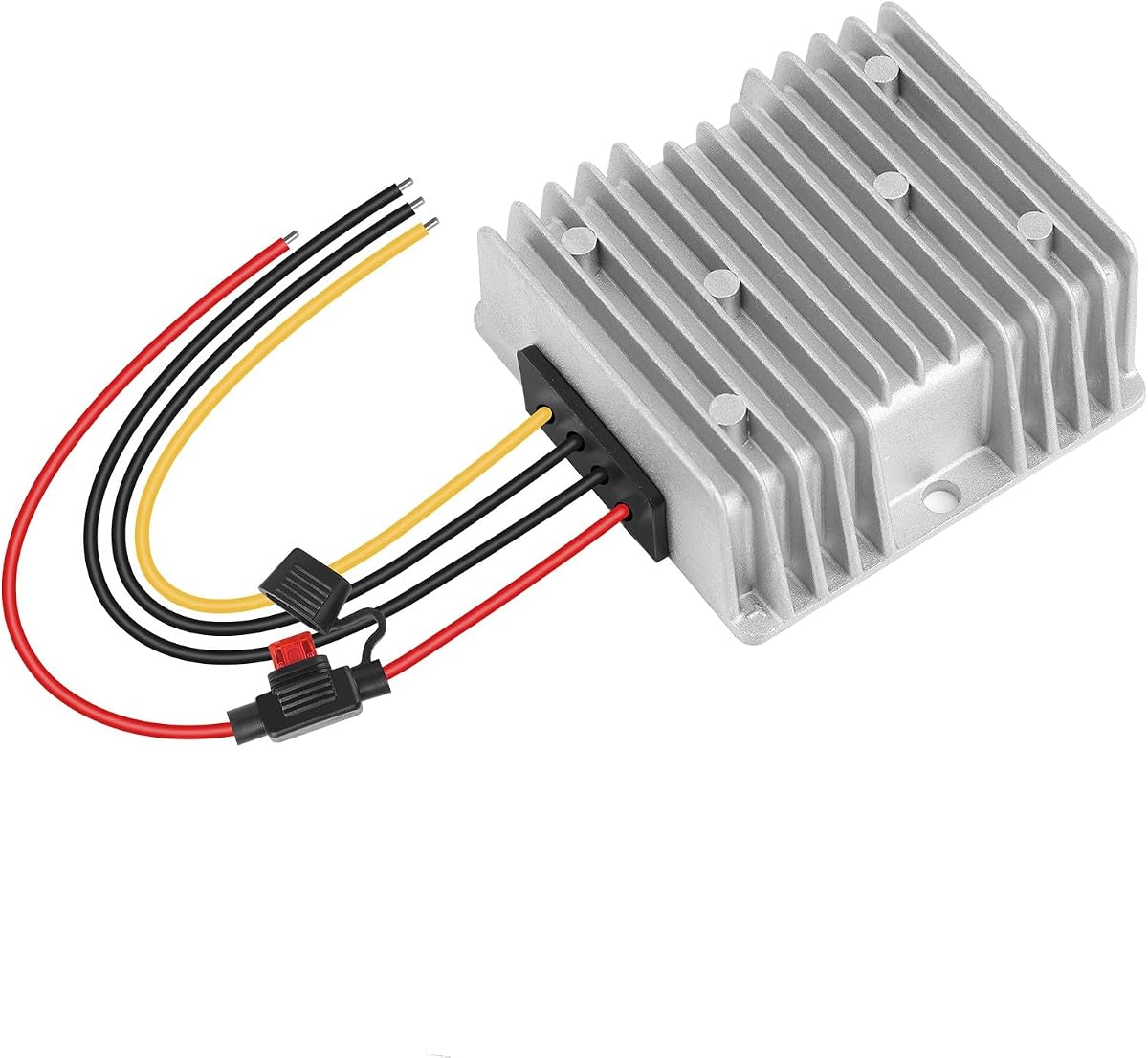


The KInuoxj converter combines a broad 20V to 60V input range with a fixed 12V output rated up to 20A and 240W. Its listed 4.5 rating reflects a generally favorable buyer reception, while the aluminum shell, silicone sealing, and included fuse give it an appealing combination of ruggedness and practical electrical safeguards.
We may earn a commission when you buy through this link, at no additional cost to you.
The input range covers 24V, 36V, and 48V systems, making this a versatile option for golf carts, trucks, LED strips, screens, surveillance equipment, motors, and DIY projects. Protection against input undervoltage, overload, overcurrent, overheating, and output short circuits helps reduce the consequences of common installation or load mistakes.
Its main limitation is the 20A ceiling, which may be insufficient for a cluster of power-hungry accessories. The product information also does not provide a numerical conversion-efficiency claim, so buyers prioritizing maximum thermal performance may wish to compare it with models that advertise efficiency of up to 95% to 97%. Even so, its sealed construction and broad protection suite make it a strong general-purpose choice.
Choose this converter when your system runs from a 24V, 36V, or 48V DC source and the connected 12V equipment can remain within a 240W maximum. It is particularly attractive for installations exposed to moisture, dust, vibration, or shock, provided the load is properly sized and the wiring is installed with correct polarity.
Supporting a 20V to 60V input range provides useful flexibility across 24V, 36V, and 48V systems. That versatility makes the converter easier to specify when the exact battery arrangement or operating voltage is not perfectly clear.
The sealed aluminum housing is designed to resist water, dust, shock, and harsh operating conditions. Multiple protection functions add another layer of assurance for long-running vehicle, lighting, or motor applications.
We may earn a commission when you buy through this link, at no additional cost to you.
The Pro Chaser DC-DC converter is designed around the electrical needs of 36V and 48V golf carts and RVs. Its 4.5 rating, vehicle-specific positioning, and inclusion of a matched connector harness make it a convenient option for adding 12V accessories without assembling every termination from scratch.
We may earn a commission when you buy through this link, at no additional cost to you.
The stated uses include headlamps, tail lamps, radios, and solar panels, which reflects the type of relatively modest accessory circuits this class of converter commonly serves. An aluminum cast shell, ventilation design, and water-resistant sealed case provide a practical enclosure for mobile environments where vibration and weather exposure are normal concerns.
The product information does not state a maximum output current, wattage, or numerical efficiency figure. Those omissions make it harder to compare directly with the more technically detailed 240W and 360W products in this guide, particularly when planning several high-draw accessories. Buyers should verify those electrical limits in the current listing or manufacturer documentation before purchase.
This converter is best for a golf cart or RV owner who values an installation-oriented package and already knows the accessory load is modest. The included matched male and female connector and fitted butt connectors simplify connection and disconnection, but adequate power capacity and correct wiring remain essential to a successful installation.
Designing the converter around 36V and 48V golf-cart and RV systems gives users a focused solution rather than a general-purpose module. It is a logical choice for lighting, radio, and other accessory upgrades.
The included matched connector harness and fitted butt connectors reduce the need to source separate compatible plugs. This makes temporary removal and future accessory changes more convenient.
We may earn a commission when you buy through this link, at no additional cost to you.
This 20A 240W converter combines a 4.6 rating with one of the strongest efficiency claims in the group, reaching up to 97%. Its 30V to 60V input range and fixed 12V output make it especially well aligned with 36V and 48V golf-cart electrical systems and other higher-voltage DC installations.
We may earn a commission when you buy through this link, at no additional cost to you.
The aluminum shell and silicone sealing are intended to improve durability, while overload, overcurrent, over-temperature, and short-circuit protection cover several of the most common operating faults. The stated application list includes cars, trucks, golf carts, LED strip lighting, screens, monitoring systems, motors, and DIY projects, which gives the model broad practical relevance.
Its 30V minimum input means it does not cover the lower-voltage systems supported by several competing units. The 240W maximum also constrains total 12V load, even if many individual accessories are compatible. Nevertheless, the claimed 97% efficiency, sealed construction, and compact 20A output make it a compelling all-around option for properly sized 36V or 48V installations.
This is a strong recommendation for buyers who want a balance of power, efficiency, and environmental resistance. It suits users with a 36V or 48V source who can keep the connected load below 20A and 240W, particularly when low heat generation and dependable protection are priorities in a compact installation.
The up-to-97% efficiency claim can help limit conversion losses and heat buildup. That is particularly valuable in enclosed battery compartments where cooling options may be limited.
Combining an aluminum shell, silicone seals, and protection against overload, excess current, excessive temperature, and short circuits gives the converter a well-rounded safety profile.
We may earn a commission when you buy through this link, at no additional cost to you.
This converter offers a 30V to 60V input range, fixed 12V output, and up to 20A and 240W. Its 4.4 rating accompanies a feature set centered on a silicone-sealed IP68 aluminum case, which is intended to provide waterproof, shockproof, and moisture-resistant operation in demanding mobile environments.
We may earn a commission when you buy through this link, at no additional cost to you.
Protection includes overload, overcurrent, overtemperature, undervoltage, and short-circuit handling. The up-to-95% conversion-efficiency claim provides a useful benchmark, while the product's stated applications range from golf carts, cars, trucks, and LED lights to screens, monitoring systems, motors, and DIY builds.
Like the other 20A/240W models, it cannot supply loads beyond its stated maximum, and its 30V lower input limit makes it less flexible than units accepting down to 18V or 20V. Nevertheless, the combination of five protection functions, an IP68 enclosure, and a 240W output creates a balanced option for exposed installations where protection against moisture and vibration is important.
This model is well suited to 36V and 48V systems whose total 12V accessory demand is no greater than 240W. It deserves particular consideration for golf carts, trucks, outdoor lighting, and motor applications where the sealed aluminum construction may be more valuable than support for a wide assortment of input voltages.
Protection against overload, overcurrent, overtemperature, undervoltage, and short circuit provides coverage for a broad collection of electrical faults. This makes the converter a solid choice for mixed accessory circuits.
The IP68 aluminum enclosure is designed to resist water, dust, and moisture while also providing shock resistance. It is a practical construction for carts, trucks, and outdoor equipment.
We may earn a commission when you buy through this link, at no additional cost to you.
The 36V 48V 20A converter uses a 20V to 60V input range and delivers a fixed 12V output up to 20A and 240W. Its 4.4 rating and zero-fan design distinguish it from conventional converter listings that may specify an active cooling system.
We may earn a commission when you buy through this link, at no additional cost to you.
A rugged aluminum enclosure with thermal pads is intended to dissipate heat during extended operation. The product information also describes vibration-proof, weather-resistant construction and protection with automatic cutoff for overload, short circuit, overcurrent, and excessive temperature. Golf carts, RVs, forklifts, trucks, solar systems, LED lighting, screens, and motors are among the stated applications.
The claim of installation in under one minute should be understood as a simplified installation claim rather than a guaranteed outcome. Actual installation time depends on routing, mounting, connector identification, and the vehicle's wiring layout. The data also gives no numerical efficiency figure, so buyers who prioritize published conversion efficiency may prefer one of the 95% to 97% alternatives.
The model is a good option for users who want a 20A converter without a powered cooling fan and who appreciate quick-access installation claims. It is best for 20V-to-60V systems with a 12V accessory load below 240W, especially where compact, passive thermal management is valuable.
A zero-fan design removes the need for a moving cooling component and uses the enclosure and thermal pads to dissipate heat. This can be attractive in installations where fan noise, dust ingress, or limited space is a concern.
The product is positioned as a direct integration path for golf-cart and RV 12V accessories. Its connectorized format is intended to simplify adding lights or other equipment without designing a converter from individual parts.
We may earn a commission when you buy through this link, at no additional cost to you.
The Nilight converter is the strongest-capacity model in this guide, providing a fixed 12V output of up to 30A and 360W. It also has the broadest stated input range, from 18V through 60V, while its listed 4.4 rating indicates positive reception despite being more specialized than the standard 20A options.
We may earn a commission when you buy through this link, at no additional cost to you.
Synchronous rectification supports a conversion-efficiency claim of up to 96%. A die-cast aluminum shell with silicone sealing is designed for waterproof, dustproof, explosion-proof, and shock-resistant performance, while an intelligent protection chip covers over- and undervoltage input, overcurrent, overload, excessive heat, and short-circuit conditions.
Its higher output ceiling means it can support a broader combined 12V load than the 20A and 240W alternatives, but users should still calculate the connected equipment's current draw and provide proper circuit protection. The 30A rating also differentiates it from most competing products, and its 4.4 rating is slightly below the top-rated choices in the list.
This is the most appropriate option in the group for a 36V or 48V system with multiple power-hungry 12V accessories. Golf carts with extensive lighting, trucks, motor applications, surveillance systems, and other high-draw installations may benefit from its 360W capacity, provided wiring and load calculations are handled carefully.
A 30A output provides substantially more usable capacity than the 20A models in this guide. It is a better match for vehicles carrying several accessories at once or for 12V equipment with higher current requirements.
The 18V-to-60V input window supports 18V, 20V, 24V, 36V, and 48V sources. That broad range makes the converter useful across mobile, industrial, and project applications where the source voltage may change.
We may earn a commission when you buy through this link, at no additional cost to you.
The DC 36V/48V Buck Converter supplies a fixed 12V output up to 20A and 240W from an 18V to 60V input range. Its 4.5 rating and combination of epoxy resin potting, an IP68 rating, and natural air-convection cooling make it a notable option for installations exposed to moisture, dust, and vibration.
We may earn a commission when you buy through this link, at no additional cost to you.
Protection against overload, overcurrent, excessive temperature, and short circuits covers the main operating hazards, while the die-cast aluminum shell adds structural rigidity. Suggested applications include golf carts, trucks, LED strip lighting, screens, monitoring systems, speakers, motors, and DIY projects, giving the unit a broad practical scope.
The converter is limited to 20A and 240W, so a larger collection of high-current accessories may require a higher-capacity model. Unlike several competing products, its protection list does not explicitly mention input undervoltage. Those differences should be evaluated against the equipment being powered, particularly in installations with variable battery conditions.
This converter suits users who value environmental sealing and broad source-voltage support. It is a sound recommendation for 12V lighting, audio, monitoring, or motor circuits on 36V and 48V systems, as long as the load remains within the specified output limits and the installation is protected against reverse polarity and wiring errors.
Epoxy resin potting helps secure the internal assembly while adding resistance to moisture and vibration. Combined with the die-cast shell, it is well suited to mobile and outdoor equipment.
Natural air-convection cooling moves heat without a powered fan. This supports quiet operation and avoids adding a mechanical cooling component to the installation.
We may earn a commission when you buy through this link, at no additional cost to you.
The DC House converter is a 20A, 240W step-down unit with a stated 20V to 60V input range. Its 4.4 rating, die-cast aluminum enclosure, and four-wire plug-and-play connection scheme make it particularly appealing for users who need to fit a reducer into a tight battery compartment or utility-vehicle installation.
We may earn a commission when you buy through this link, at no additional cost to you.
The unit supports 12V output at up to 20A with a claimed conversion efficiency of up to 95%. Its IP68 housing is designed to be waterproof, dustproof, and shockproof, while protection against overvoltage, overcurrent, excessive temperature, and short circuit covers several common electrical risks.
The four-wire connector simplifies connection, but users still need to understand the wiring arrangement and ensure that the attached equipment stays below 20A and 240W. Compared with the 30A options, this model has less capacity for several power-hungry accessories at once. Input undervoltage protection is also not included in the stated protection list.
This converter is a good fit for golf carts, trucks, LED lights, audio systems, monitors, motors, and DIY projects where compactness and quick connector-based assembly matter. It is especially appealing for mixed 12V accessory circuits that can be divided into appropriately protected groups rather than fed by one large combined load.
The compact form factor is intended for battery compartments and other confined spaces. That makes the unit practical for carts and vehicles where every available inch matters.
Matched connectors create a straightforward four-wire installation path. They can also make service and accessory changes easier without repeatedly assembling individual bare-wire connections.
We may earn a commission when you buy through this link, at no additional cost to you.
The 10L0L converter provides 12V output at up to 30A and 350W from a 30V to 60V input range. Its 4.3 rating is the lowest listed among these ten products, but its defining feature is a connection method designed around the complete battery pack and a matched six-pin plug.
We may earn a commission when you buy through this link, at no additional cost to you.
Connecting to the entire battery pack rather than a single battery is intended to balance the electrical load across the pack and help support battery-pack service life. Installation instructions are included, and the product is described as universal for Yamaha, Club Car, EZGO, and other golf carts. Protection includes overload, overcurrent, overtemperature, short circuit, and overvoltage.
Its 350W rating makes it more specialized than smaller 240W models, so buyers should verify the actual accessory demand and avoid sizing solely by a single device's stated current. The 4.3 rating also warrants more attention to recent customer feedback and included documentation than the higher-rated alternatives. A six-pin connector adds convenience, provided it matches the user's existing wiring arrangement.
This converter is best for a golf-cart or utility-vehicle owner who wants high current, whole-pack integration, and model-specific installation guidance. It is a strong candidate for extensive 12V accessory systems, provided the wiring is compatible, the load remains within 30A and 350W, and installation follows the supplied instructions.
Tying the converter to the full battery pack distributes the accessory demand across the pack rather than concentrating it on one battery. This design choice is especially relevant to multi-battery golf-cart systems.
The converter is described as compatible with Yamaha, Club Car, EZGO, and other golf carts. Installation instructions support setup, although the physical connector and wiring layout still need to be checked before purchase.
We may earn a commission when you buy through this link, at no additional cost to you.
The Professional 20A 240W converter ties for the highest listed rating in the guide at 4.6. It accepts a 20V to 60V input range, works with 24V, 36V, and 48V power systems, and supplies a fixed 12V output rated up to 20A and 240W.
We may earn a commission when you buy through this link, at no additional cost to you.
Synchronous rectification supports an efficiency claim of up to 96%, while the IP68 aluminum housing is designed to resist dust, water, and vibration. A fuse and safeguards against overcurrent, overload, short circuit, and excessive temperature provide a broad protection package. The stated uses include golf carts, photovoltaic panels, LED equipment, displays, and other 12V devices.
One important operating instruction is that input power should be at least 20% higher than the load power for more reliable operation. Users must also maintain the 20V-to-60V input range and avoid reversing the positive and negative cables. As with every 20A model, the total accessory load must not exceed 20A or 240W.
This converter is a strong all-around recommendation for 36V and 48V golf-cart systems, especially those adding LED lighting or displays. Its high listed rating, efficient design, and IP68 enclosure make it particularly compelling, provided the user follows the stated input-headroom and polarity guidance.
The up-to-96% efficiency claim reduces conversion losses, while the included fuse and four stated safeguards help protect the installation. This combination is useful for unattended or hard-to-access vehicle wiring.
The product explicitly emphasizes correct polarity, a defined 20V-to-60V input range, and sufficient input headroom. Following those boundaries helps prevent avoidable operating problems.
We may earn a commission when you buy through this link, at no additional cost to you.
Selecting a step-down reducer involves matching source voltage, load requirements, environmental conditions, and connection style. The following factors help narrow the field without overlooking installation safety or long-term reliability.
Start by identifying the nominal voltage of the battery or DC source and the lowest and highest voltage it may produce. Most golf-cart systems use 36V or 48V packs, but the products here vary from 18V to 60V or 20V to 60V. A wider range can provide flexibility, while a narrower range may give the buyer more confidence that operation remains within the manufacturer's intended boundaries.
Add the current requirements of every 12V device that will operate simultaneously, then compare the result with the converter's output rating. Most choices here deliver 20A and 240W, while the Nilight and 10L0L models reach 30A with maximum outputs of 360W and 350W. Include a reasonable operating margin rather than sizing the converter to a peak momentary figure alone.
Higher efficiency means less energy is lost during voltage conversion and less heat needs to be removed from the enclosure. Published claims in this group range from up to 95% to up to 97%. These figures come from the supplied product information and should be treated as maximum claims, so enclosure design, ambient temperature, and load level still influence real operating results.
Golf carts, trucks, forklifts, and outdoor equipment can encounter water, dust, mud, vibration, and shock. Aluminum housings are common across the list, while silicone sealing, epoxy potting, or an IP68 rating provide additional environmental resistance. A weather-resistant enclosure is especially valuable when the converter is mounted in an exposed or high-vibration location.
Overload, overcurrent, over-temperature, and short-circuit protection appear on nearly every product in the guide. Some models add undervoltage or overvoltage protection, while the 10L0L includes five stated safeguards. A good match should cover the failure modes most relevant to the planned load and wiring rather than relying on protection as a substitute for correct installation.
Options range from fitted butt connectors and a matched male-and-female harness to four-wire plugs, a six-pin plug, and converters that include a fuse. Connectorized systems can simplify installation and make future removal easier. Before buying, compare the plug configuration, cable length, wire gauge, and terminal style with the vehicle rather than assuming every connector is interchangeable.
Several converters rely on sealed housings and natural convection, while the 36V 48V 20A model explicitly uses a zero-fan design. A sealed case can make ventilation around the unit important because there may be little airflow in a battery compartment. Leave the stated installation clearance, avoid covering the enclosure, and mount it where wiring and heat can both be managed.
Purpose-built golf-cart reducers may include vehicle-specific instructions or connection methods, while general models support trucks, RVs, forklifts, solar systems, screens, and DIY projects. Consider whether the converter connects to an individual battery or the full pack, how that affects cable routing, and whether the accessory list includes items such as headlights, radios, LED strips, motors, or audio.
Before installation, disconnect the vehicle's power source, identify the positive and negative conductors, and confirm that the converter's input range contains the system's voltage. Plan the input connection according to the product instructions, especially when a model is designed to connect to the complete battery pack rather than a single battery.
Mount the converter securely in a dry, ventilated location that is protected from sharp edges, excessive heat, and moving components. Connect the input and output according to the supplied polarity markings, install the included fuse where applicable, and use appropriate wire and connectors for the expected current. Tighten terminals correctly and insulate exposed conductors.
Reconnect power only after checking the wiring. Start with a modest load, monitor the 12V output and converter for unusual heat or noise, and then increase the load gradually within the stated current and wattage limits. Periodically inspect connections, cable routing, seals, and the fuse, especially after vibration, weather exposure, or any modification to the accessory circuit.
A 48V-to-12V converter is normally used to power compatible 12V accessories on a golf cart, not to operate the cart's traction system. It can support items such as lights, radios, displays, or other suitable DC equipment. The accessory load must remain within the converter's current and wattage limits, and the installation must follow correct polarity and connection instructions.
A 20A converter is suitable for combined 12V loads up to 20A and, in most models here, 240W. A 30A model offers more capacity, reaching 360W in the Nilight and 350W in the 10L0L. The higher rating is useful for multiple accessories, but it also requires correctly sized wiring, protection, and attention to the converter's total power limit.
A converter with an IP68-rated or sealed enclosure is designed to resist water, dust, and shock more effectively than an open module. Even so, it should be mounted where connectors and cable entries are not continuously submerged, and it should be protected from excessive heat and mechanical damage. Sealing supports durability, but it does not replace sound installation practice.
A 96% efficiency claim means the converter can deliver up to approximately 96% of the incoming electrical energy to the 12V output under the conditions used for the claim. The remaining energy is lost primarily as heat. Efficiency varies with load, input voltage, and temperature, and the stated maximum should not be interpreted as a constant operating result.
That depends on the product design and the battery system. Some converters are specifically designed to connect across the full battery pack, as stated for the 10L0L, while others accept input through their supplied leads or connectors. Follow the included instructions because attaching to the wrong point can produce incorrect voltage or create an unbalanced load.
Several products in this guide explicitly include a fuse, and the converters have stated internal protection functions. An included fuse does not automatically mean every installation requires a separate fuse, nor does it replace correct circuit protection. Confirm the product's wiring diagram, the fuse location, and the appropriate rating for the load before energizing the system.
Only if the converter's stated input range includes the voltage produced by the battery system. For example, a unit accepting 30V to 60V can accommodate a nominal 48V pack, but one limited to a narrower 36V range may not be appropriate. Also account for the battery's maximum charging or operating voltage rather than checking only its label.
Keep the connected load below the converter's current and wattage limits, mount it with the required clearance, and avoid enclosing it in a completely sealed compartment unless the installation guidance allows it. Use appropriately rated wiring and connectors, and inspect the unit periodically. Passive or fan-assisted cooling can manage heat, but no cooling design compensates for an oversized load.
The KInuoxj 20A 240W model offers a balanced feature set with broad input support, a sealed aluminum housing, and multiple protections. The 20A 240W 12V converter stands out for its up-to-97% efficiency claim, while the Nilight 30A 360W unit is the strongest choice when greater output headroom and a very broad input range are priorities.
For most properly sized golf-cart accessory installations, a 20A/240W converter is the central point of comparison. Pay particular attention to input limits, protection functions, connector compatibility, mounting space, and the total simultaneous current draw. If the load approaches 20A, move up to a properly sized 30A model rather than operating at the ceiling of a smaller unit.
Ratings, product details, and prices can change, so review the current listing before ordering. Confirm the source voltage, accessory requirements, installation instructions, and current product specifications to ensure that the selected reducer is safe and appropriate for the intended system.