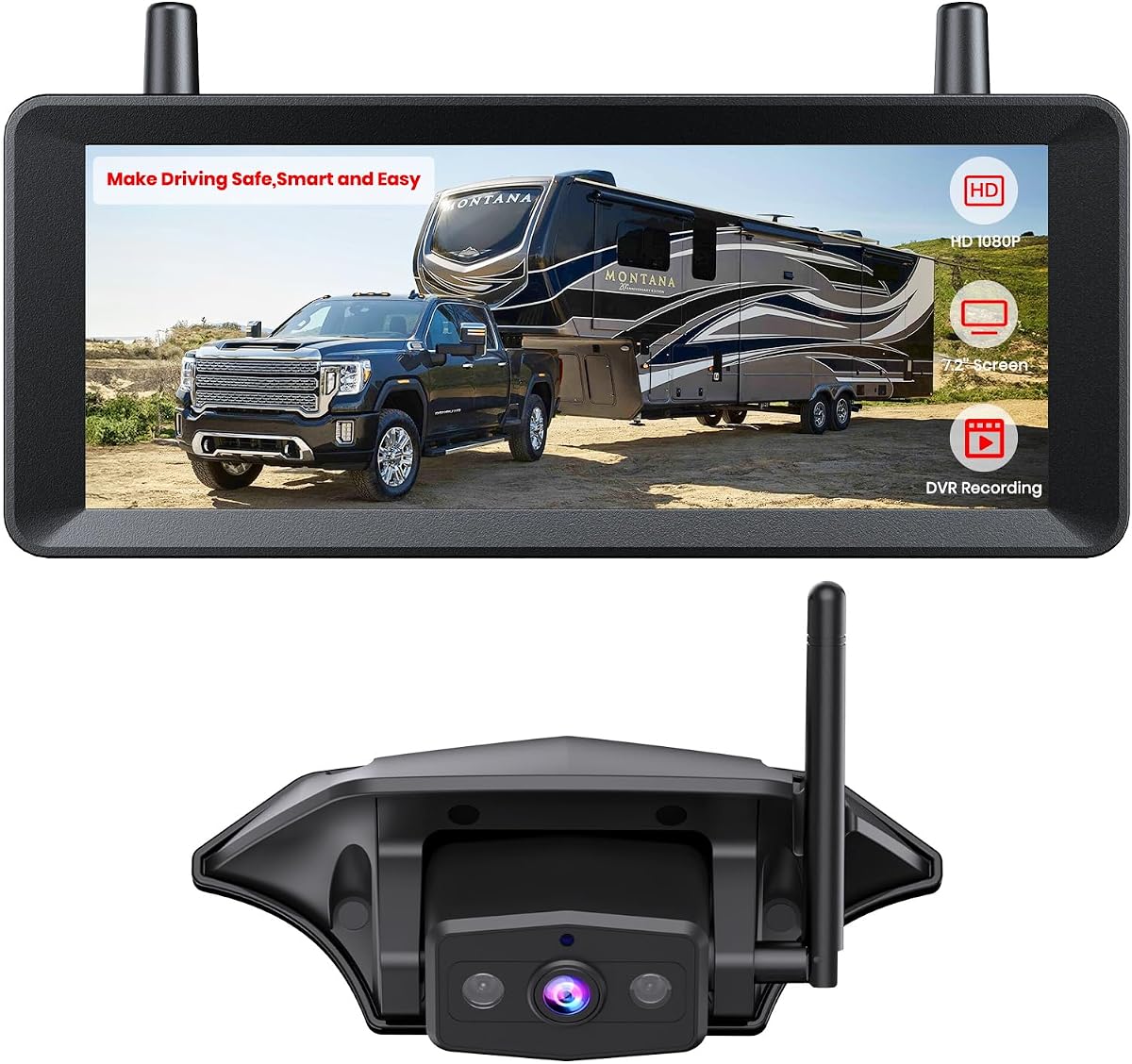
AUTO-VOX Wireless RV Backup Camera
4.3Editor score
Thirty-minute typical installation
Three-camera expansion support
Automatic infrared night vision
Included 32GB recording card
An RV backup camera can make reversing a long trailer safer and more manageable, especially when campgrounds are dark, crowded, or packed with hidden obstacles. The best system combines a clear image, dependable wireless transmission, easy controls, and enough coverage for the RV’s blind spots.
This guide compares ten RV backup camera systems across signal range, display size, image resolution, infrared night vision, waterproofing, installation requirements, parking guides, recording functions, and camera expansion. It includes pre-wired, hardwired, magnetic, and multi-camera designs for different RV types.
Each review identifies the standout features, practical limitations, and ideal use case for the product. The top three selections emphasize overall versatility, convenient installation, and advanced coverage, while ratings and specifications reflect the supplied product information. Prices and availability can change.
4.3Editor score
4.4Editor score

4.4Editor score
As an Amazon Associate we earn from qualifying purchases.
The table below compares the ten systems by their most important characteristics, including display, image quality, transmission range, recording support, and installation style. It is designed to make it easier to identify the right camera for a compact trailer, a long fifth wheel, or an RV needing wider side coverage.



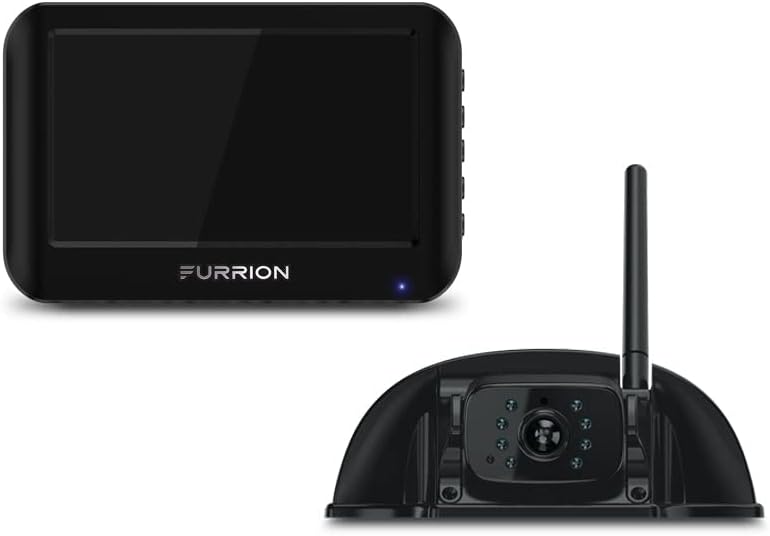
The Furrion Vision S 4.3 Inch Monitor is a compact, single-camera RV backup system with a 4.4 rating. Its strongest qualities are the unobtrusive display, wireless rear-camera design, waterproof construction, and infrared night vision. The built-in microphone also adds a useful audio dimension to parking guidance and campsite monitoring.
We may earn a commission when you buy through this link, at no additional cost to you.
Motion sensors can automatically wake the display, allowing the camera to serve as more than a reversing aid. That makes the system particularly interesting for owners who want an additional view of their RV while parked. The sharkfin rear camera and wide viewing angle are useful for judging the area behind a trailer, while infrared illumination helps reveal posts, branches, animals, and other obstacles after dark.
The central compromise is display size. At 4.3 inches, the monitor is smaller than the 7-inch and 7.2-inch screens offered by most competitors, so detailed inspection of a distant obstacle or hitch may require more attention. It also focuses on the rear rather than providing side cameras or multi-camera split-screen coverage. Buyers who need comprehensive perimeter visibility will find more capable alternatives in this list.
This is a strong recommendation for RV owners who prioritize a clean, compact installation and security-oriented features over maximum screen size. It should appeal particularly to pre-wired RV users seeking a straightforward Furrion-style setup. For a larger display, broader blind-spot coverage, or expandable cameras, the AUTO-VOX systems offer more flexibility.
The small monitor is less likely to dominate the dashboard, while motion activation and a built-in microphone make the system useful after parking. Those features extend its value beyond basic alignment assistance.
Infrared night vision helps illuminate the area behind the RV when conventional lighting is limited. The wide-angle camera also reduces the need to rely entirely on side mirrors during tight maneuvers.
We may earn a commission when you buy through this link, at no additional cost to you.
The AUTO-VOX Wireless RV Backup Camera System with Dual Lens Rear and Side Coverage is the most premium-oriented design in this roundup. It has a 4.4 rating and combines a 7.2-inch HD screen, a dual-lens rear camera, side-camera support, 1080P imagery, and a signal tested in open areas to 500 feet.
We may earn a commission when you buy through this link, at no additional cost to you.
Its dual rear lens is unusually versatile. One view follows the road behind the RV, while a lower bumper perspective helps with hookups, hitch positioning, campsite posts, and garage walls. Side cameras add visibility around blind spots, and the three-camera arrangement can be viewed on one screen. Dual antennas support stable video across rigs longer than 60 feet, an important advantage when the tow vehicle and trailer separate the camera from the display.
The system is not as simple as its plug-and-play competitors. A microSD card must be added separately for loop recording, and installing rear, side, and monitoring components requires more planning than mounting one rear camera. The range figure also reflects an open-area test, so walls, dense trees, and other obstructions can affect real-world performance. Even so, the flexible USB or 12V monitor power and DVR function add substantial value for frequent travelers.
RV owners who want the most complete visibility package should look here first. It is especially suitable for long rigs, fifth wheels, and drivers who routinely back into crowded campsites. The premium feature set makes this a strong all-around choice when budget is secondary to coverage, image quality, and long-range signal performance.
The road-facing and lower bumper lenses solve different problems. Drivers can monitor traffic without losing the close-range view needed to align a hitch or judge a campsite obstacle.
Dual antennas and a 500-foot open-area test make the system a compelling option for fifth wheels and trailers longer than 60 feet. Side views add an extra layer of protection in narrow parks.
We may earn a commission when you buy through this link, at no additional cost to you.
The AUTO-VOX Wireless RV Backup Camera with 30-Minute Plug and Play Setup earns a 4.3 rating and stands out as a well-balanced option. It combines a large 7.2-inch widescreen, high-definition imagery, automatic infrared night vision, multi-camera expansion, and an included 32GB card for recording.
We may earn a commission when you buy through this link, at no additional cost to you.
Installation is its main attraction. On a factory pre-wired RV, the system can typically be installed in 20 to 30 minutes without additional drilling. For rigs without compatible pre-wiring, included adapters allow connection to taillight power. The dual antennas are designed to maintain a stable connection on trailers and fifth wheels up to 60 feet, while the three-way split screen can show the rear and both sides.
A few limitations deserve attention. The stated signal focus is primarily for rigs up to 60 feet, so it may not be the first choice for unusually long combinations. Non-pre-wired installations also require suitable power access, and the recording function depends on the included card being inserted correctly. Despite these caveats, the combination of display size, night vision, expansion, and storage is unusually complete.
This is the best budget recommendation for typical travel trailers, campers, and fifth wheels that fit within the supported length range. It is particularly attractive to buyers who want a straightforward upgrade without paying for a more complex multi-camera package. For long rigs or comprehensive side monitoring, the premium AUTO-VOX dual-lens model offers greater range and flexibility.
The pre-wired design and included taillight adapters remove much of the complexity associated with adding a camera. Buyers should still verify connector style and available power before installation.
The included 32GB card means the DVR feature can be used without another immediate purchase. Loop recording provides a visual record of journeys and may help document an incident.
We may earn a commission when you buy through this link, at no additional cost to you.
The Fookoo HD 1080P 7-inch Wireless Backup Camera System has a 4.4 rating and a feature-rich specification. It uses a 7-inch IPS touchscreen, 1080P camera, IP69 waterproof housing, 120-degree viewing angle, six infrared lights, and dual-antenna 2.4GHz transmission.
We may earn a commission when you buy through this link, at no additional cost to you.
This model is particularly useful for owners whose RV already has a Furrion-style pre-wired mounting location, although the supplied information explicitly notes that it is not electrically compatible with the Furrion system. It can support up to four cameras and display multiple feeds at once. Touch controls, automatic screen dimming, parking lines, SD-card loop recording, and a stated 200-foot open-area reception range make it versatile for routine maneuvering.
Vehicle electrical systems are the biggest installation consideration. Some Chevrolet, GMC, and Ford models use PWM signals that can cause flickering or failure without a compatible power adapter or filter. A constant 12-volt source may also be necessary. These are not unusual automotive realities, but they can add cost or complexity if the installer does not have the appropriate adapter.
The Fookoo is a strong option for an RV owner seeking a large touchscreen, four-camera potential, and generous recording features. It is particularly suitable for compatible pre-wired installations and light-duty use. Buyers should check their wiring system and connector arrangement before buying, particularly on newer trucks with PWM-controlled lighting circuits.
The IPS display offers responsive touch operation, automatic dimming, and enough screen area for parking guides. It remains easy to consult without taking attention away from the road for long.
Supporting up to four cameras gives owners room to build beyond a single rear view. Split-screen modes can make side and rear monitoring more practical as the system expands.
We may earn a commission when you buy through this link, at no additional cost to you.
The 1080P Strong Magnetic Wireless Backup Camera has the highest rating in the supplied group at 4.5. Its defining feature is a magnetic mounting base that can attach to a metal surface in about one minute, avoiding screws, drilling, and a professional installation appointment.
We may earn a commission when you buy through this link, at no additional cost to you.
The camera delivers 1080P imagery, a 170-degree lens, infrared low-light assistance, and an IP69K rating. A built-in solar panel charges the battery, while a USB-C port offers another charging option. The magnetic base is described as having a 50-pound pull and includes a scratch-resistant rubber contact surface. These qualities make the system attractive for quick, removable installations across an RV, truck, boat, or trailer.
Its stated 56-foot stable wireless link is the main constraint. That is sufficient for many compact and mid-sized RVs, but it is less generous than the 200-, 300-, and 500-foot figures associated with several competitors. The 170-degree lens may also introduce more edge distortion than a conventional perspective camera. Since the product information does not describe a broad multi-camera framework, buyers needing several side feeds should look at a dedicated multi-camera system.
This camera is best for owners who prioritize installation speed, portability, and a very broad rear view. It is an especially attractive choice when a permanent wiring job is undesirable or when the same camera needs to move between vehicles. Longer rigs or multi-point coverage requirements are better served by a system with stronger range and channel expansion.
The magnetic base removes most installation work and allows the camera to transfer quickly. A scratch-resistant contact layer helps protect painted metal surfaces where the mount attaches.
The 170-degree lens captures more of the area beside and behind the vehicle. That wider field is useful for detecting nearby posts, pedestrians, or campsite obstacles entering the frame.
We may earn a commission when you buy through this link, at no additional cost to you.
The AUTO-VOX Wireless RV Backup Camera System with Rear and Side Coverage has a 4.2 rating and is built around a 7.2-inch HD display. It provides rear and both side angles, 1080P video, infrared night vision, dual antennas, and a wireless signal tested to 500 feet in open areas.
We may earn a commission when you buy through this link, at no additional cost to you.
The main benefit is comprehensive orientation. A full-screen rear view is useful while monitoring traffic, while split views help during reversing and slow turns. Dual antennas are especially relevant for rigs longer than 60 feet because the camera is physically separated from the tow vehicle. The monitor can draw power through USB or a 12V outlet, making it easier to organize the dashboard and accommodate different tow vehicles.
A built-in DVR records automatically when the system is powered, and an included 32GB card removes the need for an immediate storage purchase. Loop recording overwrites older clips, which is convenient for continuous documentation. On the other hand, the system lacks the dual-lens rear view offered by the rank-two AUTO-VOX product. That means users may need to switch between separate camera feeds rather than toggle a close bumper perspective.
This is a good match for large RVs and owners who value side views more than a second rear lens. It also makes sense for frequent highway travelers because of its long tested range and automatic recording. Buyers seeking one especially compact rear camera can save complexity, but those with more demanding campsite maneuvering may prefer the dual-lens premium option.
Rear and dual-side coverage closes common blind spots around a trailer. The split-screen format keeps more than one angle available when maneuvering through narrow campgrounds.
Automatic DVR operation and the included card make the system useful for documenting routes and incidents. Older recordings are overwritten automatically as storage fills.
We may earn a commission when you buy through this link, at no additional cost to you.
The Dual Camera 4CH Monitor is a 4.4-rated system that includes two cameras and a 7-inch 1080P display. It supports up to four channels, allows single, dual, and quad split views, and uses dual antennas for a stated signal range of up to 300 feet.
We may earn a commission when you buy through this link, at no additional cost to you.
The included cameras have a 150-degree lens, automatic infrared night vision, and IP69K waterproofing. Their housings are rated for temperatures from minus 23 to 179 degrees Fahrenheit and are designed to reduce fogging. A custom metal adapter bracket fits many factory pre-mounted RV bases, allowing installation without drilling in compatible vehicles. The recording system supports SD cards up to 256GB and automatically loops through available space.
Parking guide lines are unusually adjustable. They can be moved in four directions, changed in width, or disabled entirely. That gives drivers a better chance of aligning a towable RV using visual references suited to the vehicle and campsite. The main drawback is that the storage card is not included, despite recording being one of the system’s major features. Both the monitor and cameras also need a wired 12V power connection.
The system is an effective choice for owners who want multi-camera flexibility without moving to a more complex premium package. It works particularly well for compatible pre-wired RVs, but the bracket and power requirements should be confirmed before installation. Add a suitable memory card before relying on the DVR, and keep the 12V wiring secure and protected from road debris.
Four-channel support and several split-screen arrangements make it possible to add cameras over time. The included pair provides a stronger starting configuration than a single-camera system.
Movable, resizable, and removable guide lines can be tailored to different trailers and parking situations. This makes the display more useful than a system with fixed markings.
We may earn a commission when you buy through this link, at no additional cost to you.
The AUTO-VOX Wireless RV Backup Camera System with Rear and Side Cameras has a 4.3 rating and emphasizes quick installation, low-light visibility, and long-range monitoring. Its 7.2-inch monitor supports a three-way split screen, while the 1080P camera includes infrared LEDs for campground parking after dark.
We may earn a commission when you buy through this link, at no additional cost to you.
For pre-wired RVs, the included adapter bracket and pigtail harness support a faster setup. Otherwise, the camera can connect to a 12V source. Dual antennas provide a smoother live view and a stated transmission range up to 500 feet, making the system relevant to fifth wheels and other long combinations. The rear and side views can be combined when traveling through narrow campground roads and then switched to a single view for detailed alignment.
The DVR requires a compatible microSD card, which is sold separately. It also has a somewhat narrower explicit channel description than some systems: three camera views are supported, while four-channel expansion is emphasized by the rank-seven product. Buyers should confirm compatibility before adding side cameras, as not every camera with a similar appearance is necessarily part of the same system family.
This AUTO-VOX model is a solid middle-to-premium choice for long rigs and campers that need both rear and side awareness. It offers the most useful combination when the RV is already pre-wired, when nighttime campsite arrivals are common, and when automatic highway-speed viewing is important. Users who want the very lowest transmission figure should instead choose a basic single-camera system.
The bracket and pigtail harness simplify the physical and electrical connection for compatible factory installations. Non-pre-wired owners can still use a standard 12V connection.
A 1080P sensor and built-in infrared LEDs help distinguish trees, posts, animals, and other hazards in dim conditions. The feature is especially valuable during late campground arrivals.
We may earn a commission when you buy through this link, at no additional cost to you.
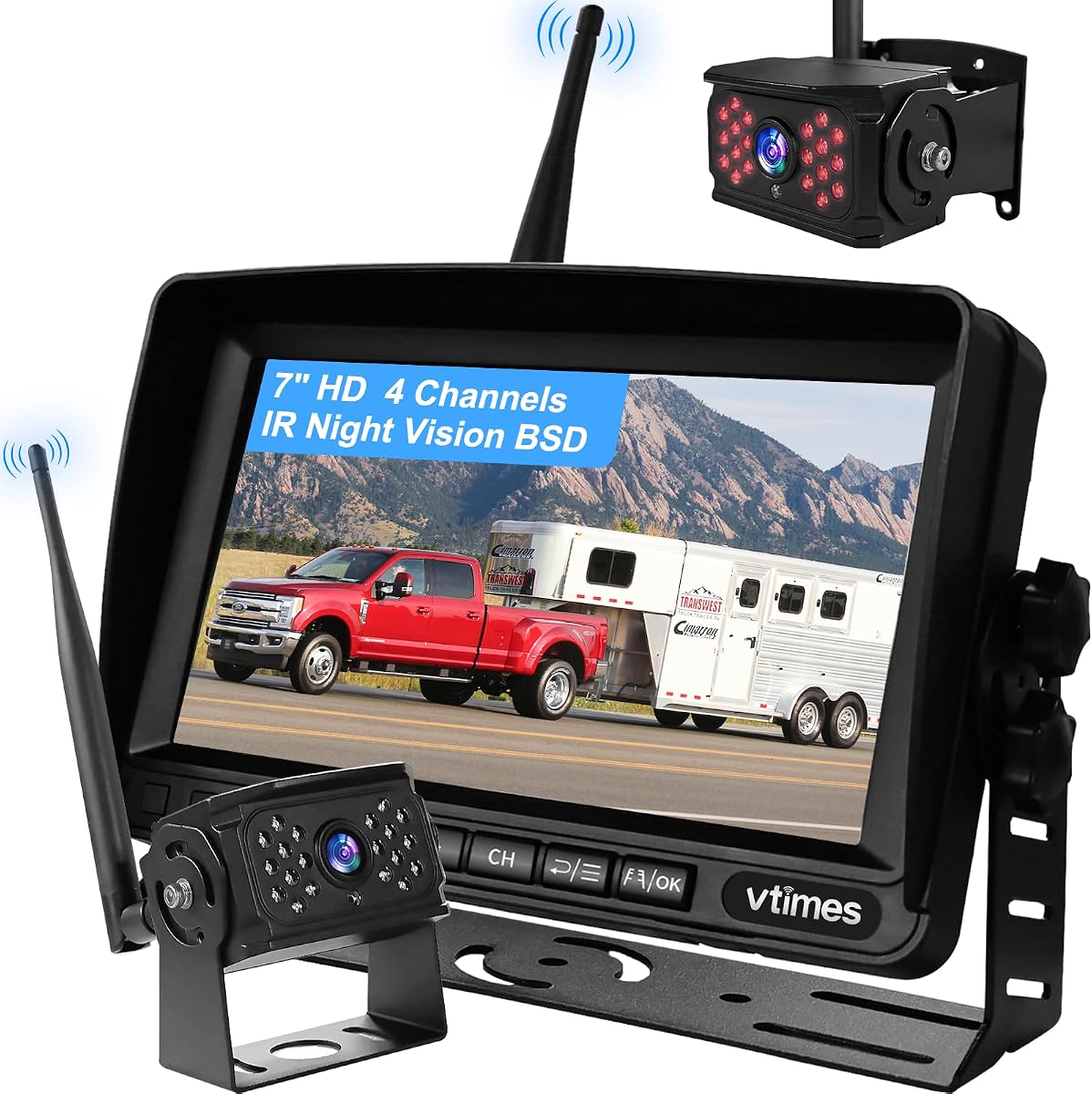
The VTimes Wireless Backup Camera for Trucks and RVs has a 4.2 rating and a 7-inch display. Its most notable features are a stated 984-foot, or 300-meter, open-area range, a 120-degree viewing angle, blind spot detection, AI human detection alerts, and support for recording all four video channels simultaneously.
We may earn a commission when you buy through this link, at no additional cost to you.
The 2.4GHz encrypted transmission is presented as a way to provide a stable, private signal. The camera uses an all-metal IP69K housing designed to resist weather, shock, road spray, and dust. Installation is partly wireless: the monitor connects to a cigarette-lighter socket, while the camera draws power from the tail, reversing, or running light. For compatible Furrion pre-installed systems, a mounting bracket and pigtail are included.
Although the product is marketed as a no-wiring system, the camera still needs a power connection, and users should not interpret the wireless video path as a fully wireless installation. Blind spot detection can be turned on or off, and identified people or objects are highlighted on the display with an audible warning. The four-channel recording function supports playback, but the required microSD card is not included.
This is an attractive choice for owners who prioritize alerts, a broad transmission range, and the ability to record several views. The open-area range figure should not be treated as a guaranteed real-world distance through dense forests or around tall structures. It is still a capable system for RV and truck use, particularly when blind spot warnings add a different type of assistance beyond guide lines.
Blind spot detection can highlight a person or object and provide an audible warning. This adds useful awareness in situations where a driver may not notice an approaching subject immediately.
The advertised 984-foot open-area range provides ample headroom for long setups. Actual performance varies with terrain, vegetation, structures, and the placement of the camera and monitor.
We may earn a commission when you buy through this link, at no additional cost to you.
The AUTO-VOX RV Backup Camera Wireless Plug and Play is a 4.1-rated system designed to suit a wide range of RVs, fifth wheels, trucks, travel trailers, campers, and buses. It includes a 7.2-inch widescreen monitor, 1080P color camera, super-wide-angle lens, infrared night vision, and support for up to three cameras.
We may earn a commission when you buy through this link, at no additional cost to you.
Installation is centered on convenience. A pre-wired RV can use the included mounting bracket adapter and pigtail wire, while other vehicles can draw power from taillights, running lights, or marker lights. Dual antennas support a stable connection, and the system is tested to 500 feet. That makes it a plausible option for long rigs as well as smaller travel trailers. DVR recording is available when a suitable SD card is inserted.
The 4.1 rating is the lowest among the listed products, though it still reflects a generally positive reception. The available information does not mention an included memory card, so recording requires an additional purchase. The system also has a less expansive channel count than the four-channel alternatives, although three cameras are enough to cover the rear and both sides in many RV configurations.
This model is a sensible option for drivers who need broad vehicle compatibility, a large display, and expandable coverage without moving to the dual-lens or four-channel premium designs. It is particularly convenient for pre-wired RVs. Comparing it against the similarly positioned AUTO-VOX Plug and Play product can help buyers determine whether included storage or more detailed camera features justify a different system.
A pigtail, bracket adapter, and several possible lighting-power connections give the system broad installation flexibility. The large monitor can also be positioned to suit the tow vehicle.
Three-camera support allows the rear camera to be complemented by side views. This is useful for campground lanes, hookup alignment, and checking both rear corners.
We may earn a commission when you buy through this link, at no additional cost to you.
The best RV backup camera is the one that fits the vehicle, installation, and driving conditions. Image quality and wireless range matter, but power requirements, screen placement, recording support, and camera expansion can be equally important to long-term satisfaction.
Wireless range should be evaluated in relation to the full length of the tow vehicle and trailer. Systems tested to 200 feet suit many ordinary RVs, while 300-foot and 500-foot options provide more margin for fifth wheels, long travel trailers, buses, and multi-vehicle setups. A generous specification does not guarantee uninterrupted performance through dense trees, buildings, or terrain, but it provides a better starting point. The AUTO-VOX dual-lens, rear-and-side, and most-RV-compatible systems claim 500-foot testing, while the Fookoo and dual-camera four-channel products advertise shorter but still substantial ranges.
A rear camera is enough for basic hookup alignment, while side cameras can help with blind spots, narrow campground roads, and parking near posts. Three-way split screens are useful for a rear-and-both-sides arrangement. Four-channel systems add more expansion potential, although only two cameras are included with the featured four-channel model. The dual-lens AUTO-VOX takes a different approach, using two rear perspectives—one for traffic and one for close bumper-level detail—while also supporting side coverage. Decide whether the priority is side visibility, close rear detail, or the ability to add more cameras later.
A high-definition image makes license plates, posts, branches, and campsite objects easier to identify. Most featured systems use 1080P, while the Furrion Vision S also lists 1080P rear-camera imagery. Resolution alone is not the whole story, so lens width and infrared illumination matter. Automatic infrared night vision can reveal wildlife, pedestrians, low obstacles, and uneven campsite surfaces after dark. Fookoo uses six infrared lights, the AUTO-VOX systems include infrared capability, and the VTimes camera has 20 built-in infrared lights. Wide-angle views improve situational awareness but may introduce edge distortion or make objects appear smaller.
Wireless video does not necessarily mean no wiring. Cameras and monitors usually need a reliable 12V power source, and many pre-wired RVs already have a convenient bracket and pigtail connection. The AUTO-VOX Plug and Play product lists a typical 20-to-30-minute installation for factory pre-wired rigs, while the magnetic system avoids drilling by attaching to a metal surface. Fookoo may require a PWM-compatible power adapter on some Chevrolet, GMC, and Ford vehicles. Before buying, inspect the RV’s rear camera location, lighting connections, monitor position, and available constant power.
Most systems use a 7-inch or 7.2-inch widescreen display, which is large enough to show parking lines and nearby obstacles while remaining practical in a tow vehicle. The Furrion Vision S stands apart with a compact 4.3-inch monitor, offering a less obstructed dashboard but fewer visible details at a glance. Bright displays with automatic dimming are easier to use during both daylight and nighttime driving. Consider where the monitor will be mounted, whether it blocks a vent, gauge, or window, and whether the controls remain easy to reach without distraction.
DVR recording can provide a visual log of trips, campsite activity, and incidents. Some products include a 32GB card, while others require a compatible microSD card that is sold separately. Capacity support varies, with the four-channel product accepting cards up to 256GB and the VTimes system supporting 8GB to 128GB. Loop recording automatically replaces older footage when storage fills. Buyers who want immediate recording should check package contents carefully, while frequent drivers should also consider card capacity, write reliability, and how easily recordings can be reviewed.
An RV camera remains exposed to rain, road spray, dust, mud, snow, vibration, and temperature changes. IP69K appears on several of the strongest outdoor-oriented options, including the magnetic camera, four-channel system, AUTO-VOX rear-and-side product, and VTimes camera. The Fookoo camera carries an IP69 rating, while the Furrion system is described as waterproof. Ratings are useful but should be supplemented by secure mounting, protected connectors, and a camera position that reduces direct impact from road debris.
Parking lines can provide a reference for aligning a trailer, but they are not a substitute for direct observation. Some systems allow lines to be moved, resized, or disabled, which helps account for different trailer lengths and camera positions. The VTimes adds blind spot detection and AI human detection with audible alerts, offering a different layer of assistance. Split-screen viewing is useful when the main display is dedicated to one camera. The best setup combines visual references, direct observation, and mirrors rather than depending on a single electronic cue.
Begin with a powered-off installation. Mount the camera securely in the recommended rear or side position, connect it to an appropriate 12V source, and route wiring away from sharp edges, suspension components, exhaust areas, and road debris. On pre-wired RVs, confirm that the bracket and pigtail match before removing anything. If the system uses an adapter for a particular vehicle, install it according to the manufacturer’s guidance and test for flicker or unstable power.
Power the monitor and pair it with the camera, then verify the image before driving. Check that the display is bright enough during the day, automatic night vision activates in darkness, and guide lines correspond to the trailer. Test full-screen and split-screen views, as well as every added camera. If DVR recording is included or supported, insert the required card, format it if requested, and confirm that the footage can be played back.
For care, clean the lens regularly with a soft microfiber cloth and avoid harsh chemicals that could damage coatings. Inspect the mount, antenna position, weather seals, and connectors periodically, especially after long trips or severe weather. Keep the camera and monitor firmware or software updated if the manufacturer provides a supported method. Never adjust the system while the vehicle is moving, and treat the camera as an aid rather than the only method for judging clearance.
Usually not. Wireless refers to the video signal traveling between the camera and monitor, but both components commonly need a 12V power connection. Some systems can use a USB connection for the monitor, while a hardwired rear camera or a magnetic solar-assisted model offers different installation options. Buyers should check the power requirements before assuming no wiring work is needed.
The camera should have a comfortable margin over the total length of the tow vehicle and trailer. A 200-foot system may suit many shorter RVs, while 300-foot and 500-foot options are more appropriate for long fifth wheels and travel trailers. Trees, buildings, terrain, and antenna placement can reduce the effective range, so a higher specification is generally preferable for long rigs.
Yes, if the system supports compatible side cameras and a split-screen display. Several featured AUTO-VOX systems provide rear and both side views, while the four-channel product can display up to four cameras and includes two. The camera, monitor, and accessories must belong to a compatible system, so owners should confirm expansion requirements before installation.
Most of the featured cameras include infrared night vision that activates automatically as ambient light falls. Infrared illumination helps reveal people, animals, posts, curbs, and trees, although image detail can vary depending on distance and the camera’s angle. A good backup camera supplements, rather than replaces, properly positioned exterior lighting and careful observation.
No. Pre-wired systems can use different mounting and electrical technologies even when the brackets appear similar. The Fookoo product fits many Furrion-style mounting locations but is explicitly not electrically compatible with the Furrion system. Measure the location, inspect the connector, and confirm power requirements before purchasing a replacement for an existing camera.
It depends on the model. The AUTO-VOX Plug and Play, Rear and Side, and Dual Lens products either include or support a card, with the Plug and Play and standard Rear and Side listings including 32GB storage. The Fookoo, four-channel, VTimes, and other DVR systems may require a separate compatible microSD card. Check the package contents and supported card capacity.
No. Cameras provide an additional view, but image limits, blind areas, weather, lighting, and driver attention can still create uncertainty. Use the display with both side mirrors, check directly around the RV whenever it is safe, and proceed slowly. A wide-angle camera may show an object without making its exact distance immediately obvious.
Some systems are better suited to parked monitoring than others. The Furrion Vision S includes motion sensors that can auto-wake the display, a built-in microphone, and rear-camera coverage. DVR-equipped models may also capture activity, but recording behavior, power needs, and storage support vary. Owners should confirm that the camera remains active when the vehicle is stationary and that wiring is suitable for extended parked use.
The Furrion Vision S 4.3 Inch is the most compact and security-conscious overall choice, with motion activation, a microphone, and a straightforward rear-camera design. The AUTO-VOX Plug and Play system is the strongest budget-oriented option because it combines a large display, quick pre-wired setup, three-camera expansion, and included storage. For broad visibility and long-range performance, the AUTO-VOX Dual Lens system leads with its dual rear perspectives, side coverage, and 500-foot tested range.
The right alternative may be the magnetic system for tool-free portability, the four-channel model for flexible camera expansion, or the VTimes system for blind spot alerts. Prioritize compatibility with the RV, reliable power, enough wireless range, and a viewing angle that suits the rig. A larger screen and night vision are helpful, but they cannot replace careful maneuvering and the use of mirrors.
Before making a final purchase, confirm the exact mount, connector, power requirements, DVR storage, and side-camera compatibility. Current prices, promotions, and product availability can change, so checking the latest listing details can help ensure that the selected camera system still represents the intended configuration.