
Yamaha MODX M6
5.0Editor score
Three modern synthesis engines
Color touchscreen and six knobs
Fifty-nine semi-weighted keys
Looking for a synthesizer for synthwave? Compare ten top-rated instruments for analog warmth, FM detail, polyphony, portability, sequencing, and live performanc
A synthwave synthesizer must balance expressive analog-style tones, fast sound design, and the ability to evoke everything from polished 1980s pop to dark, retro-futuristic electronic music. The right instrument should make vintage character accessible while offering enough modulation, sequencing, and polyphonic control to support modern production.
This guide compares ten synthesizers suited to synthwave, covering portable digital and hybrid models, performance-focused keyboards, polyphonic analog instruments, and premium monophonic designs. Each model was evaluated using its documented engine, controls, connectivity, keybed, sequencing features, modulation, and suitability for common synthwave tasks.
The list reveals that no single architecture is ideal for everyone. Hydrasynth models excel at detailed wavetable work, the MODX M6 emphasizes streamlined exploration, MOOG and Behringer deliver analog character, and Arturia instruments make hybrid sound design approachable. Product availability and pricing change, so check current listings before buying.
5.0Editor score

4.8Editor score

4.9Editor score
The comparison below highlights each instrument's synthesis approach, performance controls, sequencing capabilities, and practical advantages for synthwave. The two M-VAVE versions share the same core platform and are included separately to reflect their distinct black and white configurations.



The ASM Hydrasynth Explorer is a strong all-around choice for synthwave because it combines detailed digital synthesis with exceptionally expressive control. Its 4.8 rating reflects a well-regarded instrument capable of moving from bright, glassy wavetable patches to dark, animated sounds. The eight-voice architecture is especially useful for rich chords, arpeggios, and layered retro-inspired arrangements.
We may earn a commission when you buy through this link, at no additional cost to you.
Its three oscillators and four Mutators create a broad palette for spectral motion and complex wave shapes. These tools are particularly effective for the slow filter sweeps, textured pads, bright plucks, and dimensional leads associated with modern synthwave. POLYTOUCH polyphonic aftertouch, velocity response, MPE compatibility, and microtuning support give performers several ways to make each note interact differently with the patch.
The tradeoff is complexity. New users may need time to understand the architecture, and the 37 mid-sized keys are not ideal for pianists who require a large, heavily weighted keyboard. Even so, these limitations are easy to justify for anyone who wants detailed modulation and expressive nuance rather than a simple collection of preset categories. It is more a sound-design workstation than a one-button instrument.
The Explorer is ideal for producers who build synthwave arrangements, experiment with unusual timbres, and perform live. It works particularly well when the goal is to create distinctive evolving pads, animated basses, or richly modulated leads. For those priorities, it is our strongest overall recommendation.
The combination of wave morphing, multiple oscillators, and expressive aftertouch can turn a simple held chord into a slowly evolving sound. That level of movement is valuable for wide synthwave pads that need to develop without relying on a separate effects processor.
Velocity, note-on or note-off behavior, polyphonic aftertouch, and MPE support make the Explorer responsive under expressive playing. These features help leads respond to subtle changes in pressure and let performers shape a patch in real time.
We may earn a commission when you buy through this link, at no additional cost to you.
The ASM Hydrasynth 49 is a particularly compelling wavetable synthesizer for synthwave, and its 5.0 rating is the highest in this group. It gives players a substantial 49-key keyboard while preserving the deep modulation and rapid patch navigation that make the Hydrasynth platform attractive to sound designers.
We may earn a commission when you buy through this link, at no additional cost to you.
Its advanced wavetable engine uses three oscillators, dual Wave Mutators, and two filters that can operate in series or parallel. Those tools are well suited to constructing polished pads, crystalline bells, aggressive basses, and bright digital leads. The Polytouch keybed adds polyphonic aftertouch over each note, while the ribbon controller, pitch wheel, and modulation wheel provide additional performance options.
Its main limitation is that the instrument is not as small as a dedicated portable synth, and its deep architecture can feel demanding for a first synthesizer. The user interface is designed to reduce paging and includes workflow shortcuts, which mitigates that concern, but experimentation remains central to the experience. Players wanting instant acoustic realism may find it less direct than an instrument centered on familiar categories.
Choose the 49-key model if you want near-sized expressive playing with advanced wavetable sound design. It is particularly appropriate for studio musicians who compose full arrangements, layer complementary parts, and want a keyboard that remains practical for extended sessions.
Three oscillators and dual Wave Mutators provide enough freedom to create both clean, familiar synthwave voices and more abstract hybrids. Layered, motion-focused patches can supply the glassy upper harmonics and dimensional movement common to modern retro-inspired productions.
The 49-key layout occupies a useful middle ground between compact controllers and large studio keyboards. Full-size keys, ribbon control, and polyphonic aftertouch make it practical for both arranging and hands-on sound shaping.
We may earn a commission when you buy through this link, at no additional cost to you.
The Yamaha MODX M6 combines three synthesis engines with an unusually accessible performance workflow, making it an excellent budget-oriented choice for synthwave. Its 5.0 rating reflects strong user reception, and the instrument is designed for both stage and studio. The classic analog, modern FM, and realistic instrument engines cover much of the territory synthwave producers need.
We may earn a commission when you buy through this link, at no additional cost to you.
A color touchscreen, six dedicated display knobs, upgraded navigation, eight physical faders, and the Super Knob make sound selection and live adjustment efficient. Its 61 semi-weighted keys provide a more substantial playing surface than compact novelty keyboards while remaining lighter than a large weighted controller. The Expanded Softsynth Plugin allows the MODX M experience to continue inside a DAW.
The main compromise is specialization. Although three engines offer broad coverage, the MODX M6 does not present the same raw depth of wave morphing as a dedicated specialist wavetable instrument. It also remains dependent on a digital and MIDI-centered workflow. These are not serious drawbacks for most musicians, who often benefit more from a coherent interface and broad sound selection than maximum complexity.
The MODX M6 suits beginners, live performers, and producers who want convincing analog, FM, and acoustic textures without navigating a deeply modular system. It is an especially strong recommendation for anyone building synthwave with basslines, leads, pads, and melodic parts in one streamlined instrument.
The analog, FM, and realistic instrument engines make the MODX M6 adaptable across punchy retro leads, glassy keys, basses, pads, and supporting textures. That variety supports complete synthwave sketches without requiring several separate hardware instruments.
Eight faders and the Super Knob encourage real-time adjustment rather than menu-only editing. For live shows, those direct controls can be more useful than extensive but hidden synthesis options.
We may earn a commission when you buy through this link, at no additional cost to you.
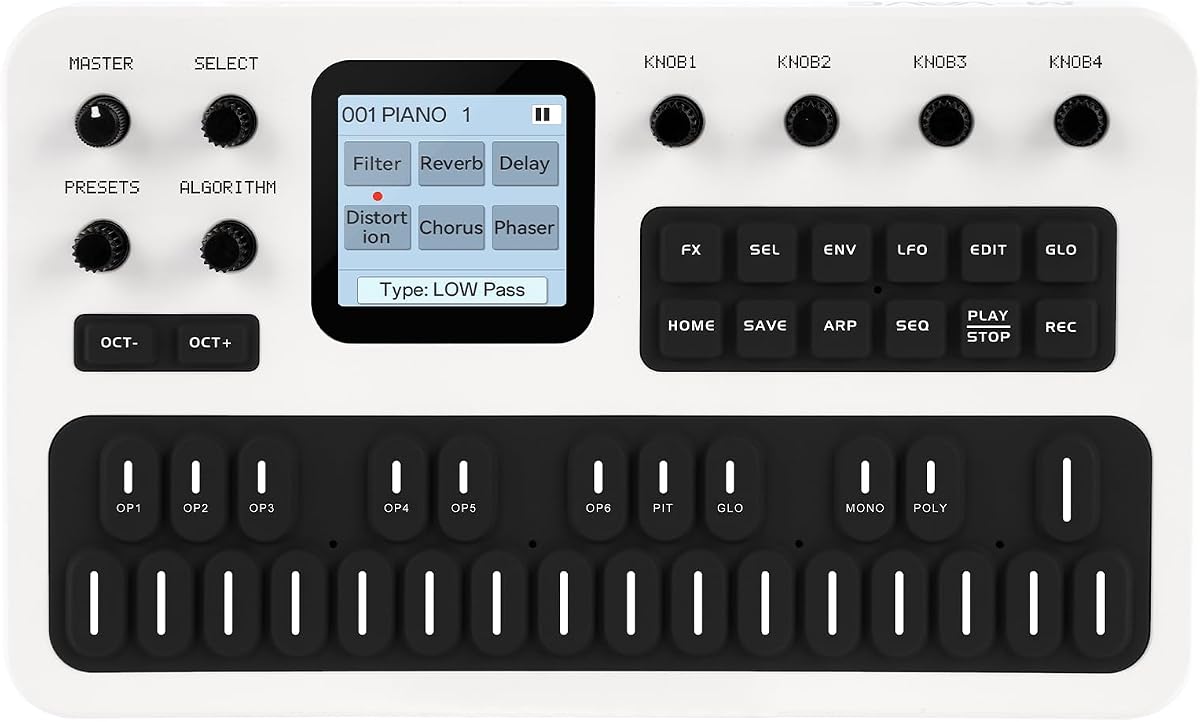
The M-VAVE FM Black puts the bright, glassy character of FM synthesis into a highly portable format. Its 4.4 rating reflects a capable instrument aimed at musicians who want to sketch ideas away from a permanent studio setup. A built-in speaker and battery operation allow it to function without a display, amplifier, or external power source.
We may earn a commission when you buy through this link, at no additional cost to you.
The synthesis engine provides six independent operators and 32 algorithm configurations, with real-time algorithm selection. Its 128 factory presets cover familiar categories such as pianos, strings, brass, basses, and electric synth sounds. A 16-step sequencer, seven arpeggiator modes, and six effects including filter, reverb, delay, distortion, chorus, and phaser support compact arrangement and performance ideas.
The 27 silicone keys are comfortable but do not imitate a traditional weighted keybed, and the TFT screen is small for intricate program editing. FM also has a very particular character, so listeners who prefer smooth analog-style basses or leads may need to rely on the instrument's presets and effects. The included sequencing and connectivity soften those limitations for portable use.
This is a good choice for practice, busking, travel, and quick inspiration sessions. Its ability to work as a MIDI controller, sound module, or wireless controller makes it a flexible companion for producers who want synthwave ideas away from the desk.
Battery operation and the integrated speaker remove most of the setup required for a portable instrument. The standard key layout and included sounds also make it approachable for users who do not want to begin with a blank patch.
The arpeggiator and 16-step sequencer can generate movement without a DAW. Combined with delay, chorus, and the ability to change algorithms in real time, they provide an effective way to develop synthwave grooves quickly.
We may earn a commission when you buy through this link, at no additional cost to you.
The MOOG Messenger is a premium monophonic synthesizer whose analog lineage and modern control system make it a compelling centerpiece for synthwave bass and lead work. Its 4.9 rating is among the strongest in the list. The instrument takes the familiar MOOG approach of immediate, knob-oriented sound design and adds a portable-oriented format with substantial modern features.
We may earn a commission when you buy through this link, at no additional cost to you.
Two continuously variable-shape VCOs, sync, frequency modulation, and a sub-oscillator provide a broad range of raw analog timbres. The next-generation ladder filter supports low-pass, band-pass, and high-pass responses, and its resonance bass compensation helps maintain body as resonance increases. A 64-step sequencer with probability behavior, parameter recording, and an arpeggiator adds modern rhythmic depth.
Its monophonic design is the decisive limitation for some players. Chords cannot be played conventionally, and users composing primarily layered pad music may find another instrument more convenient. However, a monophonic synth can force the focused melodic discipline associated with many classic electronic recordings, while the sub oscillator and bass compensation produce the weight needed for powerful synthwave bass lines.
Messenger is ideal for producers who want an instrument with a distinct sonic identity and are willing to specialize their technique. It is particularly well suited to expressive leads, punchy basslines, and sequenced sequences that benefit from analog warmth and probability-driven variation.
The dual VCOs, sub-oscillator, and compensated ladder filter can produce both weighty low-end and articulate upper-register leads. Those classic analog roles map directly onto the punchy basslines and melodic hooks expected in synthwave.
The 64-step sequencer supports independent rhythmic development and probability-based surprises. It provides the repeatability required for composed parts while retaining enough unpredictability to avoid sounding mechanically rigid.
We may earn a commission when you buy through this link, at no additional cost to you.
The Behringer POLY D brings a substantial four-voice analog architecture to synthwave players who want polyphony and traditional tone shaping. Its 4.5 rating indicates a well-liked instrument among those seeking fat analog sounds. The four VCO design offers layers of detuning and harmonic complexity that can become wide, bold, and slightly unruly.
We may earn a commission when you buy through this link, at no additional cost to you.
The instrument supports mono, unison, and polyphonic modes, making it adaptable for bass sequences, stacked leads, and chordal parts. A classic ladder filter, LFO, BBD stereo chorus, and distortion provide familiar tools for movement and grit. The 32-step sequencer and arpeggiator add immediate pattern creation, while the 37 velocity-sensitive full-size keys support practical playing.
The main compromise is the limited three-octave span, which can make full arrangements cumbersome. Its many oscillators may also become dense if every voice is pushed into the same frequency range. Clear gain staging and thoughtful unison or detuning choices remain necessary. Still, for players focused on pads, arpeggios, and retro unison leads, the architecture is compelling.
The POLY D is a good match for synthwave producers who want a hands-on analog instrument without committing to a deeply evolving hybrid system. It offers a familiar reason to use a hardware synth: simple, immediate control over familiar musical parameters.
Unison mode lets multiple voices share a note, creating the thick, slightly detuned texture associated with vintage analog performances. Adding chorus or distortion afterward can turn that raw stack into a convincing retro-futuristic lead.
Four-voice polyphony is enough for basic chords and practical melodic arrangements. It also provides a practical foundation for layering synthwave pads and short melodic parts without relying entirely on software.
We may earn a commission when you buy through this link, at no additional cost to you.
The Arturia MiniFreak is a compact six-voice hybrid synthesizer built for exploratory sound design, which makes it an exciting choice for synthwave producers who enjoy combining familiar and unfamiliar timbres. Its 4.7 rating suggests strong satisfaction, and the instrument's deliberately unconventional approach encourages experimentation rather than rigid emulation.
We may earn a commission when you buy through this link, at no additional cost to you.
Digital and analog synthesis elements work together, allowing familiar analog-filtered sounds to be placed inside more unusual digital structures. That hybrid character suits synthwave's appetite for familiar melodies presented with unusual timbres, bright digital transients, and forceful filtered movement. The 37-key format keeps the instrument compact, and six voices provide enough density for chords and layered sequences.
Compared with a conventional knob-heavy synthesizer, the MiniFreak presents a more compact and experimental control concept. That can feel liberating, but it also means users may need to consult the workflow while learning the instrument. The smaller keybed is not designed to replace a full-size studio controller, and those who need weighted playing may prefer a larger model.
The MiniFreak is best for creators who want character, variety, and discovery from a relatively compact instrument. It is especially useful for building unusual basses, animated pads, and experimental leads that can distinguish a production from a conventional synthwave preset pack.
Combining digital oscillators with analog filtering creates a useful middle ground between polished digital sounds and raw analog circuits. The result can provide both the bright edges and the filtered body associated with memorable synthwave production.
The 37-key layout limits the space available for broad two-handed arrangements, but it makes the instrument easier to position near other studio gear. For bass, lead, and texture programming, that compactness can be a practical benefit.
We may earn a commission when you buy through this link, at no additional cost to you.
The Arturia MicroFreak is the most overtly experimental instrument in this guide, and that experimentation is exactly why it can be valuable for synthwave. Its 4.6 rating reflects a distinctive hybrid design with 17 paraphonic oscillator modes, a resonant analog filter, and extensive modulation. Instead of imitating one classic machine, it combines multiple synthesis approaches in a remarkably compact body.
We may earn a commission when you buy through this link, at no additional cost to you.
Its unusual 25-key keyboard is a pressure-sensitive flat circuit board that detects notes, individual note pressure, and aftertouch. Four dedicated oscillator knobs, a 5-by-7 modulation matrix, Spice and Dice sequencing tools, randomization, and automation recording make it possible to create sounds that constantly change. Modes such as Superwave, Harmo, Vocoder, Noise, Karplus-Strong, and Wavetable offer strong starting points for unusual synthwave layers.
The atypical keyboard and minimalist interface are meaningful compromises. Some users will enjoy the novelty, while others may find the surface less natural than conventional keys. The limited 25-note span is also not designed for complete keyboard arrangements. Editing advanced modulation also takes time, so it is better suited to patients willing to explore than users seeking a conventional workstation.
Choose the MicroFreak when distinctive sounds matter more than conventional playing. It can add unusual noise, evolving digital textures, physical-modeled material, and responsive per-note expression to a synthwave production, particularly as a supplementary instrument rather than a primary melodic controller.
A broad collection of oscillator modes lets a single patch move beyond familiar subtractive synthesis. These engines are useful for adding strange upper harmonics, noisy transitions, and model-based character to otherwise conventional synthwave arrangements.
Individual note pressure detection allows one part of a chord to behave differently from another. Combined with the modulation matrix, it creates a level of internal movement that a conventional keybed and fixed signal path would not provide.
We may earn a commission when you buy through this link, at no additional cost to you.
The M-VAVE FM White offers the same portable six-operator FM platform as the black edition, distinguished primarily by its white finish. Its 4.4 rating and extensive feature set make it a practical choice for creating bright synthwave sounds in compact spaces or away from a studio desk.
We may earn a commission when you buy through this link, at no additional cost to you.
Six operators, 32 algorithms, 128 factory sounds, and support for standard FM SYSEX sound banks provide a satisfying variety of electric pianos, basses, strings, brass, and synthetic textures. A 16-step sequencer with recording, playback, and looping works alongside a seven-mode arpeggiator. The six built-in effects cover many common needs, including delay, reverb, distortion, chorus, and phaser.
Its 27 silicone keys are best suited to portable playing and idea generation rather than serious weighted-key performance. The small TFT also limits the convenience of deep visual editing, and the sound character is inherently FM-based. In addition, because the black and white versions share the same core instrument, buyers should consider finish preference alongside availability rather than expecting meaningfully different sonic capabilities.
The white model is a good fit for players who want a compact sequencer, wireless MIDI, and classic FM colors without a large footprint. It is particularly useful for rehearsing ideas, testing arrangements, and generating synthwave riffs away from a computer.
Changing among 32 algorithm configurations in real time makes it possible to move between fundamentally different harmonic relationships. That flexibility is valuable when shaping leads, basses, and textured layers during a performance.
Sequencing, arpeggiation, effects, MIDI, wireless control, a speaker, and battery operation are all integrated. The result is a self-contained instrument that can move from a standalone sketch to a DAW-connected workflow.
We may earn a commission when you buy through this link, at no additional cost to you.
The teenage engineering OP–XY is less a conventional synthesizer and more a complete portable production system, yet its eight synthesis engines, sampling capability, and 64-step sequencing make it highly relevant to synthwave. Its 4.1 rating is the lowest in this list, which may reflect the specialized nature of its workflow rather than limited creative potential.
We may earn a commission when you buy through this link, at no additional cost to you.
Eight instrument tracks can be sequenced independently, while eight auxiliary tracks can control external synthesizers, modular systems, and effects. Punch-in FX, step components, randomized timing, velocity and pitch changes, live automation, and chord generation provide a deep set of ways to manipulate patterns. Built-in sampling, a microphone, CV, effect sends, and a high-quality DAC extend the range beyond ordinary preset playback.
Its specialized layout demands a greater time investment than the more conventional instruments here. The device is optimized for a portable, sequence-centered workflow, not for playing broad two-handed arrangements on a traditional keyboard. Users expecting familiar knobs and a full piano-style key range may find the transition challenging. It also represents the most substantial commitment in the guide, so careful consideration is appropriate.
The OP–XY is ideal for artists who think in patterns, samples, and evolving arrangements. It can function as the central controller for a compact performance setup, particularly when combining its own engines with external analog or modular gear. For that workflow, it is among the most complete options in the roundup.
Independent instrument and auxiliary tracks allow several musical layers to evolve at once. The system can therefore function like a miniature arrangement workstation rather than a single-sound source.
Auxiliary tracks, CV connections, effect sends, and multi-output options allow the OP–XY to coordinate external hardware. That makes it especially useful for producers who want sequenced modulation to accompany classic analog gear.
We may earn a commission when you buy through this link, at no additional cost to you.
The right synthwave instrument depends on whether you prioritize analog authenticity, vivid FM detail, deep modulation, portability, sequencing, or a fast path from idea to arrangement. Consider the architecture and performance features together rather than judging only by the number of oscillators or included sounds.
Analog circuits are valued for continuous control, evolving nonlinearity, and recognizable tonal character. They are particularly effective for punchy basses, warm leads, and filters that respond naturally to a performer's touch. Digital and wavetable instruments excel at complex stored spectra, fast preset recall, and unusual timbres, while FM synthesis delivers bright, complex tones associated with classic digital recordings. Hybrid instruments combine these approaches and can offer broader range, although their control systems may require more study.
In short, choose the engine that matches the music you want to make rather than assuming one synthesis method is automatically more retro.
Polyphony determines how many notes can sound together. Four or six voices are enough for many chords, arpeggios, and stacked parts, while eight voices provide more room for broad arrangements. A monophonic instrument is more specialized: it excels at sequenced bass lines and focused melodic solos, but it cannot reproduce conventional chords. Examine whether the model paraphonically follows the lowest note, offers unison modes, or provides fully independent voices.
Match voice count to the role you expect the synthesizer to play in a complete song.
Filters shape brightness and movement, often defining the emotional character of a synthwave patch. Ladder-style low-pass filters can produce smooth, powerful sweeps, while multimode filters offer additional band-pass and high-pass options. Resonance increases emphasis around the cutoff frequency and can create the exaggerated vocal or acid-like character associated with electronic music. Some instruments include compensation to preserve bass weight as resonance rises.
Look for a filter that is easy to control during performance, along with enough modulation destinations to make the cutoff move naturally.
Oscillators create the initial waveform, but modulation makes a patch feel alive. LFO routing, envelopes, velocity, aftertouch, MPE, and assignable controls can add motion to pitch, filters, amplitude, and other parameters. Deep modulation is valuable for slow cinematic pads, rhythmic basses, and leads that respond to performance pressure. Macro controls can provide a simpler alternative when immediate musical control matters more than extensive routing.
Prioritize instruments that offer clear modulation paths and useful performance assignments, not merely a large number of controls.
The keybed influences how naturally an instrument feels during long sessions. Full-size keys provide a familiar layout, semi-weighted keys offer a useful compromise between lightness and resistance, and silicone or pressure-sensitive surfaces prioritize portability and experimental expression. Velocity response is essential for subtle dynamics, while polyphonic aftertouch allows each note to be shaped independently. MPE support can provide even more detailed continuous expression.
Choose the playing surface that matches your technique, whether you need conventional piano habits, fast sequencing, or sensitive per-note control.
An onboard sequencer can accelerate bassline and arp development while making an instrument more standalone. Look at step count, pattern length, recording, playback, looping, parameter recording, probability, and external synchronization. Some compact devices focus on short patterns, while larger or more specialized systems can run multiple tracks at independent speeds. Arpeggiator modes, rhythmic controls, and clock options add further flexibility.
For synthwave, a usable sequencer should support the repeated motifs and evolving variations that define many tracks.
USB MIDI, DIN MIDI, CV, gate, audio input, and multi-output options determine how an instrument fits into an existing studio. DAW users should consider whether a matching softsynth is available, since that can allow hardware ideas to be continued in software. Wireless MIDI and Bluetooth are useful for mobile setups, while CV and gate connections make an instrument more compatible with modular and semi-modular systems. Ensure the required cable or interface is supported.
Check every connection you actually plan to use instead of assuming that a long feature list guarantees a smooth workflow.
A synthesizer is easiest to enjoy when its menus, categories, and controls match your experience. Some instruments provide broad engine categories and quick navigation, while others emphasize deep, experimental editing. Consider how many pages separate you from a sound, whether favorites are easy to recall, and whether essential parameters can be reached without hunting through menus. Built-in effects and performance macros can also reduce the need for external processing.
The best instrument is not automatically the one with the most features; it is the one whose workflow encourages you to finish and perform music.
Begin with one clearly defined sound goal, such as a wide pad, resonant bass, glassy pluck, or expressive lead, rather than randomly cycling through every preset. Adjust the oscillator or wavetable, filter, amp envelope, and primary modulation source first. Save versions of a patch as you refine it so that useful improvements remain available when a later experiment fails.
Build a synthwave arrangement in layers. Start with a bass or pulse that establishes the groove, add a supporting chord texture, then introduce a lead or arpeggio. Use velocity, aftertouch, envelopes, and filter movement to prevent identical notes from sounding static. When using onboard sequencing, save pattern variations and automate only a few meaningful parameters to create gradual change without losing focus.
For care, keep the instrument in a stable environment away from excessive heat, moisture, dust, and direct sunlight. Connect audio and control cables without forcing connectors, and avoid placing heavy objects on the keybed. Update software or firmware through the manufacturer's official process, back up user patches, and consult the original quick-start documentation for cleaning and transport instructions. Always power down properly and unplug the power cable before moving the unit.
No single type is universally correct. Analog synthesizers suit warm basses, expressive leads, and vintage filter sweeps, while FM instruments excel at bright bells, electric keys, and crystalline digital textures. Wavetable and hybrid instruments are especially useful when you want detailed timbres, unconventional timbres, and deep modulation. The best choice depends on the sound you are trying to create and the amount of programming complexity you enjoy.
Polyphony is helpful for pads, chords, and layered melodic parts, but it is not mandatory. Many classic electronic basslines and lead lines are monophonic, and a monophonic synthesizer can provide a focused, disciplined sound. If your music relies on wide chords, arpeggios, or several simultaneous melodic layers, choose a four-, six-, or eight-voice polyphonic model instead.
A smaller keybed is well suited to bass programming, leads, arpeggios, and portable performance because it saves desk space. It can be less convenient for broad two-handed arrangements or players accustomed to a full piano-style keyboard. Evaluate the key range, spacing, velocity response, and aftertouch features rather than deciding from the number of keys alone.
Velocity response, wheel and ribbon controls, polyphonic aftertouch, MPE, modulation routing, and assignable macros can all make a lead more responsive. A useful filter with clear cutoff control is also important because brightness changes are central to many synthwave melodies. The best setup is one that lets you alter important parameters quickly while performing.
Most of the models in this guide support USB or MIDI connectivity, although the exact connections vary. Check whether the instrument appears as a MIDI controller, whether it sends audio over USB, and whether a virtual instrument is available. DIN MIDI, CV, gate, and audio outputs may be more relevant if you work with modular or other analog hardware.
An onboard sequencer is useful but not essential. It helps when you want to build basslines, arpeggios, and repeating motifs directly in the instrument, and it can make a synth more independent of a computer. DAW sequencing provides more extensive editing and arrangement tools. The right balance depends on whether you want the hardware to function as a self-contained sketch instrument or as a controller within a larger production system.
Analog instruments are often chosen for the continuous movement and tactile character of their filters and oscillators, while digital instruments offer stable tuning, broad preset libraries, and complex stored waveforms. Modern hybrid instruments provide a compromise. A strong starting point is to listen for the tones you admire and then determine which engine most closely matches their character.
Ratings can indicate broad user satisfaction, but they do not reveal whether a product suits your workflow. Consider the size, sound engine, keybed, connectivity, and learning curve alongside the rating. A highly rated instrument may be excellent for its intended audience while remaining inconvenient for portable use, live performance, or a particular composing style.
The ASM Hydrasynth Explorer stands out as the most complete all-round choice because it combines detailed wave morphing, polyphonic aftertouch, MPE, and strong modulation. The Yamaha MODX M6 offers the most approachable and budget-conscious path, while the MOOG Messenger delivers the most distinctive premium experience for bass, lead, and sequenced analog performance. Each serves a different style of synthwave creator.
Before purchasing, decide which role the instrument will play. Choose a portable M-VAVE for spontaneous ideas, a Behringer POLY D for polyphonic analog warmth, an Arturia model for experimental hybrid timbres, or the OP–XY for sequence-centered production. Prioritize the keybed, control workflow, sound engine, and connections that match your music instead of focusing on a single headline specification.
Ratings, availability, and pricing can change over time, so review the current product listing and seller information before making a final decision. The right synthesizer should make the sounds in your head easier to reach while leaving enough room for experimentation as your synthwave style develops.