
Skar Audio RP-1500.1D
4.4Editor score
1,500W RMS at 1 ohm
On-board bass EQ
Remote level control
This 1500 Watt Car Amp guide compares power ratings, impedance, controls, protection, installation features, and ideal subwoofer applications.
A 1500 watt car amplifier is built primarily to deliver serious low-frequency power to one or more subwoofers, but the label alone does not tell the whole story. RMS power, stable impedance, electrical efficiency, filter controls, protection, and installation requirements determine whether an amplifier suits a particular vehicle and speaker system.
This guide compares ten monoblock and bridgeable amplifiers based on their published specifications, including output at different impedances, low-pass and subsonic filtering, bass boost, remote controls, thermal protection, terminal design, and chassis dimensions. The list includes conventional Class D models, a Class AB option, and bridgeable multichannel alternatives.
Each review identifies the amplifier's strongest use case and any meaningful compromises. Ratings, specifications, and availability can change over time, as can product pricing, so readers should verify the latest listing details and confirm their subwoofer's power handling and wiring requirements before making a final decision.
4.4Editor score
4.5Editor score

4.9Editor score
The table below compares all ten amplifiers by channel configuration, power output, load compatibility, and standout controls. Actual performance depends on proper gain matching, adequate power and grounding, correct speaker wiring, and a sound system designed for the enclosure in use.


The Skar Audio RP-1500.1D is a budget-minded Class D monoblock that publishes 1,500 watts RMS at a 1-ohm load, alongside 1,900 watts peak power. Its 4.4 rating reflects a strong overall value for installers seeking substantial one-ohm power without stepping into a higher-end specialized amplifier category.
We may earn a commission when you buy through this link, at no additional cost to you.
Its most useful controls include a remote subwoofer level control, a low-pass-oriented 20-to-250Hz frequency response, and an on-board bass EQ switch offering 6dB or 12dB of boost at 45Hz. Four-way protection and large 4-gauge power and ground terminals are particularly relevant because high-current car amplifiers need robust connections and dependable safeguards.
The trade-offs are functional rather than dramatic. The bass EQ offers two boost settings instead of a broad continuously adjustable sweep, and the specified frequency range limits its role to bass amplification rather than full-range speaker use. Buyers who want broad low-pass and subsonic adjustments should look instead to the Skar SA-1500.1D or Sundown models in this list.
This amplifier is a persuasive choice for a single high-power subwoofer, a pair of appropriately wired subwoofers, or a larger system that must run at one ohm. It is especially attractive when the installer values simple remote level adjustment, robust power terminals, and strong published one-ohm output without a complicated control layout. For most value-oriented subwoofer builds, it delivers the core features needed for a clean installation.
The specified 4-gauge power and ground terminals support the demands of a powerful Class D amplifier. A secure, correctly sized power connection helps reduce voltage drop, while the included four-way protection circuitry adds safeguards against common installation and operating faults.
The included remote gives the driver convenient level control without reaching under a seat or into the trunk. The two-position bass EQ can add 6dB or 12dB at 45Hz when the subwoofer system needs extra low-end weight.
We may earn a commission when you buy through this link, at no additional cost to you.
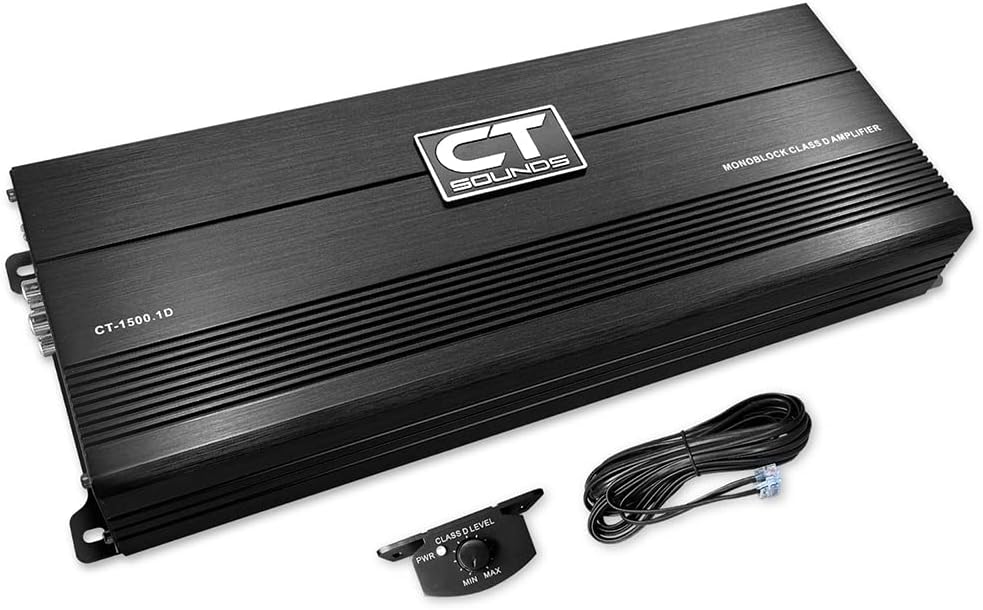
The CT Sounds CT-1500.1D combines a 4.5 rating with clearly stated output of 1,500 watts RMS at one ohm, 850 watts RMS at two ohms, and 450 watts RMS at four ohms. That makes it one of the most straightforward choices in the roundup for comparing amplifier capability against different speaker loads.
We may earn a commission when you buy through this link, at no additional cost to you.
Its compact chassis is designed to simplify installation in vehicles with limited space. A MOSFET pulse-width-modulated power supply, proprietary heat dissipation design, and four-way protection covering high voltage, low voltage, overcurrent, and high temperature emphasize efficiency and reliability rather than an extensive control suite.
The main limitation is tuning flexibility. A bass knob and subwoofer-focused frequency response are included, but the published specifications do not list a dedicated subsonic filter or the more advanced phase and crossover options found on the Sundown Audio models. Installers who need a highly adjustable system may find the simpler layout limiting.
Overall, the CT-1500.1D is the most balanced recommendation for a serious subwoofer installation that values clear specifications, compact dimensions, efficient power delivery, and essential protection. It suits buyers who want a capable one-ohm monoblock without paying for an extensive feature set, and its defined output at one, two, and four ohms makes system planning easier.
Published figures for one, two, and four ohms help shoppers estimate amplifier behavior before choosing a speaker arrangement. Matching those figures against subwoofer RMS requirements and the final wired impedance is essential for avoiding an overworked amplifier.
The compact enclosure and Class D efficiency make this model practical where cargo space is limited. Its thermal design and multi-protection approach support consistent operation, although the enclosure and vehicle ventilation should still allow heat to dissipate away from the amplifier.
We may earn a commission when you buy through this link, at no additional cost to you.
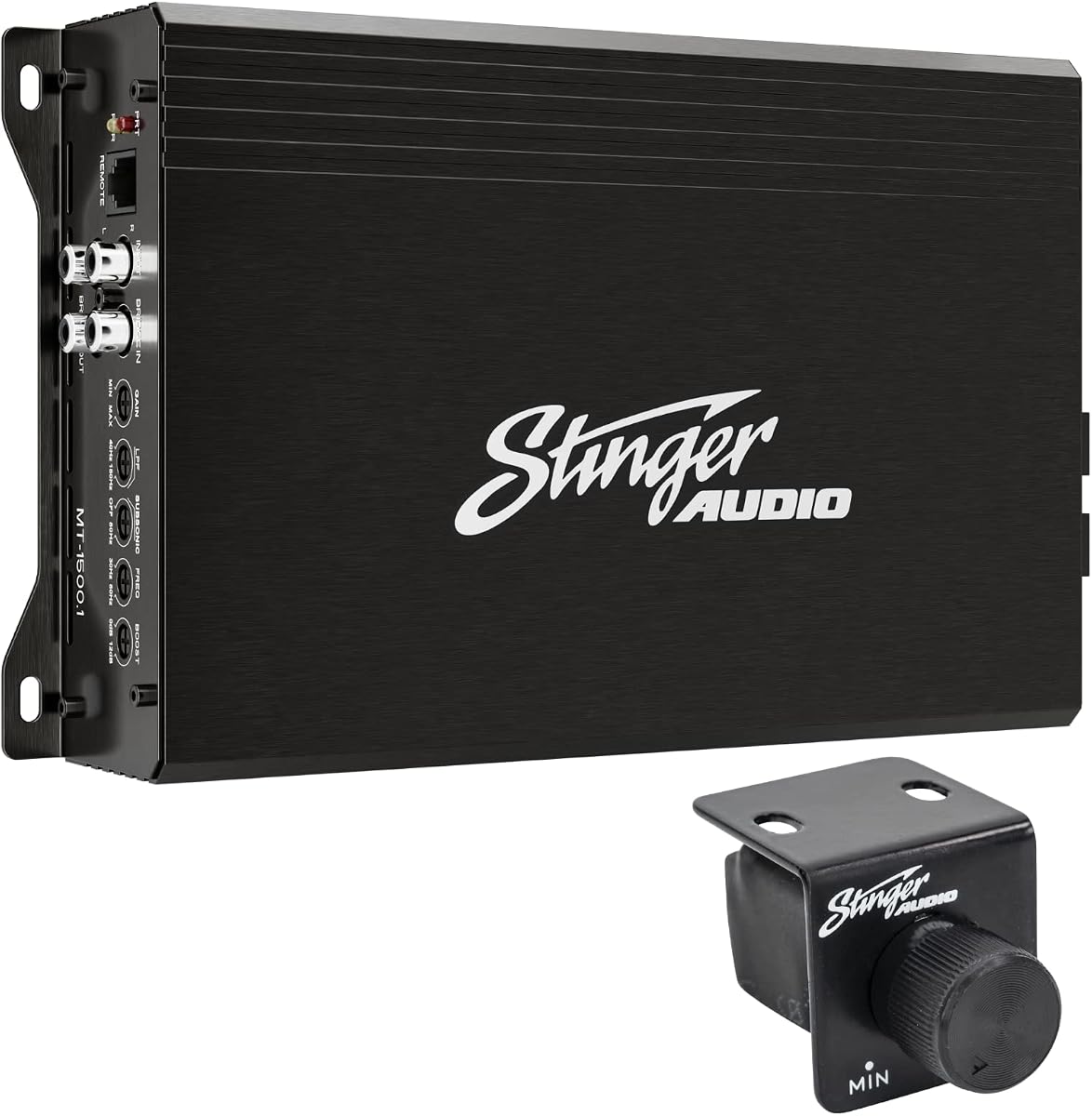
The Stinger Audio MT15001 is a compact Class D monoblock with a 4.2 rating and a feature set aimed at bass-focused installations. It is strapable at four, two, or one ohm, while the published output lists 1,000 watts RMS at two ohms and 550 watts RMS at four ohms.
We may earn a commission when you buy through this link, at no additional cost to you.
Its dimensions of 6.10 inches long by 10.16 inches wide and 2.09 inches high make it easier to place than a large full-size monoblock. Controls include a zero-to-12dB bass boost, one set of RCA line-level inputs, a remote bass control with a dash bracket, and PWM circuitry intended to improve efficiency and switching performance.
Its least clear aspect is the headline 1,500-watt designation. The specifications specify up to 2,800 watts at two ohms minimum bridged but do not provide an equally straightforward RMS figure for one ohm, and the model is described as strapable. Buyers should therefore compare the clearly stated RMS outputs with their actual load rather than assuming the headline number is continuous output.
The MT15001 is best suited to installation-sensitive builds using one or two subwoofers and a compact Class D architecture. It offers enough control for basic bass management and a convenient remote, but listeners who need broad crossover selection, phase adjustment, or numerous input options should consider a more specialized model. Its strongest appeal is the combination of compact size and practical features.
The stated chassis dimensions are particularly useful in small cars, hatchbacks, and tightly packed trunks. A smaller amplifier can simplify placement, but adequate clearance around the heat sink remains necessary so the amplifier can reject heat during sustained output.
The included remote can sit on the supplied dash bracket or be mounted flush into a console or panel. This lets the driver adjust subwoofer level conveniently while keeping the amplifier and its short control cable within reach of the cabin installation area.
We may earn a commission when you buy through this link, at no additional cost to you.
The Sundown Audio SFB-1500D earns a 4.5 rating and delivers 1,500 watts RMS at one ohm, 1,200 watts RMS at two ohms, and 650 watts RMS at four ohms. Those figures make it a serious monoblock for a single subwoofer or a multi-speaker arrangement that presents an appropriate load.
We may earn a commission when you buy through this link, at no additional cost to you.
Unlike simpler budget monoblocks, it offers a variable 12dB-per-octave low-pass filter, a high-pass filter, and bass boost ranging from zero to 12dB. A wired remote with a clipping indicator helps the installer monitor gain-related distortion, while a smart three-speed cooling fan manages heat as operating demand changes.
Thermal, voltage, speaker-short, and DC-offset protection help protect the system, and the dual MOS-FET PWM supply is designed for efficient power delivery. The trade-off is physical size and the added complexity of an active cooling fan. A 140-amp fuse rating also calls for careful, correctly protected power wiring.
This amplifier is a strong recommendation for enthusiasts who want detailed filter control, a useful remote diagnostic, and substantial output across multiple impedances. It is less compelling for a simple installation where only a volume knob is needed, but it provides more room to shape the subwoofer system without replacing the amplifier or relying on external processors.
Variable low-pass and high-pass filters give installers more control over how the amplifier interacts with the rest of the system. Bass boost can add impact, but it should be used conservatively because excessive low-frequency emphasis can increase distortion and stress the subwoofer.
The wired remote's clipping indicator offers a practical reference during setup. It can help identify a gain setting that is too high, although accurate operation also depends on correct wiring, a healthy signal source, and appropriate meter-based gain setting.
We may earn a commission when you buy through this link, at no additional cost to you.
The Crunch Ground Pounder GP-1500.2 is a two-channel amplifier rated at 750 watts per channel at two ohms and 325 watts per channel at four ohms. In bridged mono mode, it can deliver 1,500 watts into a four-ohm load, giving the model broader roles than a conventional subwoofer monoblock.
We may earn a commission when you buy through this link, at no additional cost to you.
It can operate in stereo, bridged mono, or a combination of stereo and bridged mono simultaneously. A variable 12dB-per-octave crossover adds useful system control, so the amplifier can serve component speakers, full-range speakers, or a subwoofer depending on the wiring and filter selections.
The important distinction is that this is not a one-ohm stable, 1,500-watt RMS monoblock. Its 1,500-watt figure comes from bridging at four ohms, while its per-channel output is substantially lower. That distinction should guide expectations about subwoofer control and headroom.
The GP-1500.2 is most attractive to installers building a mixed system or seeking one chassis to serve several speaker types. Its 4.1 rating remains positive, but the less specific published feature information makes it harder to evaluate than the fully specified dedicated monoblocks. Choose it for flexibility, not for a direct one-ohm 1,500-watt RMS match.
The ability to operate in several modes can simplify a mixed installation. Stereo can power door speakers while one bridged channel handles a subwoofer, provided the amplifier's channel, impedance, and crossover settings are configured correctly.
The 1,500-watt rating represents bridged output at four ohms, not the same operating condition as a 1,500-watt RMS one-ohm monoblock. Comparing the GP-1500.2 with dedicated monoblocks requires looking at the load and channel configuration behind every watt figure.
We may earn a commission when you buy through this link, at no additional cost to you.
The Audiobank P1502 is a bridgeable Class AB two-channel amplifier with a 4.0 rating and a listed maximum output of 1,500 watts. Unlike the dedicated monoblocks in this guide, it is designed as a flexible mobile-audio amplifier for component speakers, coaxial speakers, or a bridged subwoofer configuration.
We may earn a commission when you buy through this link, at no additional cost to you.
Its 2-ohm stability allows flexible channel arrangements, while tri-mode operation provides another option for multi-speaker systems. The variable low-pass filter spans 40 to 300Hz, the high-pass filter covers 80Hz to 4kHz, and bass boost runs from zero to 12dB. These controls give it broad relevance beyond subwoofers alone.
Connectivity is unusually flexible for a two-channel unit. Nickel-plated RCA and speaker-level inputs accommodate aftermarket or factory-style sources, and a remote turn-on circuit allows controlled activation with the vehicle's audio system. The 99dB signal-to-noise ratio and 90dB channel separation support clear, balanced stereo reproduction.
The P1502 is a sensible option for a boat, motorcycle, ATV, RV, truck, or car that needs both amplified speakers and a subwoofer. Class AB efficiency is lower than that of modern Class D designs, and the headline 1,500-watt figure is a maximum rather than a stated one-ohm RMS result. Its strongest case is installation flexibility and broad input compatibility.
The amplifier is listed for cars, trucks, motorcycles, RVs, ATVs, boats, and marine installations, subject to the environment's electrical and environmental requirements. A robust enclosure alone does not make every amplifier suitable for exposed or wet locations, so installers should verify the product details for their specific platform.
Both RCA and speaker-level inputs make the P1502 easier to integrate with a factory head unit or an aftermarket unit. The remote turn-on connection also helps the amplifier wake and sleep with the audio system instead of remaining active unnecessarily.
We may earn a commission when you buy through this link, at no additional cost to you.
The Skar Audio SA-1500.1D has a 4.6 rating and lists 1,550 watts RMS at one ohm, making it the highest explicitly stated one-ohm RMS figure in this roundup. Peak output is listed at 2,800 watts, while the 10-to-250Hz frequency response positions it as a dedicated low-frequency amplifier.
We may earn a commission when you buy through this link, at no additional cost to you.
Its control set is more complete than many budget monoblocks. Adjustable bass gain, a low-pass filter, a subsonic filter, and bass boost allow the installer to shape output and protect subwoofers from excessive infrasonic output. Auto remote turn-on and a quick-disconnect terminal plug add convenience to installation and servicing.
The absence of an included remote is the main practical limitation for drivers who want to adjust subwoofer level from the cabin. Detailed information about protection circuitry is also less complete than for models that explicitly list thermal, voltage, short-circuit, and DC-offset safeguards. These are points worth confirming with the seller or manufacturer documentation.
This amplifier is a strong choice for a single subwoofer or a power-matched system requiring a one-ohm load, particularly when the installer wants subsonic filtering and multiple bass adjustments. Its published RMS output and feature set distinguish it from the simpler RP-1500.1D, making it appropriate for buyers who want more control without moving to a specialized premium chassis.
The dedicated subsonic filter helps limit very low frequencies that a subwoofer cannot reproduce efficiently. This can reduce unnecessary excursion and distortion while allowing the low-pass filter to concentrate on the subwoofer's useful operating range.
Auto remote turn-on removes the need to activate a conventional remote wire in many installations. The quick-disconnect terminal plug can also simplify separating electrical connections when servicing the amplifier, provided the plug is handled carefully.
We may earn a commission when you buy through this link, at no additional cost to you.
The Rockford Fosgate Power T1500-1bdCP is a premium-oriented Class BD monoblock with a 4.7 rating. Its Constant Power design is specified to deliver 1,500 watts at both one and two ohms, plus 1,000 watts at four ohms, while promising up to 25 percent more power across impedance loads.
We may earn a commission when you buy through this link, at no additional cost to you.
The amplifier's efficiency is designed to reduce strain on a vehicle's electrical system compared with a conventional Class AB design. It includes balanced differential RCA pass-through outputs, an 18dB Punch EQ boost at 45Hz, and a 24dB-per-octave Butterworth crossover for detailed system integration.
The full-size chassis measures 2.14 by 8.14 by 14.91 inches, so installation planning is more demanding than with a compact monoblock. The published information also focuses on performance, controls, build quality, and warranty rather than listing a complete protection package or dimensions for every control.
The T1500-1bdCP is suited to a high-power build where consistent output, efficiency, and robust construction are priorities. Its Constant Power approach makes the one-ohm and two-ohm ratings particularly useful for selecting a subwoofer configuration. The included two-year parts and labor warranty adds support, while the large chassis demands careful placement and secure mounting.
Constant Power is the defining feature because the amplifier maintains substantial output as the load changes. This can make speaker planning more flexible, although the subwoofer enclosure, voice-coil wiring, and final impedance must still be checked accurately.
The 18dB boost at 45Hz offers more range than the smaller bass boosts common on budget monoblocks. Because large EQ increases place additional demand on the subwoofer, it should be adjusted alongside gain and crossover settings rather than treated as a substitute for proper system design.
We may earn a commission when you buy through this link, at no additional cost to you.
The Alpine R2-A150M carries a 4.9 rating, the highest customer rating among the ten products, and is designed as a premium mono amplifier for Alpine R-Series subwoofers. Its published power is 1,500 watts at one ohm and 1,200 watts at two ohms, with specific compatibility for two 10-inch or 12-inch R-Series subwoofers or four 8-inch models.
We may earn a commission when you buy through this link, at no additional cost to you.
Installation design is a major strength. All speaker connections are placed on one side, and gain and crossover controls sit on top beneath a removable plate for quick access. Integrated mounting brackets are also included in the chassis, reducing the need to assemble separate support hardware for many installations.
Alpine's Class D amplifier circuit emphasizes sound quality and efficiency. The tradeoff is that the product is framed around a tightly defined R-Series ecosystem rather than as a general-purpose amplifier for any subwoofer. Its headline power is written as watts rather than explicitly labeled RMS, so buyers should confirm comparison details with the manufacturer or seller.
This is the premium pick for a carefully matched Alpine R-Series subwoofer system where convenient setup and brand-specific engineering are priorities. It is particularly compelling for builders using the stated two-subwoofer or four-subwoofer configurations. The amplifier's strong rating, accessible controls, and focused design make it an excellent choice within its intended range.
The stated configurations give Alpine R-Series owners a clear starting point for power matching. A system built with different subwoofers may still work, but the installer should check each speaker's RMS rating, impedance, and amplifier power requirements before finalizing the design.
Putting gain and crossover controls on the top under a removable plate makes setup more convenient than controls hidden on a side or underside. One-sided speaker terminals similarly reduce cable routing and improve access in a crowded installation area.
We may earn a commission when you buy through this link, at no additional cost to you.
The Sundown Audio SAEv4-1500D delivers 1,500 watts RMS at one ohm, 800 watts RMS at two ohms, and 450 watts RMS at four ohms. Its 4.5 rating and extensive control set make it one of the most capable installation-focused monoblocks in this comparison.
We may earn a commission when you buy through this link, at no additional cost to you.
The amplifier includes a variable 12dB low-pass filter from 40 to 180Hz, a variable 12dB subsonic filter from 10 to 40Hz, and phase shift from zero to 180 degrees. These controls allow the subwoofer output to be integrated with front speakers and the vehicle's cabin acoustics more precisely than a basic level knob would permit.
A dual MOS-FET PWM power supply and heavy-duty aluminum heat sink support efficient, stable power delivery, while protection circuitry covers thermal, voltage, speaker-short, and DC-offset conditions. Power, clipping, and protection indicators provide visible status information. Its 12.48 by 6.3 by 2.75-inch chassis is larger than many compact alternatives.
This amplifier is best for serious subwoofer builders who value phase alignment, infrasonic protection, and diagnostic feedback. The number of adjustments can improve a carefully engineered system, but it also increases the importance of methodical setup. Buyers with a simple enclosure may get more from the CT Sounds model, while this Sundown is ideal when fine integration is a priority.
The 0-to-180-degree phase control helps align the subwoofer with front speakers and reduce cancellation around the crossover region. It should be adjusted by listening and measurement after setting gain, filters, and EQ, because changing one control can alter how another behaves.
Power, clipping, and protection indicators give quick feedback without requiring a separate diagnostic display. The remote also includes a clipping indicator, helping the installer monitor gain-related distortion during setup and routine use.
We may earn a commission when you buy through this link, at no additional cost to you.
Choosing a high-power car amplifier involves matching continuous output to speaker load, installation needs, and system tuning requirements. The following factors help separate a suitable match from an amplifier whose headline wattage merely looks impressive.
RMS power is the more useful figure for estimating sustained output, while peak or maximum power describes a higher short-term rating under favorable conditions. A serious subwoofer amplifier should be compared using RMS output at the exact impedance of the intended system, not by taking the largest number in the listing. For example, 1,500 watts RMS at one ohm is a fundamentally different product from 1,500 watts maximum in a bridgeable two-channel amplifier.
Choose continuous output that aligns with the subwoofer's RMS power needs without making the amplifier the obvious limiting factor in the system.
The final impedance seen by the amplifier depends on each subwoofer's voice-coil resistance and the way the speakers are wired. Some monoblocks are stable at one ohm, while others are intended for two- or four-ohm loads. A bridgeable two-channel amplifier may have different limitations from a dedicated monoblock, so its manual and terminal labeling should be checked before connection.
Confirm the amplifier supports the final wired load and never assume that individual speaker impedance automatically determines the combined load.
A dedicated monoblock is the simplest choice for a subwoofer-only installation. A two-channel amplifier may be more useful when it must also power front speakers, a center speaker, or multiple bracketed channels. Two-channel units that support bridged mono, tri-mode, or mixed operation can save installation space, but the configuration must be set correctly and the output at the selected mode must still meet system needs.
Use a monoblock for dedicated bass power, or choose a flexible multichannel amplifier when the same enclosure must serve several speaker groups.
Output usually falls as impedance rises, but the exact curve differs between amplifiers. A model that produces 1,500 watts RMS at one ohm may deliver only 450 watts at four ohms, which can be important if a multi-subwoofer wiring plan presents a higher load. Comparing every published point reveals whether the amplifier maintains enough power after the final load is known.
Create a simple table of output at one, two, and four ohms, then compare those values with the load your chosen speaker configuration will produce.
A low-pass filter sets the upper frequency range for a subwoofer, while a subsonic filter limits excessively low frequencies. Variable controls, phase adjustment, and bass boost provide greater installation flexibility, although they also require careful setup. Fixed-step boost may be sufficient for a straightforward system, while continuously variable filters are more useful for integration with door speakers and factory sound systems.
Prioritize a low-pass filter, then consider subsonic and phase controls when the installation calls for finer system matching.
Car amplifiers encounter vibration, changing vehicle voltage, heat, and demanding speaker loads. Published protection features can include safeguards against overcurrent, high or low voltage, thermal conditions, speaker shorts, and DC offset. Cooling may be passive, fan-assisted, or handled through an efficient heat sink. Whatever the approach, the amplifier should be installed with the manufacturer's required clearance so heat can move away from the chassis.
Favor a model with clearly stated protections and an efficient thermal design, then provide adequate installation ventilation.
A 1,500-watt-class amplifier can draw substantial current, especially at low impedance. Large power and ground terminals, an appropriate fuse rating, and a properly sized power cable all contribute to safe operation. The ground should be short, the connection clean, and the vehicle's electrical system able to support the amplifier's demands. Manufacturer guidance should take priority over generic cable-sizing rules.
Plan the full power path before ordering, including cable length, fuse location, battery connection, chassis ground, and amplifier terminal size.
A remote subwoofer level control can make daily listening more convenient, while auto remote turn-on may simplify activation. Chassis size determines where the amplifier can be mounted, and access to gain, crossover, and phase controls affects setup. Quick-disconnect plugs can aid servicing, while integrated brackets or side-mounted speaker terminals may simplify mounting and cable management.
Measure the intended installation space and decide which control features will genuinely make the finished system easier to operate.
Install the amplifier in a dry, ventilated location where it will not interfere with pedals, seats, cargo, or emergency equipment. Observe the manufacturer's mounting and clearance instructions, use the specified power and ground terminals, and protect the power cable with the appropriate fuse near the power source. Verify every speaker connection before powering the system.
Set the amplifier's filters and bass controls before raising the main volume. Use an accurate meter and a suitable test tone to establish gain without clipping, then bring the system to a moderate listening level. If the amplifier includes a remote, install it where the driver can reach it safely and route its cable away from moving pedals, sharp edges, and heat sources.
Give the amplifier time to cool before changing connections, and avoid powering it while connectors are being attached. During normal use, watch for protection indicators, abnormal odor, unstable output, or unusual heat. Periodic inspection of the fuse, terminals, wiring, and mounting hardware helps maintain reliable operation.
It can be enough when the subwoofer's power handling, impedance, and enclosure are designed to work with the amplifier. A subwoofer rated near the amplifier's continuous RMS output at the final wired impedance is a sensible starting point, but enclosure volume and system goals also matter. Exceeding the speaker's thermal and mechanical limits can be damaging even if the amplifier itself operates properly.
Yes, if the two speakers are wired in a configuration that presents an impedance the amplifier supports. Two 4-ohm voice-coil subwoofers may appear in series or parallel, while dual-voice-coil speakers offer additional wiring options. Confirm the final load and ensure the amplifier publishes sufficient RMS output at that load.
RMS power represents continuous output under stated test conditions, making it more useful for matching an amplifier to a speaker. Peak power is a maximum short-term figure and is not equivalent to sustained performance. Always compare like-for-like measurements at the same impedance and clarify whether a listing refers to maximum, bridged, or RMS output.
A separate monoblock gives a subwoofer dedicated power, simplifies gain and crossover setup, and avoids using a front-channel amplifier at its limits. A capable bridgeable two-channel unit can also work, especially in a compact multi-speaker installation. The best choice depends on channel count, available space, and the output needed at the subwoofer's final impedance.
Requirements depend on amplifier draw, battery voltage, cable length, and whether the system operates at very low impedance. Follow the amplifier manufacturer's recommendations for cable gauge, fuse rating, and terminal size, and keep the ground path short. A heavier cable and appropriate fuse help maintain voltage and reduce the risk of overheating during sustained output.
A subsonic filter can protect a subwoofer from frequencies below its useful operating range, particularly when a sealed enclosure and steep low-pass slope are used. It also reduces the chance of excessive excursion. Set it according to the manufacturer's recommendation and the subwoofer's specifications rather than simply choosing the lowest available frequency.
Use an accurate meter and a suitable test procedure, set the amplifier's filters and bass boost appropriately, and adjust gain until the target output voltage is reached without clipping. Then verify the setting through the vehicle's head unit and source. If the amplifier has a clipping indicator, treat it as a warning rather than a target.
The Audiobank P1502 is specifically listed for marine and several other mobile applications, including boats, RVs, motorcycles, and ATVs. For any model, confirm its enclosure, protection, and environmental specifications. A car installation location can still experience condensation, salt, or standing water, so suitable placement and weather protection remain essential.
The Skar Audio RP-1500.1D stands out as the value-focused choice, offering 1,500 watts RMS at one ohm, a remote level control, bass EQ, and robust terminals. The CT Sounds CT-1500.1D is the most balanced overall recommendation, with clear output at one, two, and four ohms, a compact chassis, and four-way protection.
For a premium Alpine R-Series system, the Alpine R2-A150M combines a 4.9 rating with purpose-matched power, top-accessible controls, integrated brackets, and efficient Class D operation. Buyers seeking extensive tuning should look to the Sundown Audio SAEv4-1500D, while those needing broad speaker and source flexibility may prefer the Audiobank P1502.
Before purchasing, verify the amplifier's continuous output at the exact final impedance, check enclosure compatibility, and confirm the electrical requirements. Product specifications, ratings, and pricing can change, so compare the current listing and manufacturer documentation before making the final choice.