
LEILUO 6-Piece Diamond Grout Blades
4.5Editor score
Six-piece diamond blade set
Flat and curved profiles
Universal quick-release interface
Our expert guide compares 10 oscillating tool for grout removal options, covering blade materials, profiles, compatibility, precision, and project fit today.
An oscillating tool for grout removal offers a controlled way to clean out failed joints, trim excess mortar, and prepare tile surfaces without committing to a large demolition saw. The right accessory depends on grout width, access, material, and the mounting system supported by your existing multi-tool.
This guide compares ten purpose-built grout removal options using their stated blade materials, shapes, dimensions, applications, and interface compatibility. It includes single-blade DEWALT choices, compact diamond-grit blades for narrow joints, and multi-piece sets designed for flat, curved, and semicircular work.
Each review explains the strongest reason to consider the product, along with its important limitations. The top selections highlight the best balance of versatility, convenience, and capability, while current listings and manufacturer details should be confirmed before purchase because product information and availability can change.
4.5Editor score

4.6Editor score

4.3Editor score
The comparison below organizes all ten options by blade construction, set contents, working width, and tool compatibility, making it easier to identify the accessory that matches a specific grout-removal task.




The LEILUO six-piece diamond oscillating tool blade set carries a 4.5 rating and stands out as a budget-minded way to cover several common renovation jobs. Its combination of flat and curved blades gives a DIYer a practical way to enter grout lines, work around tight corners, and handle residual mortar without buying unrelated accessories one at a time.
We may earn a commission when you buy through this link, at no additional cost to you.
The set uses high-density diamond grit for controlled removal rather than heavy demolition. Its ultra-thin two millimeter design is particularly useful when reaching into narrow spaces or shaving away old adhesive, while the curved blade is intended for corners and angles where a rigid flat blade may not sit naturally. These characteristics also make the set relevant when preparing a substrate for replacement tile.
The important limitation is the mounting system. The listed universal quick-release interface covers major brands such as DEWALT, Makita, Milwaukee, Ryobi, and Porter Cable, but the product is not compatible with Starlock systems used by Bosch and Fein. Dremel tools require the included C-clip adapters. Operators should also use light pressure and a low or medium tool speed to reduce heat and premature dulling.
This is a strong choice for homeowners who want several useful blade shapes at an accessible entry point. It is less suitable for someone whose only tool uses a Starlock-style interface, and it may not be the most specialized solution for extremely narrow joints. For a broad, adaptable grout-removal kit, however, the range of shapes and the straightforward operating guidance make it an appealing recommendation.
The ultra-thin profile makes the flat blades a sensible option when access is restricted. Work from the center of the joint, keep the blade shallow, and advance gradually rather than trying to remove the full depth in one pass.
Besides grout, the manufacturer identifies uses such as plaster, thin-set, wall adhesive, and general joint cleaning. This wider scope gives the set value for bathroom remodeling and floor preparation projects.
We may earn a commission when you buy through this link, at no additional cost to you.
The DEWALT DWA4220 earns a 4.6 rating and is the most focused single-blade option in this guide. Rather than presenting a general-purpose multi-tool accessory, its stated purpose is grout removal, and its carbide edging reflects that specialized role. It is a straightforward pick for users who want a familiar oscillating-tool format without managing adapters.
We may earn a commission when you buy through this link, at no additional cost to you.
Its main advantage is the claimed universal fit. The product information states that the blade works with all major brands and requires no adapter, which can simplify tool setup and reduce the chance of an incorrect mounting choice. Because it is sold as one dedicated blade, it also avoids the complexity of selecting among several profiles when the job is simply clearing deteriorated grout.
A single-blade format does not offer the same redundancy as a set. If a multi-piece kit is needed for cleaning mortar, shaping corners, or moving among several joint widths, the DWA4220 will not provide those extra tools. The product information also gives less detail about blade dimensions and recommended cutting technique than many diamond-grit alternatives.
For a homeowner or professional who primarily needs a no-fuss, purpose-built grout blade and values straightforward compatibility, this remains one of the strongest picks. It is especially attractive to DEWALT users, although the advertised universal fit means it is not limited to that brand. For broader renovation work, choose a multi-profile diamond set instead.
The universal-fit claim removes much of the uncertainty from installation. A user can inspect the existing oscillating tool, confirm the stated fit, and begin without first sourcing a brand-specific adapter.
Carbide edging gives the blade a focused identity for failed grout and tile-joint work. Its value lies in doing one common task clearly rather than offering several broadly advertised profiles.
We may earn a commission when you buy through this link, at no additional cost to you.
This LEILUO six-piece set has a 4.4 rating and offers a balanced combination of quantity, shape selection, and two working thicknesses. Three flat blades and three crescent blades cover both narrow-gap access and broader scraping, making the set suitable for bathroom remodeling, flooring work, and household repair projects.
We may earn a commission when you buy through this link, at no additional cost to you.
The flat blades measure one-sixteenth inch, or 1.6 millimeters, while the crescent blades measure about 2.2 millimeters. This distinction is useful because blade width influences how deeply it can enter a joint and how aggressively it engages material. The crescent profile can also provide a different cutting angle when the tool is being held at an angle or working around an edge.
Diamond grit is designed for rapid grinding and can address stubborn grout, excess concrete around wall pipes, and plaster during outlet or switch-box installation. The recommended technique is to use a lower speed, avoid excessive force, and move the blade side to side so more grit teeth engage. The set is not compatible with Starlock systems, and Dremel users need the included C-clip adapters.
This is an attractive option for buyers who want a balanced toolkit without choosing a more specialized profile set. It offers fewer distinct shapes than the three-profile kits in this comparison, but the balanced quantity of flat and crescent blades makes it easy to understand. Choose it when a bathroom or floor project may require both precise joint access and broader surface scraping.
The 1.6 millimeter flat blade favors narrow spaces, while the 2.2 millimeter crescent blade offers more material for general scraping. Matching blade size to the joint is a practical way to improve control.
Using moderate speed and a lateral oscillating motion lets multiple abrasive points engage. This reduces the temptation to force the blade, which can lead to heat, vibration, or premature wear.
We may earn a commission when you buy through this link, at no additional cost to you.
The XXGO three-piece diamond grout blade set has a 4.4 rating and is framed primarily as a solution for small jobs. With an approximately 2.3 millimeter thickness, it is best suited to one-eighth-inch grout lines and is expressly not recommended for very narrow one-sixteenth-inch joints. It also states that it is not intended to cut tile, granite, hard wall material, or marble.
We may earn a commission when you buy through this link, at no additional cost to you.
Despite its narrow grout focus, the set covers a useful range of repair materials. Listed applications include plaster, mortar, sanitary base, thin-set, stucco, concrete block, brick shaping, and joint cleaning. This makes it relevant for small bathroom repairs, localized tile work, and general household maintenance where removing the existing joint is more important than cutting the surrounding tile.
Compatibility is extensive but not universal. The product information lists many fitting brands while also identifying specific Bosch, Dremel, Black and Decker, Craftsman, DEWALT cordless, Fein, Makita Starlock, Rockwell, and other models that will not fit. Some excluded tools require an adapter. Buyers should therefore identify the exact oscillating-tool model before ordering.
The set is best for someone working on a limited number of conventional-width joints rather than a complete renovation involving many tight lines. Its three-blade format provides some redundancy without becoming an oversized kit. It is a sensible focused option, but anyone dealing with very narrow grout should choose a thinner or more variable-width set.
The stated 2.3 millimeter thickness aligns with one-eighth-inch grout lines. This limitation is important because a blade that is too wide for the joint may chip adjacent tile or fail to reach the bottom cleanly.
The listed uses extend to plaster, mortar, thin-set, stucco, concrete block, and brick shaping. Those secondary applications can be valuable during repairs where several compatible materials need cleaning.
We may earn a commission when you buy through this link, at no additional cost to you.
This three-piece diamond oscillating blade set has the highest listed rating in the guide at 4.9. Its straight, curved, and semicircular profiles make it a strong choice for users who want to move from precise grout cleaning to broader grinding and shaping without relying on a single-purpose blade.
We may earn a commission when you buy through this link, at no additional cost to you.
The flat blade is positioned for narrow gaps and can also cut bricks, while the semicircular blade offers a larger surface for grinding flat areas. The crescent profile is intended to make cement-block work on the floor more efficient. Together, the three geometries provide a useful range of contact angles and cutting footprints for bathroom renovation, flooring, correction work, mortar cleanup, and deck-joint reworking.
The product claims a diamond-grit edge with service life described as six times that of standard multi-tool blades. It also recommends a quick-release universal interface compatible with most market tools, although Starlock systems are specifically not recommended. Users should still check the exact mounting design of their oscillating tool, especially if it uses an unusual adapter or a brand-specific lever system.
This set is a good match for a contractor-like household toolkit or a homeowner planning several kinds of repair. The broader cutting options are more useful than a narrow grout-only selection, but the aggressive profiles demand light pressure and controlled passes. For varied renovation work, the shape variety is the product's strongest argument.
Use the straight blade for narrow entry, the crescent for concentrated floor and cement work, and the semicircle for broader flat contact. Changing profiles is more efficient than forcing one blade into every situation.
Applications include defective grout, mortar, plaster, porous concrete, and planked-deck joints. This range gives the set value beyond a single bathroom repair.
We may earn a commission when you buy through this link, at no additional cost to you.
The EZARC three-pack diamond blade set has a 4.3 rating and is distinguished by its narrow 1.6 millimeter kerf and included adapters. The slim cutting width makes it particularly suitable for precise work right into corners and along tile edges, where a wider blade may be difficult to control.
We may earn a commission when you buy through this link, at no additional cost to you.
Its diamond-grit edge is advertised as lasting five times longer than carbide-grit blades in tough applications. The stated material range includes defective tile grout, mortar, plaster, porous concrete, and planked-deck joints. These characteristics make the set suitable for bathroom renovation, flooring, trimming, corrective work, and general household maintenance rather than only one isolated grout task.
Two additional adapters are included, and the product lists compatibility with many brands, including DEWALT, Dremel, Milwaukee, Fein, Bosch non-Starlock models, Makita, Genesis, Ridgid, Craftsman, Rockwell, Black & Decker, Porter-Cable, Worx, AEG, and Ryobi. However, the presence of adapters does not mean every model is covered. Bosch Starlock is expressly excluded, so the exact tool model should be checked before purchase.
This is a strong selection for precision-oriented grout work and for users who value having simple mounting options included. Its limitation is that all three blades share the same narrow kerf, so buyers needing several widths should consider the EZARC four-pack instead. Even so, it remains a well-rounded choice for controlled removal and short cuts.
The narrow kerf helps the blade enter a joint or corner without creating a wide channel. It is especially helpful when the objective is to remove damaged material while preserving the surrounding edge.
The included adapters expand the range of supported tools, although buyers should still verify the exact interface. They are useful for owners of older or less common multi-tools that use a different release arrangement.
We may earn a commission when you buy through this link, at no additional cost to you.
The EZARC four-pack is the most comprehensive option in this guide, combining four diamond blades, three profiles, and three kerf widths. Its 1.6, 1.8, and 2.2 millimeter choices allow the user to adapt the blade to different joint sizes while retaining precise cutting and short-cut capability.
We may earn a commission when you buy through this link, at no additional cost to you.
The set is built around tough renovation work, including defective grout, mortar, plaster, porous concrete, and planked-deck joints. Diamond grit is advertised as offering five times the life of carbide-grit blades in demanding applications. Its shape and width variety also reduces the need to purchase a separate accessory when moving from a narrow grout line to a broader repair area.
As with other diamond-grit products, the greatest risk is improper use. Applying excessive force can reduce control, while a wider blade in a narrow joint can damage the tile edges. The different kerfs are an advantage only when matched to the task. The set also adds more items to organize, and the broadest blade may not provide the same precision as the narrowest one in tight corners.
For a buyer who expects varied grout-removal and surface-preparation work, this is the strongest premium-style toolkit. It balances access, cutting width, and material capability better than a single-blade option. Users should select the narrowest blade that can still reach the target material, then work gradually to preserve the adjacent tile.
The 1.6 millimeter blade is the most precise choice, the 1.8 millimeter blade adds a small amount of cutting capacity, and the 2.2 millimeter blade is better suited to broader scraping. Gradation makes it easier to match the tool to the joint.
Diamond grit can address hardened grout and mortar, but the tool should still make light, controlled contact. Letting the abrasive edge do the work is more effective than pressing down to force rapid progress.
We may earn a commission when you buy through this link, at no additional cost to you.
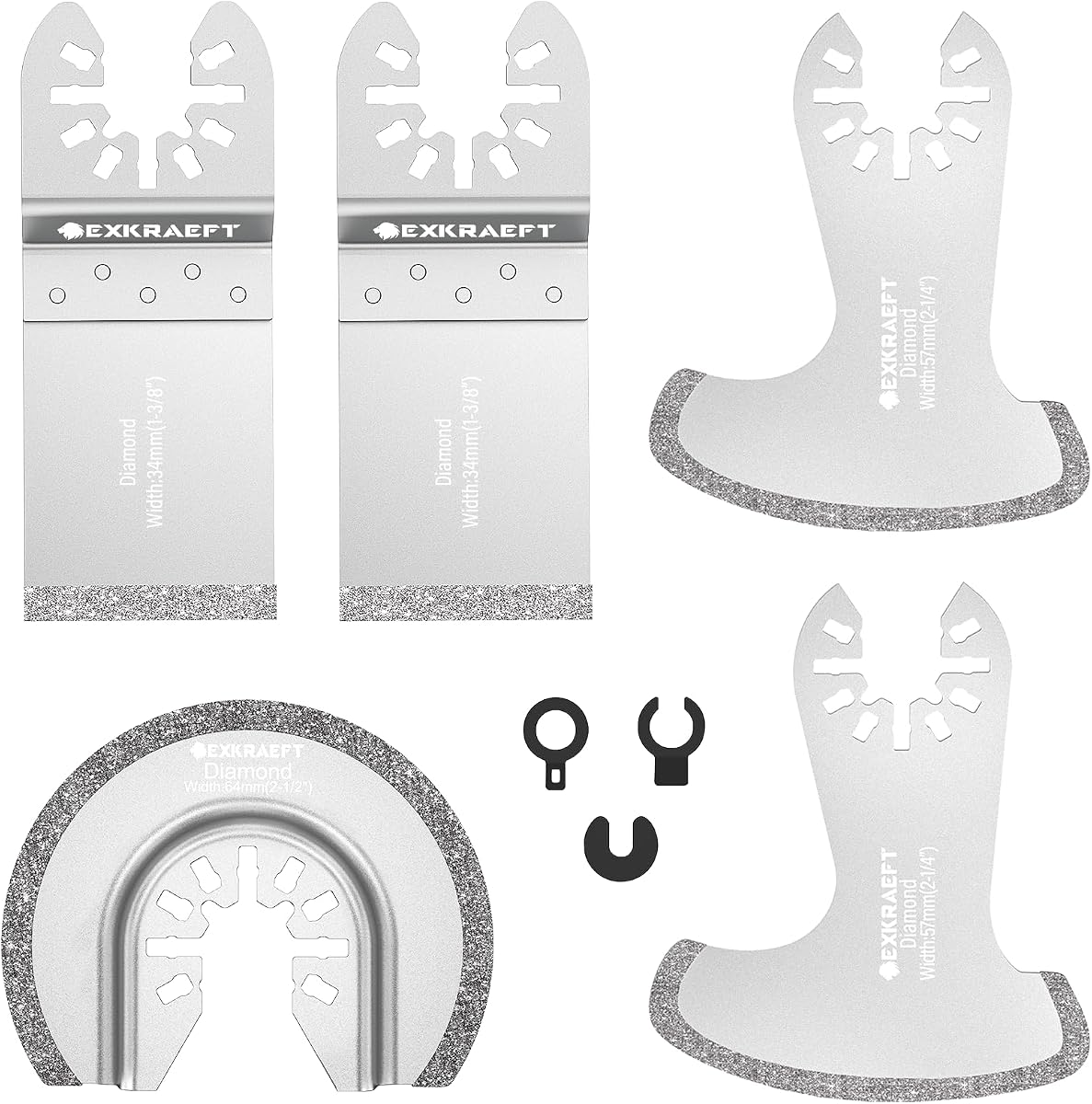
The EXKRAEFT five-piece set has a 3.9 rating, the lowest listed score among these products, but it still combines a generous quantity of blades with three shapes and three included clip adapters. It is a practical option for buyers who want versatility and a broad fit without acquiring separate accessories.
We may earn a commission when you buy through this link, at no additional cost to you.
The set includes two flat diamond saw blades, one semicircular blade for sanding larger flat surfaces, and two crescent blades for grinding floor concrete. The manufacturer also lists defective tile grout, soft tile, plaster, porous concrete, and planked-deck joints as appropriate applications. This makes the collection useful for bathroom remodels, flooring, tile work, and general home repairs.
Compatibility is described through a universal interface and three adapter clips, with DEWALT, Bosch, Fein, Milwaukee, and Ryobi given as examples. The stated fit is broad, but exact blade dimensions are not provided in the supplied product information. As a result, users with very narrow grout may have less certainty about which blade will enter the joint. The manufacturer recommends low speed, light pressure, and side-to-side movement.
This set is most compelling for users who value the number of included components and adapter options. Its lower listed rating and less precise dimensional information make it harder to recommend as the first choice for a tightly controlled installation. Still, for broad household renovation work, the five different blades can cover everything from narrow-gap cleaning to larger grinding areas.
Flat blades handle narrow gaps, crescent blades concentrate on floor concrete, and the semicircular blade supports broader sanding. This separation of roles reduces unnecessary blade changes during mixed repair work.
The three clips can make installation easier for several multi-tool brands. As always, checking the tool model and the exact release mechanism before ordering is the safest approach.
We may earn a commission when you buy through this link, at no additional cost to you.
This nine-piece diamond oscillating tool blade set has a 4.5 rating and offers the largest accessory count in the guide. Its assortment includes multiple profiles, while the flat-side swing design is intended to improve access in tight spaces and around the edges where replacement tile must be fitted.
We may earn a commission when you buy through this link, at no additional cost to you.
The stated blade kerf is approximately two millimeters, placing it in a middle position between the narrowest and broadest options compared here. The product description identifies flat, semicircular, and other shapes within the set, with the semicircular form intended for intensive cutting. That range is useful for bathroom renovation, flooring, trimming, mortar cleanup, defective grout removal, and household corrections.
Diamond grit is advertised as lasting five times longer than carbide-grit blades in tough applications. Compatibility is described broadly as covering most major brands, but the supplied information does not provide a detailed brand-and-model list. Nine blades also require more storage space and make it easier to select the wrong profile if the set is not organized. Users should confirm the mounting system and joint width before beginning.
This collection is well suited to installers, property maintainers, and serious DIY renovators who expect varied work. Its count provides useful redundancy and a broad selection of shapes. For a single small repair, the extra components may be unnecessary, but for repeated projects the nine-piece set can serve as a compact multi-material accessory library.
The swing design is intended to let the blade reach corners and narrow working areas. Even so, the two millimeter kerf should be checked against the joint before full-depth removal is attempted.
With nine blades and several shapes, the set can cover grout, soft tile, mortar, plaster, porous concrete, and deck joints. Separate profiles can be reserved for each material to preserve their edges.
We may earn a commission when you buy through this link, at no additional cost to you.
The DEWALT Dwa4219 has a 4.6 rating and offers a simple alternative to the DWA4220. Like the other DEWALT option in the guide, it is a single carbide-edged oscillating blade designed specifically for grout removal, with a universal-fit interface and no adapter required.
We may earn a commission when you buy through this link, at no additional cost to you.
Its appeal is simplicity. A buyer who already owns a compatible oscillating tool and has one recurring grout-removal task does not need to sort through several diamond shapes or manage a large accessory collection. The blade can be installed directly and used to remove failed grout before tile repair or regrouting.
The single-blade format is the principal drawback. There are no alternate profiles for wider joints, corners, mortar cleanup, or a second spare if the edge becomes worn during a project. The supplied product information also contains fewer technical dimensions than the detailed diamond-grit alternatives, making it harder to assess joint-width suitability in advance.
The Dwa4219 is a solid choice for straightforward, repeat grout removal using a compatible multi-tool. It provides a focused tool without unnecessary accessories and carries one of the stronger listed ratings. Buyers needing varied profiles or a wider range of materials should look to a multi-piece diamond set instead.
Keeping a grout-specific blade on hand makes it easy to tackle small failures without interrupting a larger tool setup. It is especially convenient for homeowners who already recognize the DEWALT accessory system.
The design concentrates on grout removal rather than advertising heavy cutting or multiple surface profiles. That focused approach simplifies the decision but offers less flexibility than a comprehensive set.
We may earn a commission when you buy through this link, at no additional cost to you.
The best oscillating tool for grout removal is not determined by blade count alone. Consider the joint dimensions, material hardness, blade shape, tool interface, and amount of renovation work before choosing an accessory.
Diamond-grit blades provide a highly abrasive cutting edge suited to grout, mortar, plaster, and other hard renovation material. They are a natural choice when the old joint is hardened, extensive cleanup is required, or several different abrasive applications may arise. Carbide-edged blades offer a simpler, purpose-built alternative specifically marketed for grout removal. The material alone does not determine suitability, however; blade geometry, operating technique, and pressure matter just as much as the abrasive type.
Choose diamond grit for broad abrasive work and carbide for focused grout removal with a straightforward blade. Whichever material you select, light pressure is usually more effective than forcing the cut.
Blade width or kerf determines whether the accessory can enter a grout line cleanly. The products in this guide include approximately 1.6, 1.8, 1.9, 2.0, 2.2, and 2.3 millimeter examples, although not every listing provides a measurement. A narrow blade can reach deep into a tight joint and work close to tile edges, while a broader blade removes material faster but leaves a wider channel and may chip adjacent tile if used carelessly.
Measure the joint before ordering when possible. Choose the narrowest blade that can reach the material, and reserve wider profiles for broader scraping or concrete cleanup.
Flat blades are best for entering narrow gaps and making controlled, straight cuts. Curved or crescent blades can engage differently and may be more useful when working around corners, floor concrete, or areas where a straight blade does not maintain contact. Semicircular blades cover a larger surface and can be more efficient for broad grinding or sanding tasks. Multi-piece sets often combine these forms so one tool can handle several stages of surface preparation.
Match the shape to the geometry of the joint. A versatile set is useful for mixed renovation work, while a narrow single-task job may only require one suitable profile.
The mounting system is one of the most important compatibility checks. Some products use a universal quick-release arrangement, while others provide adapters for common brands. DEWALT's listed blades are described as universal fit without an adapter. Several diamond sets exclude Bosch and Fein Starlock systems, and Dremel tools may require a C-clip adapter. Even a product listing many compatible brands can exclude specific models, so the exact oscillating-tool model should be checked before purchase.
Confirm the interface, release mechanism, and any brand-specific exclusions before ordering. Keep the supplied adapters accessible if your tool requires one, and never force a blade that does not seat correctly.
A small repair involving a few conventional-width grout lines may be handled efficiently with one dedicated blade. A bathroom renovation involving many joint sizes, corners, residual mortar, plaster, and concrete benefits from a set containing flat, curved, and semicircular profiles. Larger collections also provide spare blades, which is useful because abrasive edges wear during hard, repetitive work. The right project scope avoids both under-equipped and unnecessarily complex selections.
For one small task, prioritize compatibility and a correct width. For repeated work or multiple materials, choose a set with several profiles and a reliable mix of widths.
Fine grout removal near a tile edge calls for a narrow, controlled profile. Removing thick mortar or grinding a larger floor area benefits from a broader or more aggressive blade. Starting too aggressively can cause vibration, chipping, heat, or premature wear. A precise blade used on a large area may work slowly, while an aggressive blade in a tight joint may remove too much surrounding material. Think about the most delicate part of the job before choosing the blade used for the first pass.
Begin with the least aggressive blade that can reach the target. Increase the profile only when the material, access, and edge condition justify it.
Access determines the practical usefulness of a blade. Tight corners, wall edges, and narrow joints favor slim flat blades, while open floor areas and larger patches of mortar can be handled with semicircular or crescent profiles. Consider the angle at which the oscillating tool must be held and whether the blade can physically reach beneath fixtures or along the edge of installed tile. A theoretically powerful blade has limited value if its profile cannot reach the damaged material.
Walk the work area before selecting accessories. Include corners, wall transitions, floor edges, and the depth of the old grout in your assessment.
Some blades are designed mainly for grout, while others are advertised for mortar, plaster, thin-set, stucco, concrete block, porous concrete, soft tile, and deck joints. A blade that is excellent for brittle grout may not be the best choice for cutting hard tile, granite, marble, or wall surfaces. Several products explicitly warn against using grout blades for these harder materials. Identify every material likely to be encountered and choose a product whose stated applications include those surfaces.
Do not use a grout-removal blade to cut tile unless the manufacturer specifically permits it. Keep harder-material cutting separate from delicate joint cleanup.
Prepare the workspace by removing loose debris, identifying the grout width, checking the tool interface, and installing the correct blade according to the manufacturer's instructions. Wear appropriate eye protection and dust respiratory protection, secure the work area, and test the oscillating tool on a concealed or scrap section before approaching the installation. Confirm that the blade is fully seated and that the tool's speed setting is appropriate for the accessory.
Place the blade nearly flat against the old grout and begin at a low or medium speed where recommended. Use light pressure and move the blade in a controlled side-to-side motion, allowing the abrasive edge to contact more of the material. Work along the joint in short passes rather than trying to excavate the full depth in one movement. A wider blade should be used only where the joint has enough width to accommodate it.
Clean the blade after use, let it cool before storage, and inspect it for cracks, missing segments, or excessive wear. Wear protective gloves when handling a used abrasive blade and avoid touching the cutting edge. Store blades in a dry protected case, and replace a blade that has lost its shape or cutting performance rather than forcing it through additional material.
The best blade depends on the grout width, joint condition, and oscillating-tool interface. A narrow flat diamond blade works well in tight joints, while crescent and semicircular profiles provide more contact for larger areas. A focused carbide blade is also appropriate when the task is limited to ordinary grout removal.
Yes, when the correct blade width and profile are used with a light touch. Start with the narrowest blade that can reach the joint, keep the tool moving, and avoid forcing the blade into the edge. Working from the center of the joint and advancing gradually reduces the chance of chipping.
Diamond-grit blades are generally better suited to hard, abrasive work and offer more profiles or widths in many multi-piece sets. Carbide-edged blades can be ideal for a straightforward grout-removal task with a simple universal-fit design. The best choice depends on material, joint size, and how many other repair applications you expect.
It depends on the blade and the exact tool model. DEWALT's listed products are described as universal fit without an adapter, while several diamond sets include adapters for common brands. Some sets exclude Starlock systems, and Dremel tools may need a C-clip. Always confirm the exact model and interface before purchasing.
A blade around 1.6 millimeters is the narrowest option described in this guide and is more appropriate for tight joints. The XXGO set states that its approximately 2.3 millimeter blades are not best for one-sixteenth-inch grout. Measure the joint and choose a blade slightly wider than the line, then use a shallow angle.
Many of the diamond-grit sets are advertised for mortar, plaster, thin-set, concrete, stucco, and related materials. A dedicated carbide grout blade may have a narrower application range. Check the listed uses and avoid taking a grout blade into hard tile, granite, marble, or other materials not approved by the manufacturer.
Several manufacturers recommend a low or medium speed, light pressure, and side-to-side movement. These settings allow more abrasive teeth to engage without overheating or damaging the blade. If the tool begins to bog down, lift it slightly, let the blade cool, and resume with less force.
Choose a blade that fits comfortably within the joint, start near the center, and keep the blade shallow. Move consistently rather than stopping in one place, and avoid pushing sideways against the tile. If the joint is too narrow or the blade visibly overlaps the edge, switch to a narrower profile.
The LEILUO six-piece diamond set is the best budget-oriented choice because it combines flat and curved profiles with a thin design, while the DEWALT DWA4220 is the editor's choice for users who want a focused, purpose-built carbide blade with straightforward universal fit. The EZARC four-piece set is the strongest premium-style option, offering three profiles and three kerf widths for varied renovation work.
Prioritize the condition and width of the joint, the material you actually need to cut, and the exact mounting system of your oscillating tool. A large collection is not automatically better than a focused blade, and a diamond profile does not replace correct technique. Use the narrowest suitable blade, begin at controlled speed, and let the cutting edge do most of the work.
Before ordering, review the current product listing, included accessories, dimensions, and compatibility statements. Manufacturer information and availability can change, so confirming the current details for the exact model helps prevent an incompatible or unsuitable purchase.