
Fenix HM71R
4.5Editor score
Up to 2,700 lumens
Detachable right-angle design
IP68 waterproof rating
Our expert Caving Headlamp guide compares ten rugged models for brightness, beam control, comfort, waterproofing, runtime, and cave-ready versatility.
A caving headlamp must illuminate narrow passages, open chambers, wet passages, and steep descents without becoming uncomfortable during hours of wear. Brightness matters, but beam control, low-light modes, waterproof protection, battery endurance, and a secure fit are equally important when a reliable light is essential.
This guide compares ten rechargeable headlamps using the information supplied for each model, with particular attention to lumen output, beam distance, lighting modes, ingress protection, weight, mounting options, and included accessories. The list covers compact caving lights, high-output models, right-angle designs, and rugged general-purpose headlamps.
Each review explains who the headlamp is best suited for, the strengths that set it apart, and any practical trade-offs visible in its specifications. Ratings reflect the supplied marketplace feedback, while deal terms and availability can change. Check the current product listing before making a final purchase.
4.5Editor score

4.6Editor score

4.6Editor score
The comparison below highlights maximum output, beam reach, water resistance, power configuration, and practical physical design, helping readers identify the most suitable headlamp for different cave environments.


The Fenix HM60R V2.0 is a strong all-around caving headlamp because it balances usable brightness, compact weight, flexible beam options, and serious environmental protection. It produces up to 1,600 lumens with a beam distance of 185 yards, and its supplied 4.6 rating reflects generally favorable buyer feedback. Those figures make it suitable for passages where the light must reach beyond the immediate foreground without becoming excessively bulky on the head.
We may earn a commission when you buy through this link, at no additional cost to you.
Its lighting system is especially useful underground. Four spotlight levels support tasks that need reach and concentration, while three floodlight levels provide broad coverage for chambers, camps, and close inspection. A red mode with two brightness levels and a flash option help preserve dark adaptation and can make signaling easier. The top switch permits quick movement between spotlight and floodlight, while the side switch handles brightness adjustments. Even with cold or wet gloves, the separated controls should be easier to operate than a crowded single-button layout.
Battery endurance and charging convenience are other meaningful advantages. The lamp can operate for up to 292 hours on low, making it a sensible choice for extended underground trips where conserving power matters. Its hidden waterproof USB-C port supports a full recharge in about 2.5 hours, and the included charging cable keeps the setup straightforward. At 6.1 ounces, it is light enough for prolonged wear, while the impact resistance to two meters and IP68 rating support use in rough, wet environments.
The main limitation is that the HM60R V2.0 is primarily a headband light rather than a removable right-angle lamp. Users who want to place a light on a wall, stand it on a surface, or aim it around corners lose some placement flexibility compared with the Fenix HM71R or Coast models with magnetic bases. Even so, its combination of output, focused beam options, long runtime, fast charging, and compact construction makes it the most balanced choice for most cave explorers.
The separate spotlight and floodlight levels let cave explorers match illumination to the terrain instead of forcing one beam pattern onto every task. A concentrated spot helps reveal distant passages, while broad flood coverage illuminates walls, floors, and nearby formations.
The 292-hour low-mode figure provides substantial reserve for prolonged outings. Fast USB-C charging also makes it practical to replenish the lamp between trips without carrying a proprietary charger.
We may earn a commission when you buy through this link, at no additional cost to you.
The Fenix HM71R stands out as a premium, high-output option for cavers who want substantial reach and flexible placement. It can deliver up to 2,700 lumens, illuminate objects as far as 251 yards away, and supply a separate 500-lumen floodlight for broad coverage. Its supplied 4.5 rating indicates strong buyer satisfaction, and the industrial design suggests a capable light for large chambers, long galleries, and rescue-oriented equipment lists.
We may earn a commission when you buy through this link, at no additional cost to you.
The 90-degree right-angle format is the feature that makes this model especially versatile. A quick-release clip lets the light body detach from the breathable, reflective headband. It can then be clipped to a pocket, stood on a flat surface, or attached to a magnetic surface, providing hands-free illumination for rigging checks, route finding, photography, and tasks where both hands need to remain free. That flexibility is valuable in confined spaces where a fixed forehead beam may not reach the required angle.
The HM71R also has reassuring environmental specifications. It is rated IP68 for waterproofing, carries an industrial-grade housing, and is listed for operation in temperatures from -31 to 113 degrees Fahrenheit. USB-C charging takes approximately four hours, and a power-status indicator helps users check the remaining charge. The included cable and LumenTac Organizer provide useful supporting accessories.
The trade-off is size and runtime compared with more compact alternatives. Its maximum stated runtime of 48 hours on low is ample for many outings, but it does not match the extraordinary endurance of the Fenix HM60R V2.0. It may also feel more substantial during long hikes. For users who prioritize raw output, distant reach, and detachable placement over minimum weight, the HM71R is a compelling premium caving headlamp.
The 2,700-lumen maximum output and 251-yard beam distance provide useful power for large open spaces and long passage views. Low and intermediate settings are still more appropriate for conserving battery and reducing glare in tight formations.
The removable right-angle body can be positioned on metal, floors, or pockets. This turns the headlamp into a more flexible task light for route checks, equipment inspection, and hands-free work underground.
We may earn a commission when you buy through this link, at no additional cost to you.
The Coast XPH30R is a compact, adaptable option with a 4.7 rating, the highest supplied rating in this group. Its 1,200-lumen turbo mode delivers strong output for a cave lamp, while the regular 500-, 160-, and 46-lumen settings provide finer control over brightness and runtime. The combination makes it well suited to people who move between narrow passages, larger chambers, and campsite tasks.
We may earn a commission when you buy through this link, at no additional cost to you.
Its defining feature is Coast's Pure Beam Twist Focus system. Rather than switching between separate spot and flood structures, the user rotates the light to move smoothly between a concentrated long-range beam and a broad short-range view. The supplied product information describes the beam as having no halos or hot spots, which can provide a cleaner field of vision. This is particularly useful underground because sharply defined transitions can reduce uncertainty when checking distant shapes or nearby walls.
The body detaches from the strap and mounting bracket to become a handheld flashlight, and the built-in magnetic base allows attachment to suitable metallic surfaces. That lets users use the lamp for close inspection without removing it from their body. USB-C recharging adds convenience, while the stated 6.75-hour high, 10-hour medium, and 28-hour low runtimes allow power planning based on the level actually required.
The XPH30R is rated IP54 for water resistance and is also described as durable against one-meter drops. IP54 is not as comprehensive as an IP67 or IP68 sealing rating, so it may be less reassuring for prolonged submersion or heavy water exposure. It is also a dual-power design, which can add complexity and weight compared with a sealed integrated-battery design. Even so, its compact weight, flexible beam control, detachable magnetic form, and excellent supplied rating make it a compelling choice for general cave use.
The twist-focus mechanism makes beam selection continuous and intuitive. Fine-tuning the transition can be more convenient than cycling among separate lighting modes, especially when moving through uneven passage shapes.
The magnetic base turns the lamp into a hands-free inspection light for metal surfaces. Removing it from the headband also helps direct light exactly where it is needed without fumbling with the strap.
We may earn a commission when you buy through this link, at no additional cost to you.
The Blukar LED Headlamp is the value-focused choice in this guide, combining a 4.6 rating with a broad set of lighting functions in a simple headlamp format. It uses a T6 and XPE light source, offers a stable, wide beam, and includes a rear red light intended to improve visibility to people following behind. That combination is practical for cave approaches, group travel, and camp tasks.
We may earn a commission when you buy through this link, at no additional cost to you.
Five modes cover main white light, side white light, all-white illumination, flashing white light, and main red light. A rotating main lens provides adjustable focal length, allowing the user to move between flood and spotlight characteristics. The lamp body tilts through 90 degrees, which is important when the wearer is looking up or down a sloped passage. Its elastic headband is adjustable for different head sizes and can also be secured to a helmet.
Charging is handled through USB-C, with a stated full charge time of approximately five hours. The integrated lithium battery is not removable, so users cannot quickly exchange cells in the way they might with a conventional AA headlamp. The sealed battery compartment supports the stated IPX6 waterproof rating and adds shock resistance, while the lightweight construction keeps the unit manageable on the head.
The biggest limitation is the absence of a published maximum lumen figure. That makes direct output comparison with the Fenix, Coast, Black Diamond, OLIGHT, and Nitecore models impossible. It also does not offer the same strong ingress-protection rating as several alternatives. Nonetheless, the Blukar provides multiple beam options, a rear safety light, helmet compatibility, and a rechargeable design at a budget-focused tier, making it a sensible entry point for occasional cave exploration.
The rear red light offers a practical way for other members of a group to see the wearer in darkness. It adds visibility without relying on the main beam, although it is not a substitute for proper group spacing and communication.
The breathable, adjustable elastic band is designed to resist slipping and accommodate different head shapes. Its ability to mount on a helmet also gives caving groups more flexibility when a hard hat is required.
We may earn a commission when you buy through this link, at no additional cost to you.
The Coast XPH34R is a high-capacity cave lighting choice, combining up to 2,700 lumens with a maximum stated runtime of 120 hours. Its 295-meter beam distance is the longest figure among the supplied products, and the supplied 4.6 rating reflects favorable buyer feedback. The result is a versatile option for explorers who may need both serious reach and extended endurance.
We may earn a commission when you buy through this link, at no additional cost to you.
Coast's Pure Beam Twist Focus system transitions between an Ultra View flood for broad, edge-to-edge coverage and a BULLS-EYE spot for distant targets. That continuous adjustment is useful when the user needs to scan a chamber and then inspect a distant passage without changing modes. The detachable body and magnetic tailcap add further versatility, allowing the lamp to stand or attach to metal while also providing a real-time power indicator.
Its dual-power configuration is the most distinctive feature. Depending on the supplied battery configuration, the product supports a rechargeable ZITHION battery and compatible alkaline cells. This gives users the option to recharge for routine use or carry conventional batteries as a backup. The top-grade aluminum body, dust-resistant and storm-resistant construction, one-meter drop protection, and Coast lifetime warranty add confidence for demanding use.
This model is not as light or sealed as the strongest ultralight IP68 alternatives, and its IP54 rating provides less assurance against sustained water exposure than an IP67 or IP68 designation. The rechargeable and alkaline capability can also make the lamp bulkier. For long expeditions where runtime, beam reach, and backup power options outweigh minimum weight, however, the XPH34R offers a compelling combination.
The stated 120-hour maximum runtime is a major advantage for multi-day exploration. Using lower output levels can extend operational time further, while dual-power capability provides additional resilience when expedition conditions demand it.
The twist-focus design handles both close and distant viewing, while the magnetic tailcap allows flexible placement. This makes the headlamp useful beyond simply lighting the route ahead.
We may earn a commission when you buy through this link, at no additional cost to you.
The Coast WPH20R is built around a useful three-in-one concept: it can function as a headlamp, clip light, or magnetic work light. It produces up to 2,000 lumens and carries a supplied rating of 4.5. For cave explorers who switch between walking, inspecting equipment, and illuminating a campsite, that flexibility can be more valuable than a headlamp with a marginally higher maximum output.
We may earn a commission when you buy through this link, at no additional cost to you.
Its dual optic system combines Coast's PURE BEAM flood and BULLS-EYE spot. Five optic modes provide control over brightness and beam shape, allowing users to choose wide-area coverage for chambers or focused light for distant passages. A pocket and hat clip expand placement options, while the magnetic work-light configuration is useful on suitable surfaces. USB-C recharging removes the need for disposable batteries in routine use.
Environmental protection is a clear strength. The IP67 rating covers full submersion up to one meter and protection against dust and debris, giving it a reassuring specification for wet passages, muddy chambers, and humid underground systems. A built-in power lockout helps prevent accidental activation, a useful feature when the lamp is packed against gear, carried in a bag, or worn continuously during a long trip.
The supplied information does not state runtime figures, so users cannot compare endurance as precisely as with several other models. It also does not explicitly identify a red-light mode, which can be valuable for preserving dark adaptation. Those omissions may matter to experienced cavers, but the combination of 2,000 lumens, full waterproofing, multiple optics, USB-C charging, and three mounting formats remains highly practical.
The IP67 rating is among the strongest in this comparison and supports use around spray, rain, dust, and brief submersion. It is a reassuring choice where cave moisture and sediment are constant concerns.
The headband, pocket or hat clip, and magnetic work-light modes allow the same light to serve several tasks. That versatility is valuable during route checks, camp setup, and equipment inspection.
We may earn a commission when you buy through this link, at no additional cost to you.
The Black Diamond Icon 700 has an expedition-oriented design and a supplied 4.4 rating. Its 700-lumen maximum output is lower than the brightest models in the guide, but it still provides meaningful reach for cave travel, route navigation, and technical terrain. The emphasis is on dependable construction, flexible power, and lighting modes suited to long-duration use.
We may earn a commission when you buy through this link, at no additional cost to you.
The headlamp offers full strength, dimming, strobe, red night-vision, and lockout functions. Red output helps preserve night adaptation, while lockout can stop accidental activation during transport. Its IP67 rating provides dust protection and full-submersion resistance up to one meter, which makes it well suited to rain, snow, wet alpine environments, and damp underground routes. A rugged housing and secure headband support the expedition positioning.
Power flexibility comes from support for four included AA batteries or a compatible rechargeable Icon battery, which is sold separately. This is useful for people who prefer the availability of standard cells, although carrying spare cells adds pack weight. The option to move to a rechargeable battery can reduce ongoing consumable use for regular trips without requiring the dedicated battery at the outset.
The principal trade-off is output compared with models reaching 1,600, 2,000, 2,700, or even 3,000 lumens. It may feel less powerful in a vast chamber, and buyers who want rechargeable operation out of the box need to purchase the optional battery. For cavers who value red light, lockout, robust sealing, and standard battery availability, the Icon 700 remains a dependable expedition-style option.
The red night-vision mode is useful in darker chambers and during group travel. It provides a low-disruption output option when preserving the wearer's night vision is important.
Four included AA cells make the lamp easy to power in areas where replacements are readily available. A compatible rechargeable battery adds a more sustainable option for frequent use, though it is purchased separately.
We may earn a commission when you buy through this link, at no additional cost to you.
The Black Diamond Storm 500-R is a compact rechargeable headlamp built for outdoor users who want a comfortable fit and straightforward controls. Its maximum output of 500 lumens and supplied 4.4 rating position it as a capable general-purpose cave light rather than a high-output chamber beacon. That makes it relevant for smaller passages, campsite tasks, hiking approaches, and emergency kits.
We may earn a commission when you buy through this link, at no additional cost to you.
The 2,400 mAh integrated lithium-ion battery eliminates disposable cells and supports a cleaner packing routine. It recharges through micro-USB, which is a widely available connection, although USB-C would offer a more current and versatile charging experience. Full-strength, dimming, strobe, and red night-vision modes allow users to adapt the output to route finding, signaling, and proximity work.
Its low-profile construction and adjustable headband are particularly relevant during long caving trips. A stable, unobtrusive fit reduces the chance of the lamp shifting when crawling, climbing, or negotiating uneven ground. The housing is described as rugged and able to withstand heavy rain, snow, and challenging outdoor conditions, supporting dependable performance across changing environments.
A maximum output of 500 lumens may be insufficient for illuminating distant features in a large chamber, and the supplied data does not provide a maximum beam distance. Micro-USB is also less convenient for travelers who already carry USB-C cables. Those limitations are acceptable when compactness, rechargeable simplicity, red illumination, and low-profile comfort are the priorities. For closer-range cave use, the Storm 500-R is a straightforward and comfortable companion.
The compact housing and adjustable band are designed for stable, low-profile wear. This helps reduce bulk during crawling, climbing, and long approaches through confined passages.
The integrated 2,400 mAh battery removes the need to carry spare disposable cells. It is a practical approach for regular trips, even though the micro-USB connection is less flexible than USB-C.
We may earn a commission when you buy through this link, at no additional cost to you.
The OLIGHT Perun 3 has the highest maximum output in the guide at 3,000 lumens, paired with an exceptional stated maximum runtime of 20 days. Its supplied 4.6 rating indicates strong buyer satisfaction. Together, these specifications make it an intriguing choice for cavers who want very high power for large chambers without assuming that a rechargeable light must have limited endurance.
We may earn a commission when you buy through this link, at no additional cost to you.
The red-light function provides two brightness levels and a flashing mode, making it useful for signaling and low-light tasks while protecting dark adaptation. A proximity sensor is an unusually thoughtful feature: when the headlamp detects an object immediately ahead or within 0.5 seconds after turbo activation, it automatically reduces output. That behavior can help prevent unnecessary glare and heat when a user is looking at a nearby wall or inspecting equipment.
Operation is handled through large metal side buttons, which should be straightforward to use with gloves. The lamp can detach from the headband and operate as a right-angle flashlight, expanding placement options for close work. Its stainless steel mount, breathable headband, and anti-sweat rubber strip are designed for stable, comfortable wear during physically demanding trips.
The IP68 rating provides excellent waterproof and dust protection, matching the strongest environmental specification in the group. Maximum output can consume battery energy quickly, and the 20-day runtime applies to the lowest mode rather than turbo. Nevertheless, the Perun 3 offers the guide's greatest raw output, strong low-light controls, and a practical sensor. It is a compelling high-powered choice for explorers who often visit large, open underground chambers.
The 3,000-lumen turbo output provides the strongest stated illumination in this comparison. It can reveal large formations and distant features, although lower levels are usually more practical and energy-efficient in confined passages.
Automatic output reduction when an object is close can limit glare during equipment checks or narrow passage navigation. The feature makes high output easier to use safely without constantly changing modes.
We may earn a commission when you buy through this link, at no additional cost to you.
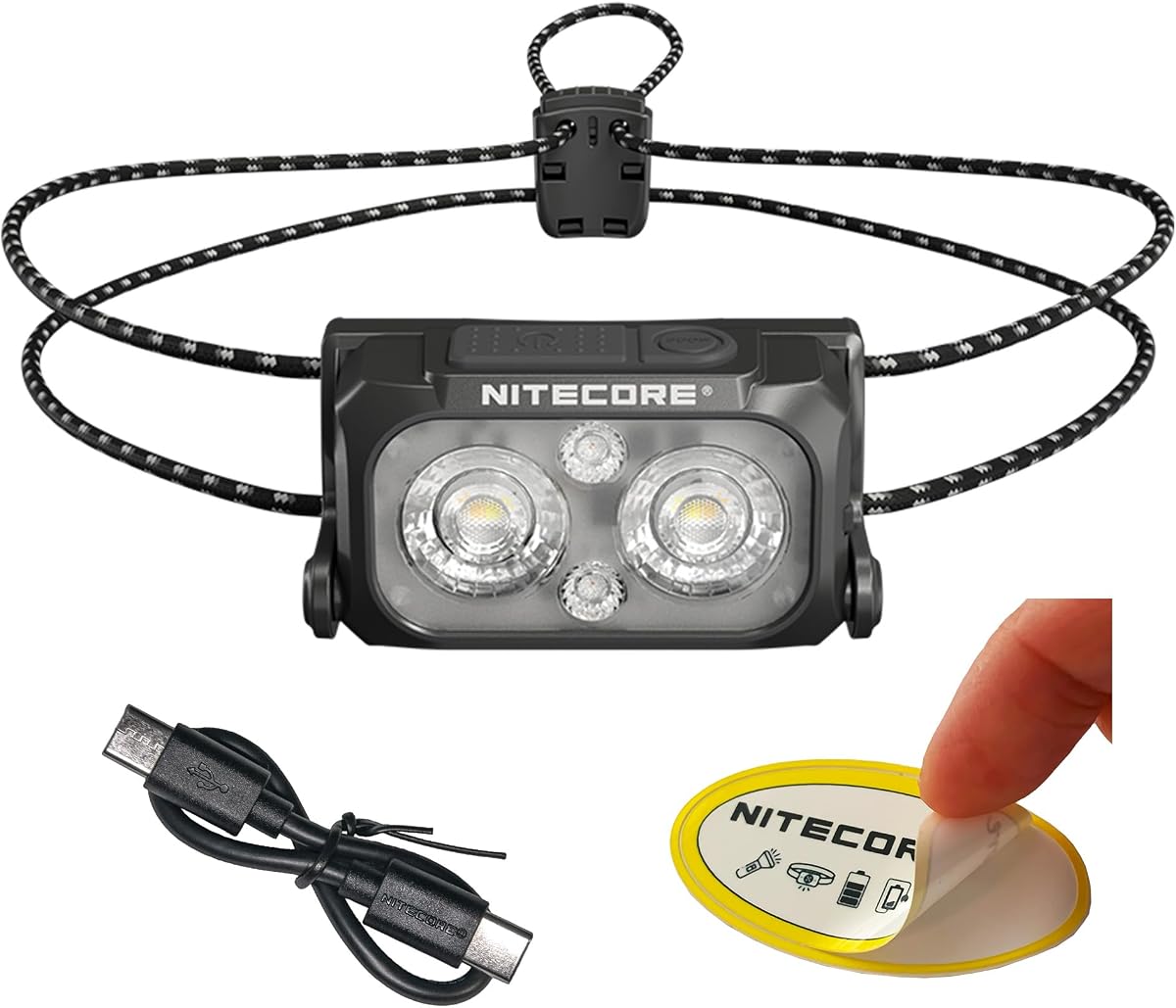
The Nitecore NU25 MCT UL is the ultralight selection, weighing just 1.65 ounces in total and carrying a supplied rating of 4.7. It emits up to 400 lumens with a maximum beam distance of 144 yards. Those are modest figures beside high-output models, but the light's low weight makes it attractive for caving trips where every carried gram and every hour of head comfort matters.
We may earn a commission when you buy through this link, at no additional cost to you.
Its multi-color temperature system is the standout feature. Warm, natural, and cool white outputs can be selected with a button press. Warm light is easier on the eyes and can penetrate fog or rain, neutral light supports natural-looking task illumination, and cool light improves outdoor contrast. An auxiliary red light adds another layer of low-light usefulness for close work, campsite tasks, and preserving night vision.
The output controls include four regular outputs, SOS, and a beacon function, giving users both steady lighting and signaling options. USB-C recharging takes just over an hour, while a power-status indicator helps prevent surprises. Runtime reaches up to 45 hours on the relevant low setting, making the lamp practical for extended low-output use.
The IP66 rating provides solid protection against dust and water jets, though it is not as strong as the IP67 or IP68 ratings offered by several alternatives. The 400-lumen maximum also means it may not illuminate a huge chamber as effectively as a higher-output model. For lightweight overnight exploration, smaller passages, and use as a secondary or backup lamp, though, the NU25 MCT UL is an excellent specialist tool.
Warm, natural, and cool white outputs let users tailor the light to the task and environment. This is unusual in an ultralight design and can improve comfort, visibility, and close-work usability.
At 1.65 ounces, the NU25 MCT UL is easy to forget on the head or carry as a backup. Its low weight is particularly valuable during approaches, crawls, and climbs where a bulky lamp becomes tiring.
We may earn a commission when you buy through this link, at no additional cost to you.
Choosing a caving headlamp involves balancing illumination, beam control, protection, endurance, fit, and placement. The right model for a large expedition cave may differ from the one that works best for local pots, wet passages, or a lightweight overnight trip.
Maximum lumen output indicates the lamp's available brightness, while beam distance shows how far useful light can reach. A high-output lamp can reveal distant passage features, large chambers, and hazards beyond the immediate foreground. However, the highest setting is not always the most useful underground: intense output can create glare, reveal fine dust or moisture, and consume the battery quickly. Mid-range settings are often better for sustained route finding, while maximum output is valuable for checking large spaces or confirming distant passages.
Choose enough output for the environments you expect to explore without carrying unnecessary bulk. A 400-lumen ultralight model may suit smaller passages, while 1,600 to 3,000 lumens provides more capacity for open chambers and long galleries.
A spotlight concentrates light into a narrow beam for distance, while a floodlight spreads illumination across a wider area for nearby work. Caving often requires both: a focused beam to inspect a distant opening, followed by broad light to examine a chamber, rope, or group member. Fixed dual-beam lamps provide distinct modes, twist-focus systems allow smooth transitions, and zoom lenses alter the apparent focal length. The most effective design is one that can be changed quickly without breaking stride or losing your place.
Prioritize a light with easily accessible beam controls and multiple usable levels. Continuous focus control is especially useful when cave shapes change rapidly, while a clear spotlight-to-flood transition helps avoid wasting time cycling through many modes.
Red light is valuable in caves because it helps preserve the eye's adaptation to darkness. It can make close equipment checks, map reading, and group communication less disruptive than white light. Many experienced cavers also appreciate a very dim white mode for tasks that require some color perception without ruining night vision. Strobe, flash, SOS, and beacon functions can support signaling or emergency attention, although these should not replace a sound or communication plan.
Look for red illumination with at least one or two brightness levels and a low white setting that is genuinely dim. This combination is more useful than having many flashy modes but no comfortable low-light option.
Caves can be wet, muddy, dripping, or unexpectedly flooded, so water resistance is a central safety feature. An IP54 rating indicates resistance to water ingress and dust under specified test conditions. IP67 adds protection against temporary submersion up to one meter, while IP68 indicates a higher level of dust and waterproof protection as defined by the manufacturer. These ratings do not make any lamp suitable for prolonged submersion, and seals should still be checked before use. Impact resistance adds confidence in narrow, abrasive passages.
For reliable underground use, choose at least IP67 when the route is damp or flood-prone. IP68 offers additional reassurance for wet systems, while rugged housing and stated drop resistance help protect against the knocks and scrapes that occur during crawls and climbs.
Runtime figures are most meaningful when they are tied to a particular mode, because maximum output drains power much faster than the lowest setting. The Fenix HM60R V2.0 lists up to 292 hours on low, the Black Diamond Icon 700 supports AA cells, and the Coast XPH34R offers dual rechargeable and alkaline power. These approaches suit different trip styles. Rechargeable models reduce disposable waste, while replaceable cells can be valuable in remote areas where charging access is uncertain.
Match the power system to the trip. USB-C is the most convenient charging standard among the selections, while micro-USB remains workable but less versatile. For multi-day exploration, compare low-mode runtime, carry a backup light, and never depend on a single lamp as the only illumination source.
A caving headlamp may be worn for hours, so comfort and stability affect both safety and enjoyment. Lightweight models reduce strain on the head and neck, while a broad, breathable band can remain comfortable during long walks. Adjustable straps should hold the lamp in place without slipping when looking upward or crawling. Helmet compatibility is valuable in passages where a hard hat is needed. The 1.65-ounce Nitecore and 4.37-ounce Coast XPH30R are especially compact, while higher-output models may feel more substantial.
Try the fit with your normal headwear and consider whether the lamp stays aligned when worn over a cap. A secure, low-profile fit matters more than raw output if the light bounces, shifts, or causes discomfort during a long expedition.
A detachable lamp body can be removed from the headband and used as a handheld or right-angle flashlight. Fenix quick-release designs allow the light to sit on a surface, clip to a pocket, or attach magnetically. Coast models add magnetic bases, and the WPH20R can serve as a headlamp, clip light, or magnetic work light. These arrangements are useful for inspecting ropes, checking equipment, illuminating a campsite, or directing light into awkward locations without constantly removing the head strap.
Consider whether you need hands-free placement during your planned activities. Detachable and magnetic formats add convenience and versatility, but they can also introduce more joints, brackets, and contact points that must remain secure and clean.
A caving headlamp should be easy to operate when hands are wet, muddy, gloved, or occupied with rope. Large buttons, distinct top and side switches, and one-touch mode changes reduce mistakes. Glove-friendly controls are specifically highlighted for the Fenix HM60R V2.0, while the OLIGHT Perun 3 uses large metal side buttons. Lockout prevents accidental activation inside a pack, and a power-status indicator helps users judge when charging is needed. Automatic proximity reduction can also improve high-output performance at close range.
Favor controls that remain easy to identify by touch. A complicated interface is not necessarily more capable, and in an emergency the ability to change brightness or red mode quickly can matter more than accessing every function.
Before entering a cave, fully charge the headlamp and confirm that the selected low, red, and maximum modes work. Test the strap, housing, buttons, battery compartment, and any detachable mount outside the cave. If the lamp accepts replaceable cells, carry an appropriate backup and confirm that each battery is in good condition. Read the manufacturer's charging and waterproofing instructions rather than assuming that every port, seal, or battery behaves identically.
During a trip, begin with a moderate level rather than maximum output and adjust as the passage changes. Use the spot beam for distant route checks and the flood beam for nearby obstacles, formations, rope work, and group tasks. Preserve night vision with red or the lowest white mode when appropriate. Keep the lens clean, point the lamp away from other people's eyes, and make sure the headband or helmet attachment cannot snag on branches, clothing, or cave projections.
After returning, switch the light off, disconnect the charging cable, and wipe away dirt, mud, salt, and moisture with a soft cloth. Do not immerse a lamp beyond its stated rating, and avoid charging a wet unit unless the manufacturer explicitly permits it. Keep the charging port covered when it is not in use, inspect seals for debris or damage, and store the light in a dry, ventilated place. Recharge it before a trip rather than waiting until the final moment.
A moderate output of roughly 400 to 700 lumens is often sufficient for smaller passages and close route-finding tasks. Large chambers, long galleries, and distant passage checks benefit from 1,600 lumens or more. Maximum output is best used selectively because it can create glare and consume the battery faster than lower settings.
Strong water protection is advisable because cave environments may be dripping, wet, muddy, or subject to sudden flooding. IP67 and IP68 models offer stronger protection than IP54 or IP54-style specifications, but no rating means the lamp can be submerged indefinitely. Seals should be clean and intact, and the manufacturer's limits should always be followed.
Yes. Red light is less disruptive to dark adaptation than bright white light, making it useful for reading maps, checking nearby equipment, and communicating within a group. The Fenix HM60R V2.0 and OLIGHT Perun 3 both provide red modes, while the Nitecore NU25 MCT UL includes an auxiliary red light.
Detachable and magnetic models provide more placement options for inspecting equipment, lighting a campsite, or working with both hands. Fenix right-angle designs and Coast magnetic models are particularly versatile. They may add complexity or weight, so users who only need a secure fixed beam can choose a lighter integrated design.
Battery duration depends on output, features, battery condition, and temperature. The listed maximum runtimes range from about 48 hours to 292 hours on low, but maximum-output use is much shorter. For long trips, carry a second light, monitor the status indicator, and use the lowest practical illumination level whenever possible.
AA batteries are easy to replace and may be convenient in remote areas, while rechargeable batteries reduce recurring waste and are simpler for frequent trips. The Black Diamond Icon 700 supports four AA batteries or a separately sold rechargeable Icon battery, and the Coast XPH34R supports a dual-power arrangement. Availability and trip duration should guide the decision.
Most cavers benefit from both spot and flood capabilities. A spot beam reveals distant turns and route features, while a flood beam illuminates nearby walls, floor irregularities, rope systems, and companions. Twist-focus models such as the Coast XPH30R and XPH34R are convenient because the transition between beam shapes is continuous.
Yes. A headlamp can fail because of an exhausted battery, accidental impact, a damaged connector, water ingress, or a control issue. Carry a second light in a protected location and keep it accessible without depending on the primary lamp. For critical trips, a small constant-on light can provide redundancy and conserve the main lamp's battery.
The Fenix HM60R V2.0 is the strongest all-around selection because it combines 1,600 lumens, selectable spot and flood levels, red light, fast USB-C charging, long low-mode runtime, and a compact 6.1-ounce body. The Fenix HM71R is the premium option for maximum reach and detachable right-angle placement, while the Blukar LED Headlamp delivers the most approachable feature set at the budget tier.
The right choice ultimately depends on cave size, water exposure, trip duration, and how much the user values low weight. High-output Coast, Fenix, and OLIGHT models suit large spaces and route verification, whereas the Nitecore NU25 MCT UL minimizes carried weight. The Coast WPH20R and Black Diamond Icon 700 stand out for stronger waterproofing, and the Storm 500-R offers a simple integrated rechargeable format.
Before ordering, verify the current listing, included accessories, charging requirements, waterproof rating, and battery configuration for the specific model. Specifications and deal terms can change, so the latest product page is the most reliable source for current details. Whichever headlamp you select, carry a backup light, test it before entering the cave, and use the lowest output that still provides a safe view.